I wanted to write a blog today, on International Women’s Day, to honor the women I love the most in this world. Although I have incredible sisters, cousins, teachers, pastors, and friends, these laughing ladies have my heart. They are my heart.
As I was looking for a photo to go with this blog, I realized that I don’t take nearly enough pictures of the women in our family together. I have lots of the whole and lots of the parts, individually and in different combinations, but of the three of us together, very few. I know why that is, but it saddens me that I haven’t made it more of a priority. Being sisters, “sitsering” each other, standing together – creating that bond for them is one of my greatest desires as a mother and one of the most difficult to fulfill. Keara and Molly are so different from each other. The gap of five years between them is nothing compared to the gap in the way they see and experience the world. In a simple binary way, one is athletic, while the other is artistic. One is petite, while the other is zaftig. One is a night owl, the other an early bird. One wants to compete, the other wants to create. One likes romance movies, the other art house films. Raised in the same home, by the same set of parents, our girls have turned out completely different – at least on the surface.
I know my two girls better than probably any one and so I feel like I can say with confidence that despite their obvious differences, they have the same heart. They may show it differently, but their motivations are the same. They want to make the world a better place; they ache for the pain of others. They aren’t afraid to stand up for justice and say what they believe when it comes to right and wrong. They value family, big and small, by blood and choice. They value adventure and travel and education and loyalty. That is the big picture, but that shared heart doesn’t always come through though, particularly in their interactions with each other. I guess that’s why I’m writing this.
In addition to what I hope they see they have in common, I also want Keara and Molly to see in one another the legacy their mother left behind. Someday, I will be gone and I pray that removing me from the picture will not remove the maternal tie that binds them.
In Keara, I hope Molly will see my legacy of creativity. I use words, most of the time, but Keara has taken that desire to create to a whole new level. She uses her head and heart, her hands and body. From her makeup to her cross stitch, her music to her humor, Keara always finds new ways to express what is inside of her. I hope Molly will witness Keara’s engagement with stories, ones she’s read and heard and watched, as a legacy of my love of stories, from my time as an English graduate student to my obsession with reading good books. I hope she will respect Keara’s fierce originality and independence and find its genesis in my own quirky style and desire not to be like everyone else.
In Molly, I pray that Keara will come to appreciate how she has always wanted to be a ‘mother,’ to others. Like her own mother, Molly wants to heal people with her touch and presence. She wants to lift others up and make them see themselves as whole, beautiful and special. Like me, Molly is disciplined about her practices – with sports, academics, food. Although it might seem strange to Keara, we work better on a schedule and we know it. Like me, Molly seems to want traditional things – a home and family and career and there is nothing limited or prosaic about that. Within those confines, beautiful things flourish.
I don’t know that my girls will need this pep talk. I don’t know that this pep talk will even work, if or when they read it. I only know that when I look at this picture of the three of us, my heart is broken open with joy for the connection these momentary laughter and smiles represent and I hope continues for the rest of their lives.
P.S. My own sister and I grew up thinking we were about as different as two women could be. Ten years apart in age and at least that far in temperament, she is now my best friend. We share the same heart.
Last week, Richard Rohr published a meditation that included this line.
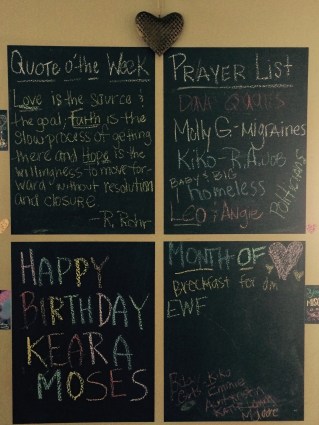
“Love is the source and the goal, faith is the slow process of getting there and hope is the willingness to move forward without resolution and closure.”
This week’s chalk wall – the Wall of Fame was temporarily replaced by Month of Love in honor of Valentine’s Day.
It blew me away and so I wrote it up on our chalk wall in the dining room. We have 4 grids: Wall of Fame, Prayer List, Quote of the Week and Do-er’s Choice. We also keep a bucket of chalk on the table. Though I conceived of it as a place for family expression, probably about 80% of the time, I am the only one who expresses herself there. Occasionally the kids will chip in with a “Thanks, Mom,” or a “Way to go” on the Wall of Fame. A little more often, they will add someone’s name to the Prayer List. When they were small, they would jockey for space to draw in the Do-er’s Choice lower quadrant. When inspiration strikes, Tim will commandeer the Quote of the Week for a song lyric, usually from U2. So what I thought was a fun and inexpensive way to get the kids involved has mostly become another place for me to do my “mom-thing.” It does however, on occasion, open up some family conversation, so I just put things up and see what happens. Sometimes they ask, but mostly they ignore it.
However, I loved Richard’s words so much that I wanted to make sure they saw them. During dinner last week, I pointed out the quote and asked what they thought.
Clearly, I threw them for a loop, because they kind of nodded, said, “Uh-huh,” and moved on. Our dinnertime conversations cover topics like school, friends, our goods and bads, sometimes song lyrics, and these days, even politics, but rarely do we stray into theology. At the end of a long day, it’s just too much and on a normal night, if it were an obscure text from some 14th century mystic, I would have given up and moved on, but the idea is so central to my understanding of the world that I thought I’d try one more time.
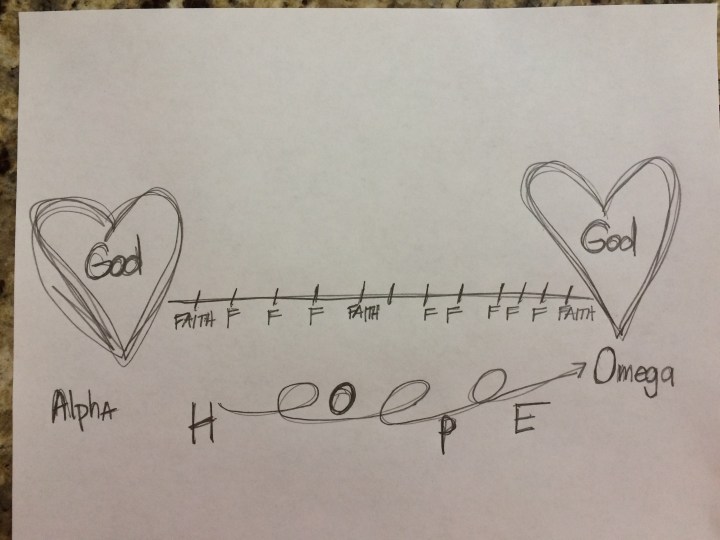
“Let me draw you a picture.”
“Love is the source and the goal.”
On the left side is our ‘source,’ the beginning of the universe, the Big Bang. It began with what the scriptures in Greek called the Alpha; what we would call God. Richard Rohr, drawing on the work of the saints and the mystics across the ages, calls it Love. That’s why it’s a heart. God’s desire to be in relationship got the whole thing started and it’s what keeps the whole thing going. NOTHING operates in isolation or solitude. On a most basic level, that’s what Love means. From the tiniest sub-atomic particle to the global population, we are drawn toward each other and we are changed and charged by those connections.
On the right side is our ‘goal,’ where we are headed. That is also God, what the Greeks called the Omega point. That is also Love, for God is Love and despite all the setbacks, the violence and injury we do to each other, the primal urge is to draw back together. What is scattered is gathered again. It is the way of life and evolution, the way of Love.
“Faith is the slow process of getting there.”
The line from the left to the right is the length of our days. We go along; we live our lives. We are sure of our path and where we are headed, except when we aren’t. There are moments when our surety and safety are disrupted. Bad things happen! We get bullied; people die; we fail miserably at school, at a job, at a marriage. In those moments, we need Faith to see us through. Faith is our will to live; it is knowing where we came from and where we are headed.
“Hope is the willingness to move forward without resolution and closure.”
Even with Love and Faith, we will not move forward on that line without Hope, because things won’t be resolved as quickly as we’d like. In discouragement, it would be easy to stop, but Hope is the engine that drives us forward anyway. Life does not operate according to perfect plans, but even when we don’t know the answer, Hope allows us to trust that an answer will come eventually.
“Does that make more sense?” I asked them.
“Sure mom, we get the picture.”
Good enough, I thought. If they have the picture of Love at the beginning and end of it all, that’s good enough for me.
I sheepishly put down my pencil and the conversation moved on to other things. Sometimes, I think I overwhelm them with too many ‘big ideas,’ but I hope they will retain some of the biggest, the ones I repeat most often.
This is the truth of our lives. Love is where we came from and Love is where we are headed. Yes, we encounter circumstances every day that challenge that truth, but Faith allows us to carry on ‘as if’ it were true. And if we look for it, we can also find clear evidence to fuel our Hope. We can witness Love winning through compassionate giving, community building, truth telling, and resource sharing. I see it in my friends and my enemies. No one is exempt from the ability and desire to Love. And that truth gives me the Hope to walk further down the road in Faith toward even greater Love.
Even, and maybe even especially, during family dinners.
My Catholic readers know that tomorrow is Ash Wednesday, the beginning of the season of Lent. For my non-Catholic readers, which is most of you, Lent is the 40 day period before Easter, the pivotal moment of our Christian faith when we celebrate the death and resurrection of Jesus. During Lent, Catholics (and some other denominations) try to focus their energy on preparing themselves to celebrate the Easter season. Technically, this is done through fasting, prayer and almsgiving, but mostly, people focus on the fasting. If you ask a Catholic, or even a non-Catholic, what Lent is about, they will probably say it’s about giving something up – a favorite food, or drink, indulgence, or bad habit. I was raised to think that way and it’s taken me a very long time to move beyond emphasizing that one practice.
Looking back at my childhood, I’m trying to remember the theology behind the fasting – why we were asked to sacrifice something. I don’t think the priests actually said this, but in my mind, I thought it was for one of two reasons.
#1 – Jesus gave up his life for me, so the least I could do is give up candy (it was always candy growing up!) for him during Lent. You know, tit for tat. Fair is fair after all.
Or #2 – You aren’t worthy for Jesus to have died for you – so your candy sacrifice is your way of becoming more worthy of Jesus’ death.
As if that were possible, as if anything we could do in a lifetime, much less forty days, could make us worthy of Jesus’ life.
I knew there was something about those theological constructs didn’t sound quite right, but I couldn’t quite move past those child-like assumptions for a really long time. But of course, as I grew and matured, my Lenten practices did as well. And so what I ‘gave up’ changed, but I was still doing it for the same reason – to somehow become more worthy of God’s love and Jesus’ sacrifice.
The fasting habit fell apart for me a couple years ago, which you can read about here, and it came about as most failures do, through a confluence of good intentions and misguided execution. Of course, it was my husband, who had the words to help me see the light. After suffering through a Lent that left me feeling deeply saddened and discouraged, Tim gently called me out. He reminded me that he loves me “as is,” and that God does too.
God always loves us ‘as is,’ not ‘when,’ not ‘whether,’ not ‘if,” we get our act together during Lent, or at any time. If God is the Abba that Jesus taught us about, then we are loved beyond measure already and it is knowing and experiencing that Divine Love that inspires any changes we make. It is never, “First you are worthy and then you are loved.” Contrary to most of our cultural conditioning and human reasoning, with God, you are always loved first and that Love makes you worthy. What you do with that Love is up to you, but personally, I have never once in my life been loved unconditionally and taken it for granted. True Love has never turned me against myself, or another person. Being Loved deeply has always inspired me to become a better version of myself, a truer reflection of the woman God created me to be.
Through that conversation, I finally got it: Lent is never a question of worthiness; Lent is a question of mindfulness, of bringing to our minds the Mind of Christ, which is compassionate, loving, and tender to all human beings and absolutely faithful to the Love of God, which he experienced first hand in the Trinity.
At the end of our talk, Tim reminded me of this bit of wisdom from my own teacher, Richard Rohr, who often says, “Don’t try to engineer your own death; it will be done unto you!” The scriptures are full of this imagery about the death of our ego, the part of ourselves that we keep separate from God and each other. We read over and over again that we must die to ourselves. I know the truth that unless a grain of wheat dies, it remains alone, a simple grain of wheat; but if it dies, it bears much fruit. But the point I had missed in my Lenten fervor was the fact that life itself will take care of death, both literally and metaphorically. Life is already full of losses – of the people we love, of seasons and situations we cherish, of dreams, hopes, plans, and health. And we don’t have to manufacture those losses on purpose; they happen as an inevitable course of our lives, but what we can do, during Lent, and every day of our lives, is prepare ourselves to face them.
And that is what I plan to focus on this Lenten season. Last year, I committed to just keep practicing my practice and that is what I plan to do this Lent as well and what I’ve tried to do almost every day in between.
I’m going to meditate and walk, read and write.
I’m going to hug my family members whenever they get within arm’s length.
I’m going to smile at friends and strangers alike.
I’m going to find Love and pass it on whenever and however I can.
Whatever I am already doing that opens me up to God’s Loving presence in the world, I’m going to keep doing. Whatever shuts me down, I’m going to forgive and move on.
I may hold a different intention, or pick up alternate readings to begin my meditation. I may find a special focus for my journal, but I will not fool myself into thinking I need to be different than I am to celebrate the new life that is constantly before me.
Death is inevitable, but so too is resurrection as long as we have a deep commitment to Love and Faith and Life. Only in that soil is there an invitation and a space for the Divine to work in us. Life and Love will win if we want them to and if we release our preconceived notions of what that life looks like!
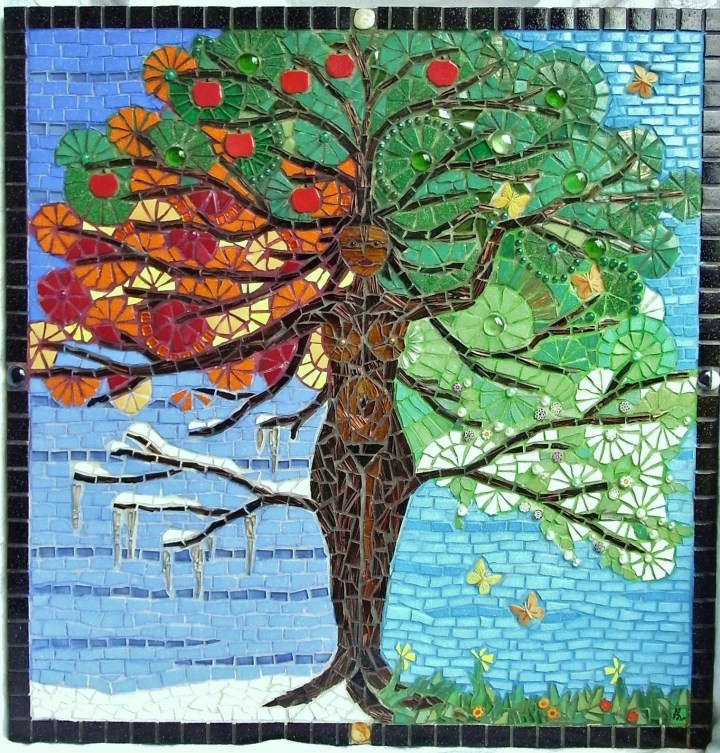
We are all moving through a season. Some are observing Lent; others are experiencing the transition from winter to spring, in nature, or in their own lives. Though we are in different parts of the cycle, we are all participating in the eternal movement from death to new life. As gardeners of our own soul, the only thing we can do is prepare the soil and trust that God will do the rest.
We can aerate our egos, poking holes in the outer shells that protect us from each other. We can soften the hardness of our hearts with the holy water of tears (you too guys!). We can let the things that have died over the past year become fertilizer for the new life to come. I cannot think of a more difficult practice for Lent, or any time of year.
My first two children were twenty months apart, and although I know they can be a lot closer than that, they were much closer than Tim and I wanted them to be. It was a rough transition for us to go from a party of 2 to a party of 3 and then 4 in rapid succession. And after baby #2 arrived, I actually went to see a therapist. Tim was worried about me for some reason, ostensibly, because he would leave for work and I would still be in my pajamas and he would get home from work and I would still be in my pajamas and he would leave for work the next day and I would still be in those same pajamas. You get the picture. (I really wish yoga pants had existed back them. I could have totally fooled him!)
So one day I actually did get dressed and went to the therapist, and through laughter and tears, told her all about what was going in my life and how I was feeling and she said, “Aw honey, you aren’t depressed. You are having far too many emotions for that! You are just exhausted. I don’t think you have any idea how tired you are.” And she gave me permission, it was more like a prescription, to just rest. For a little while at least, to just give it all up! And that was the nicest advice, some of the best advice anyone had given me. Just let it be. Stop trying to do it all, and be it all, on time and looking good. But most importantly, she said to me, “You know, it’s okay to acknowledge the season of life you’re in.” Yes, I was young and healthy and just on the cusp of motherhood, but I was also in a winter season. Finn was born in late October and this probably took place in mid-December, so it was literally a winter season as well. The days were short and cold and so were my reserves of physical, mental and emotional strength.
There are seasons and then, there are seasons. There are seasons of the year, and seasons of our lives and within each season of our life, we will experience different seasons.
And as far as seasons go, I am a summer person. I love the light and the heat and the warm ocean water, and the long days. I am also by nature a sunny, happy person. My mind gravitates towards a sense of wonder and possibility in almost every situation. I don’t like to focus on the dark stuff. So when I had my first two kids so close together, what the therapist helped me see was that I was a summer person, in the spring of my life, experiencing a winter season. No wonder I was confused.
All the seasons, all the time
In Southern California, we use the word “seasons” loosely. Growing up here on the beaches, cold meant 60 degrees and the only days you couldn’t wear flip flops were the rainy ones, but even then you could probably get away with it, if you timed it right. I was operating on a completely different system. Winter was for occasional skiing and snowboarding. It was a recreational activity, not a way of life. And so, the weather of my daily life totally fed my optimistic, fun-seeking personality. Rain was supposed to go away in a day. Clouds only lasted until 10 am when the sun would burn them away. Actual natural hardship, or limitation was temporary, evaporating almost immediately.
So when I became a new mom, and entered this long stretch where my sunny self disappeared, it scared me and Tim as well. I didn’t know what to do with the darkness and sadness I felt inside; I didn’t know if the sun would ever come back, and I hated that thought. I had been through some difficult things before, but those seasons had passed when I was a child. Now, I was ‘adulting.’
I was the “adult” in charge of a marriage and the emotional, psychological and physical well-being of two little babies. And I was searching for a way out of this darkness I was in. I was looking for the light and I wanted it fast, because that’s how I thought it worked. I wanted to be where I thought I should be already – in the glory days of summer, but it wasn’t to be. Let me give you just one story from the winter that blanketed the Kirkpatrick family for about two years in the late 90s.
Even the worst winter storms bring on snow days, where everyone drops their cares and worries and has a good time. There were moments of real joy and laughter, but Keara was a handful as a toddler – strong willed, and mommy-centric. Her naps and our tempers were equally short, but Tim often came home from work early to help me. One afternoon, I was sitting on the couch, nursing Finn and reading stories to Keara. I saw Tim pull up in front of the house, but he thought it would be funny to ring the doorbell and I thought it would be funny to let Keara get the door. It wasn’t. She opened it, saw Tim and yelled, “No daddy home!” and slammed the door in his face. That kind of puts a chill on a relationship. It might have happened between the two of them, but it is a perfect example of the frost that covered our home. I may have been the one in the winter season, but everyone was feeling it. We were trying, and often failing, to connect with each other. Too often, like our two-year-old, we were more concerned with protecting our own turf.
We have warmed up from that winter and been through all the other seasons: the spring when Molly was born, the glorious summer when all our kids were out of diapers and none of them were yet teens and another winter when the Great Recession hit and we struggled to keep our business alive.
At this point in my life, at 44, in another fall, I am far more comfortable with the language of seasons (though I would still never choose to live in any place that actually had them), because I have been through them over and over again. I know the truth they represent and the wisdom I can learn from them.
In one of my darker winter days, I asked my spiritual director, a wise woman in her sixties, “Where is God in this darkness?” and she said to me, “If you want to know what God is like, look out your window. Look at life; look at the seasons of the year; watch the pattern of your days. God is not other than what is created. God is found in the pattern of creation itself.”
And really what she was saying is: Life is change and transformation, death and rebirth, light and darkness. Nothing good lasts forever.
I know that now.
I know that no season can last forever, no matter how good it is, or how badly I want it to.
I know that no season will last forever, no matter how dark or difficult it is, even if it lasts longer than I think I can stand it.
I know that wanting what was, or clinging to what is, or anxiously waiting for what will be is the surest way to miss the beauty of the season I’m in, or to learn any of the lessons it has to teach me.
And when I understood that, I could stop clinging to a vision of life where only eternal summer – light and goodness – could make me happy. My efforts to always keep it light are wasted energy, energy that could be better spent getting comfortable with darker days, digging in the soil, and nurturing whatever new thing is trying to come to the surface. What is born in the spring is what the world needs, not what fades away when its natural time comes.
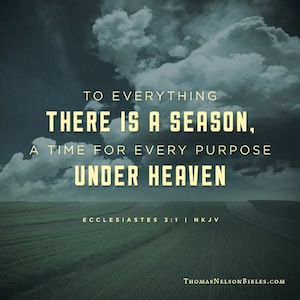
Rob Bell likes to say that things come into our lives for a season and for a reason and if we stay, or cling to them for too long, what was once joyful, becomes bitter. We have to let them go. The Book of Ecclesiastes reminded the ancient Hebrews that for everything there is a season and a time for everything under heaven.
A time to give birth and a time to die;
A time to plant and a time to uproot what is planted.
A time to tear down and a time to build up.
A time to weep and a time to laugh;
A time to mourn and a time to dance.
I always heard that passage, or the song by the Byrds and thought it applied to farmers and hippies, not 20th century beach girls like me.
But now, whenever I sense a waning of the light, I can hear my spiritual director saying, “Look out your window. What do you see? What do you know is true?”
Reverend Nadia Bolz-Weber, pastor of The House for All Sinners and Saints, is one of my heroes. Someone asked her once in an interview why she keeps talking about the Resurrection, the fact that Jesus rose from the dead on Easter morning, because she talks about that story all the time, not just in the springtime when it’s topical for most of us, and she said simply, “Because it’s the truest story I know.”
And what she was getting at was not just the fact that Jesus died and was raised up again on the third day, although that is of ultimate importance to her as a Christian and a pastor, but also that it is the truest story she has experienced in her own life. Over and over again, her plans for herself, her life, and her church have failed, or been disrupted and when it happens, she is desperately sad, or wildly angry, or probably both, because she has a temper, but over and over again, they come back to life. They are resurrected. Sometimes they push back to the surface, just slightly changed, but sometimes they are unrecognizable, a lot like Jesus after the Resurrection. No one, not even his closest friends – not Mary Magdalene, not Peter, not his apostles on the road to Emmaus – recognized him, because he was a brand new creation.
Always, without fail, Nadia says, the things that arise from the death of her dreams are better; they are more life-giving for everyone. Even more importantly, she says, is the fact that every time she dies to herself and her own ego, her need to control and perfect, SHE rises again with more potential to Love the world – and everyone in it, from herself, to her family, to her community, to the stranger on the street and for her this is a big one, even a Wall Street trader. She says in her first book, Pastrix, “Every single time I fight it (the death, the loss, the disruption). And every single time, I discover more life and more freedom than if I had gotten what I wanted.”
I love Nadia and her insistence on the resurrection, because it is one of the truest things I have come to know as well, but I didn’t always. Even though I have always considered myself a Christian, or perhaps because of it, I thought Resurrection was a miracle that happened once, long ago to God’s son. I still do believe that, but I also believe that God appears to be resurrecting everything all the time and everywhere, as Franciscan priest, Richard Rohr says.
Death is inevitable, but so too is resurrection as long as we have a deep commitment to Love and Faith and Life. Only in that soil is there an invitation and a space for the Divine to work in us. Life and Love will win out if we want them to and if we release our preconceived notions of what that life looks like!
Life is a constant repeat of loving something, and then having to let it go, not necessarily tragically, sometimes just naturally, because life is change. What we can trust, if we have a deep familiarity with the story of Jesus, or with the seasons of life itself, is that new life will come from what we have lost. If we don’t short-circuit the process through clinging, or denial, or impatience, a new season will flourish and bring new life. It won’t be the same as what we lost, but it can be even better. If we allow it, the soil of our lives can be enriched by the death of our fantasies about what we, or our lives, or our families should look like. And in that soil, we can plant deeper roots, and we can weather more storms and we can enjoy the autumns and survive the winters, because we KNOW that spring is coming and that summer isn’t the only season worth living for.
Over the last few rainy days, I have been reflecting on my most recent blog. What am I really talking about when I talk about Love? There are clearly some things I don’t mean. Obviously, for me, Love isn’t just romantic, sweet or mushy feelings, but it isn’t simply an obligation to a person, community, or cause either. Recently, in another writing project, I defined Love in this way.
Love means saying, “Yes” to all that life brings me: to all that is, has been and will be.
When I am in Love, I have forgiven myself and others for past dramas, disappointments and detours. When I am in Love, I am not anxious about the future; I don’t have to force my own agenda, or protect myself from what might happen. Most importantly, when I am in Love in the present moment, I am at peace with what is: myself, my circumstances, the people and possibilities around me. When I am in Love, I don’t need to change anything and when I am really feeling it, I don’t even want to.
But I am not always able to Love like this, which is why I intend to practice Loving even more in 2016. It might sound funny to think of Love as a behavior we have to practice, but we do. Like anything we want to be better at, we have to give it our focus and find ways to improve our abilities, especially if it doesn’t come naturally.
I came across a great image to help inspire me in these early weeks of the new year. It is from Mark Nepo’s Book of Awakening. (If you haven’t picked up a copy yet, I highly recommend it.) Mark tells the story of a friend who wants to paint his family room. He gets home with all the supplies from the hardware store and preps everything in the garage, but when he wants to enter his house, he can’t get in. He has a bucket of paint in each hand, the drop cloths and rollers under his arms and the paintbrush in his mouth. He struggles to open the front door, refusing to put anything down, (because we hate to put anything down!) and just as he’s about to get in, he slips and falls and ends up covered in red paint. He could laugh about it now, but you can only imagine how angry and frustrated he must have been when it happened.
These are the words of wisdom Nepo gleams from the story:
…In a moment of ego we refuse to put down what we carry in order to open the door. Time and time again, we are offered the chance to truly learn this: We cannot hold on to things and enter. We must put down what we carry, open the door and the take up only what we need to bring inside.
As far as I’m concerned, it is the beginning of Love when we recognize that we are in front of a closed door in the first place. If nothing else, we’ll know we’re there by the way it feels in our bodies – the clenched jaw or balled-up fists, tension in our stomach or neck, our deep sighs, or raised voice. When we notice ourselves getting angry, anxious, or insisting on our own way, it is Love that allows us to stop, take a deep breath, and put our baggage down, whatever it is – our fears, expectations, justifications. Instead of seeing the situation, or person in front of us as an obstacle to be conquered, we see them as a doorway to something new.
In that moment, we are doing the most Loving thing we can. We are saying a resounding, “Yes” to what is, instead of ignoring, denying, or fighting against it. Once we’ve put things down, the rest is just a little bit easier. We can choose to act, instead of react. We can assess what we need to pick up, what is truly important and what will actually help us (and them) on the other side of the door. The rest, we leave behind. Loving actually makes us lighter! (How’s that for a New Year’s diet plan?)
The best way I know how to reinforce this kind of Loving is through my meditative practice of Centering Prayer. For twenty minutes each morning, I “put things down,” over and over again. Inspired by Jesus’ kenotic, or self-emptying, communion with God, Centering Prayer asks me to release my self-centered thoughts, desires and agendas. When I find my mind wandering through daydreams and to-do lists, I repeat my sacred word and put it all down. This practice reminds me that it is not my will that needs to be done.
Sidenote: In case you’re wondering, I have been meditating daily for almost three years and I still have to “put things down” at least fifty to a hundred times in those twenty minutes. I know, shockingly bad statistics there, but my first teacher told me that the only way to fail at meditation is to fail to do it. I choose to use that as my guide still.
Coincidentally, my meditation practice ends about the time my children’s alarm clocks go off. That’s when my real practice begins. My morning agenda is clear: get everyone fed, dressed and out the door on time. My expectations are much higher than that: I want morning hugs, smiles, thank yous for lunch, beds made, teeth brushed, dishes cleaned. You can imagine how many “closed doors” I encounter in those 45 minutes. Every morning, I have 45 minutes to practice Loving my kids in their tired grumpiness and haste. I have 45 minutes to respond to teenage stimuli with Love, patience, forgiveness, encouragement, and physical affection. I have 45 minutes to fail at Loving the way I want to, and when I do, (and yes, I find myself covered in red paint pretty frequently), I apologize. Love also means cleaning up the messes we’ve made. And then, when they leave, I just “put it down” again, even the self-criticism and frustration. I have to Love myself too, or I’ll never get anywhere at all.
In 2016, I want to meet more minutes of my days like I do those first forty-five, fresh off the meditation mat when the challenges are small and the challengers are people I care deeply about. It’s a different story entirely in the real world where I encounter people I don’t much like with even higher stakes. Pope Francis may have declared it the Year of Mercy, but I’ve declared it the Year of Love and I want it to last a lifetime! I will keep trying. At more and more of those closed doors, I will take a deep breath and drop my shoulders. I will think of the red paint I’m carrying. I will remember the crime scenes I’ve created when I refused to put my baggage down and then I will face that door with the freedom that only Love can bring.
So, yeah, in case you were wondering, that’s what I’m talking about when I talk about Love.
I found this photo on Facebook this morning and it inspired a little year-end review. I decided it summed up what I discovered about myself in 2015.
In 2015, a few external things changed. Keara graduated from high school and went off to college. Finn got his driver’s license and stepped into the serious college hustle of AP classes, varsity sports and a job. Molly, our baby, became a teenager and is winding up jr. high, ready to launch into the next phase of her life. I am in the stretch run of having a house full of kids, and all the care that involves. Nowhere is this transition captured more poignantly than in the Team Kirks 2015 Christmas card. You can click on the link to watch it here. In the words of REM, it’s “The End of the World as We Know It.” Despite all the changes, we feel fine.
But what I have noticed even more than the external changes in my life are the internal ones, which the quote above captured so beautifully. In 2015, through the Living School and the people I have met there, through raising teenagers and meeting their friends, through reading, writing, teaching and everyday life, I have fallen in Love over and over again. Obviously, I am not talking about romantic love here, the heart-pounding flush of infatuation and the inevitable crush that follows. I am talking about Love – the Love that says Yes to all that is. The Love that can only be discovered when people reveal something vulnerable and true about themselves.
Dostoyevsky describes this Love beautifully in The Brothers Karamazov. It’s been twenty-plus years since I last read the book, but it has been mentioned three times in the last week by people I respect, and so it goes on the top of my reading list for 2016. Here’s is Fyodor’s commandment to Love:
Love people even in their sin, for that is the semblance of Divine Love and is the highest love on earth. Love all of God’s creation, the whole and every grain of sand of it. Love every leaf, every ray of God’s light. Love the animals, love the plants, love everything. If you love everything, you will perceive the divine mystery in things. Once you perceive it, you will begin to comprehend it better every day. And you will come at last to love the whole world with an all-embracing love.
This Love is a gift, though most of us treat it as a burden. We’d rather have a facsimile, projection, or image of Love than the real thing. I know for most of my life, this has been true, with few exceptions. But in 2015, I began to see my own preferences for what they were: fear and self-preservation and this is not the kind of Love Dostoyevsky, the mystics, prophets and even Jesus talk about.
This year I fell in Love with all sorts of people who showed me a piece of their soul. I fell in Love with authors: Glennon Melton, Liz Gilbert, Parker Palmer, and Omid Safi. I fell in Love with poets: Rumi, Hafiz, David Whyte and Mary Oliver. I fell in Love with mystics, musicians and artists. I fell in Love with my own friends and family. I even began to fall in Love with strangers, the refugees and homeless and victims of all the “isms” of the world, though I am not yet sure how to show that Love appropriately. I have a feeling that will be the journey of 2016 and beyond. I have a feeling that is the journey of a lifetime. How do I serve those I Love? How do I meet them where they are?
We know that real Love changes us. Once experienced, we cannot forget the joy Love brings; we cannot un-know the secrets it reveals; we cannot re-harden our hearts. We are different on the other side of Love’s door.
My resolution for 2016 is to keep stepping over the threshold.
P.S. If anyone wants to read The Brothers Karamazov with me, comment below. I’d love to get a little virtual discussion group going!
Last Saturday, Tim and I had the privilege of attending the wedding of a darling couple. I’ve known Brianne since she was just a little tyke and she’s known her now-husband, Michael, for almost that long. The wedding took place in the same church where we were married over two decades ago. It was great to be back and recall the excitement and the nerves that accompanied us that day, but also the joy and the Love we felt. Watching Brianne and Michael, I am pretty sure they were experiencing the same.
In honor of this Thanksgiving holiday, I wanted to share with you the letter I wrote to them and enclosed with their wedding gift. I am grateful for my health, my family and friends, and my home, but I am most grateful for the opportunity to Love and to witness Love wherever it takes place, whether it’s halfway around the world, or in my own backyard.
The happy couple
November 21, 2015
Dear Brianne and Michael Blackmun –
Granted this is an unusual wedding greeting – a missive inside a card. Wait until you open the box. It’s an unusual wedding gift as well. But you two, like Tim and I, make for an unusual couple. Personally, those are my favorite kind. So, when you open the box, this is what you will find. Two coffee mugs, two dish towels and one very special book called Big Magic.
I often give one of my favorite books on marriage, The Zimzum of Love, to young couples just tying the knot. You two, however, having been together for ten years, need a little less advice perhaps than most in that area. I love how madly in love you two still are after all this time and I’ve got a little secret for you…
You might have been told your feelings will fade, that it won’t always be like this, but I look at you and I think, “They’re wrong.” Brianne, you are clearly in love with LOVE itself (so am I – it takes one to know one) and so I think your marriage will always be full of love – the romantic, playful, silly, affectionate kind of love. Yes, there will be hard times and struggles and dry spells, but I think they will be weathered with affection, good humor, grace and forgiveness. Your marriage will always feel like an adventure, in good times and bad, something to be eagerly embraced, thinking, “I wonder what tomorrow will bring.” Brianne, this gift of Loving joyfully and whole-heartedly is not something everyone has and Michael brings it out in you, so appreciate it and use it well! You hit the Love Jackpot, not just in finding the right guy, but in having a heart made for it. Congratulations!
But there’s more, so on to Big Magic: Creative Living Beyond Fear. The author calls it basically a permission slip for everyone to use their creativity.
Brianne, you are one of the most creative women I know. I remember going to your college graduation party with your degree in studio art and looking at all your work and being blown away by the tender beauty of it all, especially your heart sculpture. I hope you have that piece somewhere on display still! You decided not to pursue your art professionally, which I totally understand, but what I want to say, as you’re making this lifetime commitment to Michael, is that I hope you have also made a lifetime commitment to your creativity. Your artful heart and creative spirit are the essence of you. I hope this book will encourage you to continue to find expressions and outlets for the art that wants to be born from your soul. It is so important, for you and the world.
A marriage is only as healthy as each of the people speaking their vows and our culture makes it so easy to hide our truest selves behind all sorts of masks. But a marriage between two hiders can’t become the fullest expression of Love and happiness. It can work for a while, maybe even a lifetime, but it won’t allow each person to flourish and become all they are meant to be in and for the world. In Big Magic, Liz Gilbert will remind you over and over again to be Brianne! Be Michael! Commit to practices of concern, compassion and courage in your Love for each other and for yourselves as well.
You have so many gifts and cards to open that I will stop talking now. This isn’t meant to be advice. It is just meant to be encouragement to listen to what your heart already knows. You and Michael clearly Love each other and are committed to the well-being and freedom of the other person. Keep living that out, all the days of your life!
With so much Love, hope and faith in you two!
Ali and Tim
P.S. – I couldn’t end without sharing one of my favorite poems from one of my favorite poets. This kind of Love works, but only if you’re both doing it!
Adapted slightly from Hafiz, a 14th century Sufi mystic and poet.
P.P.S. I wrote that letter before the wedding and sharing it here allows me to write a second post-script. I know that brides and grooms are technically supposed to be the ones writing the thank you cards after the wedding, but every time I leave a wedding, I feel like I’m the one who should be saying thanks. Not only are wedding days wonderful parties (and it doesn’t matter how big, or small the budget), they are also beautiful expressions of the energy, hopefulness and joy that Love builds and brings to the world. Since Love is my favorite emotion, weddings and newlyweds are some of my favorite things. Thank you, Brianne and Michael for delivering big time!
I don’t often write in response to tragic events happening on the world stage. I am all too aware how small I am in comparison, how limited my knowledge, how distant from the actual suffering of the victims and their families. But I also frequently get asked,
“What do you think?”
“How are you seeing this?”
“Give me something but anger to hold on to.”
So for what it’s worth, this is how I am holding these most recent tragic events in my heart.
I don’t know exactly what the just, or appropriate response is to those attacks, or to the people and organizations that perpetrated them. I don’t know what you or I, as individuals sitting across the globe, can actually do to stop the violence of ISIS, Al-Shabaab, or other Islamic militants. I only know what I can do to stop the violence here, in my own body, my own home and among the people I come into contact with. And I actually think that is a really important place to start, which too often gets ignored in our desire for immediate answers and concrete action.
I begin by reminding myself that none of these angry, violent, suicidal and psychopathic men started out that way. At one time, they were just little boys like our own, who loved to crawl into their mama’s laps and be cuddled. They passed out, milk-drunk, at their mother’s breast, while she dreamed of all that he might be someday. At one point, I imagine, those boys had dreams of their own, to be helpers, teachers, leaders, fathers even, but that all changed.
And it probably changed at home first with the messages they learned from their very own fathers and mothers. Eventually those messages were built upon by their religious leaders, their surroundings, culture and the world around them. They learned that a loving response was a foolish one, that whoever had the biggest guns had the most power, that economic freedom was never going to be theirs. They learned that violence was the best answer to every problem and that their God approved and applauded it. This is not what they were born knowing; this is what they were taught and so it is my obligation to teach my own son and daughters something different, but I have to live it myself first.
After hearing about the attacks in Paris and Beirut, I immediately thought of the words of Etty Hillesum, a young Jewish woman who was killed during the Holocaust. She wrote: “Each of us moves things along in the direction of war every time we fail to love.”
Oh my God, I thought, I’m part of the problem, but Etty’s words also remind me that I can be part of the solution. I can start by making conscious choices to Love more, to stop making war inside my own heart, judging, criticizing and condemning myself and others for simply being human and imperfect. Whatever peace I create from that Love, I must bring to my own family and friends, primarily through kindness and compassion. And if I can Love just a little more, I can hold even more space for difference, and diversity among the people I know and come into contact with.
But let me be clear, when I find myself in conflict with others, I do not have to agree; I do not have to approve; I don’t even have to allow, or excuse behavior that I object to, but what I cannot do is hate. I believe Einstein’s observation that “No problem can be solved from the same level of consciousness that created it.” I have seen that play out in my own life. I cannot offer the same, or equal response to violent, or aggressive stimuli and expect a good outcome. Even if I “win,” we both lose in the long run and believe me, I’ve lost plenty of times!
Finally, as someone who has considered the teachings of Jesus her whole life, there is one thing he said we CANNOT do. We cannot hate the other. Jesus said, “Love God and Love your neighbor as yourself.” Jesus also said, “Love your enemies” and he made it clear that your enemy was often your neighbor, just in case you wanted to skip that one.
I don’t have it in me to Love God, my neighbor, my enemy, or even myself in the way I must in order to create perfect peace, but that doesn’t mean I can give up trying. I must persevere, at least in my own heart. One woman, when asked about the futility of her quest for justice and equality for women within her community, said, “I don’t have to complete the work, but that does not mean I am free to abandon it.”
Anthropologist Margaret Mead famously said that every person has three marriages in them. We marry the first time for sex, the second for security, the third for companionship. While I have great respect for the thrice-married Dr. Mead, I was grateful she added, “even if they are all to the same person.”
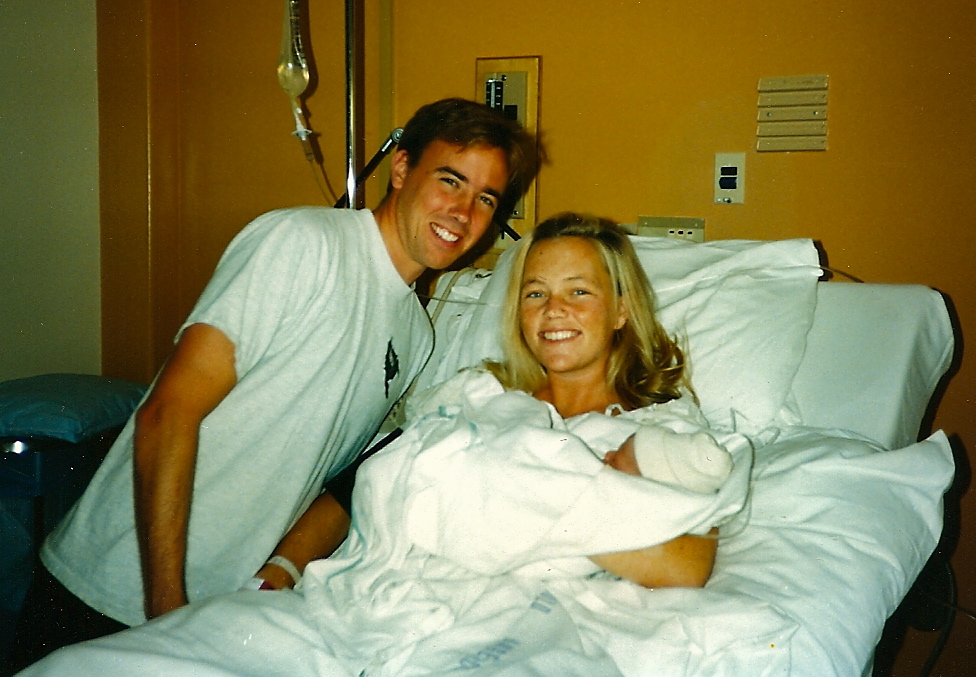
This is Tim, my “first” husband, and I just after I gave birth to Sarah Moses on September 18, 1991.
Three years ago, I told the story of how I met my “first” husband, in the post,“So This Guy Walks into a Bar…” I highly recommend starting there to understand my marital history, but on our wedding anniversary, I’d like to introduce you to my “second” husband. He is usually referred to in my blog as “Tim,” or “Babe,” his given and pet names respectively, but he is almost always reduced to playing the straight man in my stories. He is frequently the Ricky to my Lucy, instead of the real, flesh and blood man he is and I thought this might be a chance to improve upon that limited role, so let me tell you a story about how I met my “second” husband.
By the time Molly Grace was born, Tim and I had been married for almost ten years. The purpose of our “first marriage” had been met, as was obvious by the number of dependents we traveled with. And so as she toddled off to preschool, I was ready for a new experience and attended a religious and spirituality conference in Los Angeles. I’m sure Tim never gave a thought to the trouble I would find there, attending daily mass and singing worship music with my Catholic mother. But I found it. Speakers like Ron Rolheiser, Paula D’Arcy and Richard Rohrspoke to parts of me I thought I had lost forever in the oxytocin-fueled haze of breastfeeding and the drudge of diaper changes. They reawakened my curious mind and restless heart.
But by the third day, I was so full of new ideas that I almost skipped out early, eager to get home to Tim and the kids, but I had one more ticket to see an Irish poet named David Whyte. I had never heard of him before, but something urged me to stay and to this day, I am grateful I did. Whyte offered a piece of wisdom that would become the pattern for my life moving forward. He said,
“You must learn one thing ,
The world was made to be free in.
…
Anything or anyone
that does not
bring you alive
is too small for you.”
(Please don’t read the poem dualistically. Not every moment of every day, or situation can bring us to life and it doesn’t mean we leave. It just means we can start asking questions and getting curious about the situation.)
Whyte postulated that we were not created to stay the same over the course of our lifetimes. We do not hit thirty, or forty, or fifty and stop growing. We are a product of evolution, and as such, it is our God-given gift and responsibility to evolve ourselves, to stay on the creative edge of life, always adapting to survive and thrive in the new situations and habitats we find ourselves in.
I loved Whyte’s deep, Irish brogue, but as I listened, anxiety churned in my belly for he was naming the very sense of discomfort that had been creeping into my life during that time. Though I had told my “first” husband that I all I ever wanted to be was a stay-at-home mom, I realized that wasn’t true anymore. Although I loved my life, some part of me was buried underground and I wanted to go digging. I wasn’t looking for Tim’s permission exactly, but I certainly wanted his support.
After tucking the kids into bed that Sunday night, Tim and I crawled into a hot bubble bath, our favorite place for long conversations on winter nights, and I began to unpack my ideas. He was a great listener. He didn’t get defensive, even though it couldn’t have been easy to hear that after providing everything I’d ever wanted, I now found it “small,” and limiting in some crucial way. I looked at the discomfort in his eyes, and plowed ahead. (Since then, I’ve learned the art of greater conversational subtlety and patience and how to apologize when I push too hard.)
David Whyte had echoed Mead’s insights on marriage – that marriage is about freedom, not limitation. Being married doesn’t mean you can’t change; in fact, it means you both have a safe place to do so. You’ve made a commitment to be just that. When you say, “I do” at the altar, you don’t marry just one person. You are vowing to love and honor every version the person standing in front of you will become over the course of your lifetime together. I told Tim that my intentions were good, that I didn’t want to become someone he wouldn’t know. I just wanted to look in a mirror and see beyond the roles I played, to the ME I might become if I explored the depths of my heart and the possibilities of my life. And then I asked him, “Do you trust me?”
He looked at me in my excitement and pain and longing and he said, “Yes,” knowing it was going to cost him something, and praying it wouldn’t cost him everything.
And in that moment, I met my “second” husband.
My “first” husband rescued me, made me feel like a beautiful princess, and set about delivering my happily ever after. My “second” husband stepped back and let me rescue myself, knowing that true happiness could only come from within.
Brené Brown has developed a kind of litmus test for the maturity of partners in a marriage, or any deep relationship. She writes, “If you show me a man who can sit with a woman in deep struggle and vulnerability and not try to fix it, but just hear her and be with her and hold space for it, I’ll show you a guy who’s done his work and doesn’t derive his power from controlling and fixing everything and if you show me a woman who can sit with a man in real vulnerability, in deep fear, and be with him in it, I will show you a woman who has done her work and does not derive her power from that man.”
Like any young couple, Tim and I spent years trying to shore up our power by attempting to fix each other, the faults and annoying habits obviously, but also the friendships and foes that caused our loved ones pain. When you’re young, you think everything can be improved with just a little more effort and care, but when you’re older, you know life is more about keeping vigil than keeping it all in line. Tim showed me how that night and in the years that followed by walking and talking with me, listening to my prayers and holding me in my pain as I discovered who I wanted to be. A few years later, he let me return the favor when the economy tanked and his business was on the line. I couldn’t fix a damn thing when it came to the Great Recession, but I could do what he had done for me.
Over the years, we have become successively new versions of ourselves, transformed by our personal and professional successes and failures, as well as those of our children, families, communities and the world at large. If one of us is feeling “small,” we both try to show up to do the work it takes to set them free. To be clear, it is hard work and we often fail. Like any couple, we fight and bicker; we fall in and out of love (but never out of Love); our tempers get the best of us, though we are quick to apologize. That is the humility of marriage; the mirror is always there in front of you, reflecting your best and worst qualities, if you dare to look.
Team Kirks makes new vows 2008
On our 15th anniversary, a few years after we embarked on our “second” marriage, Tim and I renewed our vows. We invited couples who had supported us over the years and also modeled the kind of marriage we were trying to practice ourselves: a loving, respectful partnerships of equals. Tim and I recommitted to supporting each other in what Carl Jung called “the privilege of a lifetime: to become who you truly are.”
I am so grateful for having experienced a “first” marriage that was so full of romance and intimacy. I am still blessed with a “second” marriage that transformed my still-lovely lover into a safe house for growth and experimentation and finally, we look forward to our “third” marriage, whenever it arrives, but we’re in no hurry. It feels like we’re living the three marriages of a lifetime already. We have a lover, a safety net and a best friend at our sides every day.
So when I make cracks about Tim tuning out my stories, or mocking my attempts to try something new, know all this about him too. Though I may write about him as my sidekick, he is so much more than that. I am only me, because I have been loved by him.
A casual friend asked me recently how Keara was doing. Though she doesn’t know Kiko personally, she’s a reader of the blog and loved how we blessed K on her way to college last month. Though I had considered writing about how it went, I thought it might be too late. She assured me it wasn’t. On the hope she’s not the only one, I thought I’d follow up.
On Friday, the morning after the blessing, we packed up the car to drive from San Diego to Long Beach. I noticed some butterflies in my stomach, nothing too distracting, just an occasional flutter, a hint that today was not an average day.
On Saturday, her move-in day, I woke with a nagging sensation that something was wrong. I took a shower, asked Tim to bring me a cup of coffee and sat down to write and pray. Here is an excerpt from my prayer journal that morning:
We move Keara into her dorm this morning and it is very clear to me that I have two choices: I can write, or I can cry. Since I’ve already done my makeup and I am determined not to scare her, I’m writing to you God. All I keep saying, over and over again – even during my sit as I tried to return to my sacred word – is, “May you be safe. May you be content. May you be strong. May you live your life at ease.” I am praying that blessing for Keara and myself, over and over again.
I pulled myself together; we drove up the coast and created a semblance of a home in a 15×15 dorm room. I was so bewildered that day. I kept looking at all the parents and their eighteen-year-old children. What had seemed like such a good idea in the previous months suddenly seemed like bad idea, one of the worst really. I felt like I had Tourette syndrome. It took everything I had to not start shouting, “Does anyone else think this is a terrible idea? Take your children and go home. All of you!” Obviously, I didn’t do it, but Tim, perhaps sensing my need for solidarity, kept squeezing my hand and giving me appropriately concerned smiles. Before I knew it, it was 5 o’clock and Kiko was racing out to dinner with her new roommates, saying she’d see us in the morning for breakfast.
Sunday morning dawned and I found myself , unable, or possibly just unwilling, to get out of bed. I was physically nauseous, dreading the day ahead. Eventually I persevered, but only with Tim’s help and on his insistence. We picked Kiko up from campus and did one more Target run, one more cup of coffee, one more hug goodbye and that’s when it got ugly. I held her in my arms and whispered my morning’s blessing to her one more time, and then she started to cry and I started to cry and Tim started to cry. We let her go, got in the car and drove away.
And before we were even out of the parking lot, Tim asked me, “What are you feeling right now?” as if he didn’t know. But sad didn’t even begin to cover it, so I took a deep breath and told him.
“I know this is going to sound really weird, but it feels like the morning I left Sarah in the hospital. It’s that same sense of being hollowed out, of leaving half my heart in the high-rise behind me and driving away, ON PURPOSE, and knowing that things are never going to be the same again. She’s never going to be mine again…. And don’t turn on the radio, because God help me, if Lionel Richie is playing, I just might not be able to do it. I don’t care if you’re crying; DON’T STOP THE CAR! We can’t stop, because if we stop, I don’t think I can start again. If we just keep moving, I can do this. I know how to do this, but if there is one second when I can turn around and take it all back, I just might and that would be the worst thing ever! So please, just keep going….” As I trailed off into sobs. *
And so he did. We turned left out of the parking lot, found the 405 freeway and traveled south at seventy miles an hour, silently, in our pain and grief. We couldn’t talk about it, or listen to music, because we’d both start crying and Tim’s so responsible that he won’t cry and drive. He said the tears messed with his visibility and we still had two kids at home to raise, so instead we talked about stupid, silly things – work and politics and the weather. We made it home, went to church and out to dinner that night and the new normal began.
And it was okay.
Like the day after I left Sarah Moses and gave her up for adoption, twenty-four years ago this week, I woke up and took deep breaths. I listened quietly for the beating of a heart I thought was broken. I found a routine I could live by and if I lost track of time intermittently throughout the day, thinking about my baby girl somewhere far away, that was okay too. I knew she was safe; I knew she was content; I knew she was strong; I prayed she would live her life at ease, but I also knew the ease would come more easily if she was living apart from me. It’s the reason I let them both go, my two Moses girls. Love, my love anyways, would never be all they needed to become all they were meant to be.
I guess I didn’t share this story earlier, because it hurt so much and I couldn’t make sense of it. I didn’t have the right language to explain how, or why doing something that you know is so right can feel so wrong. And for me, sense-making is an important part of the healing process. Now, I may not have it all figured out yet, but I’m getting closer, with some help from my friends in the Living School.
A couple weeks after we dropped Keara off, I went on my annual pilgrimage to Albuquerque, NM and spent time with the faculty and my fellow students. We listened and learned and talked late into the night. We laughed and cried and fell in love with the world and each other a little more. It helped with my healing process, especially something called the Law of Three and ternary metaphysics. Basically, the Law of Three holds the premise that “three-ness,” like that we see in the Holy Trinity, is the basis of creation for the whole universe. Nothing new comes into being with out the dynamic interweaving of three distinct, but inseparable forces.
According to 17th century German mystic, Jacob Boehme, at first, there is a yearning, a desire for something. Then, there is the frustration of the desire; the will cannot get what it wants. As long as there are only two, there will be anguish. They will endlessly go back and forth, pushing and pulling without reconciling, or changing anything. (Think of U.S. politics.) If one is much greater than the other, it may “win,” but nothing new will come of it, because it is the friction, the pain itself, which is the “ground of motion.” It is only when a third force enters the equation that the two can be transformed and something new can be born. Frequently, this third force is gelassenheit, what we might call equanimity, the “letting-be-ness” of the surrendered will. In her commentary on it, Cynthia Bourgeault writes, “Will, desire, and pain are not obstacles to spiritual perfection, but rather the raw materials out of which something yet more wondrous will be fashioned. Thus, these things are not to be feared, denied, or eradicated; they are to be transformed.” **
Don’t worry, I’ll stop there with the dry stuff. If you’re anything like Tim, you’re about to check out anyways. Here’s what it means to me personally.
Although I didn’t have the language of ternary metaphysics at nineteen, I knew what Boehme was talking about. Here is my simpler formula:
Desire + Will = Pain + Surrender = Transformation < A New Being
When I was nineteen and got pregnant with Sarah, there was so much pain (SO MUCH PAIN) as I held the tension between the desire to raise her and my will to give her the best possible life, which I believed meant not being raised by me as a single teenage mother. Only through surrendering to the process was I transformed. I became someone new on the other side of that experience, someone who knew that it was possible to have your desire and your will completely at odds with each other emotionally and energetically and yet completely aligned in terms of their purpose. It was in the alignment that the resolution was found.
I had that same sensation as we left Keara on her college campus. My will was for her to become independent and find her place in the world. My desire was to have her place in the world be next to me, in my arms and the shelter of my home. Those two forces created enormous anguish in me – as they have done, I imagine, in virtually all parents across time and space. But it is only by letting that pain be what it is, neither clinging to it (by over-involving and inserting myself into this phase of her life), nor rejecting it (by denying my pain, or shutting myself off from feeling it) that she and I, and our relationship, actually have a chance to become something new. I have no idea what that new thing might look like, but in faith, based on evidence, I’m not worried.
Here’s how I look at it. I think we are screwed, or blessed either way, or perhaps more exactly, we feel screwed in the moment and are blessed in the long run. But I think the blessing only comes if we believe it will come and live as if it will come. If we refuse to surrender and choose to stick with the pain, then we will view our path as either an inevitable frustration of our desire, or of our will, and then it will become thus – simply frustration, not transformation. If there is no surrender, no faith in a new arising as yet unknown and undefined, then there will be nothing new under the sun.
The process of giving Sarah up burned into my body, heart and mind, the lesson that you do not stop wrestling with the angel of God (who comes disguised as every moment of your life) until you receive the blessing. When something unknowable, but potentially precious is placed in your life, you have to grasp it, embrace it fully, know it intimately, see what it has to teach you. Don’t bury it in the desert and walk away too soon. Find some way, however small, to allow it to bless you before you let it go. You may always walk with a limp, scarred in some way, but you will be wiser and better for it and you take that wisdom out into the world with you. ***
Stephen Colbert has said recently in many interviews promoting the new Late Show that he can never be glad for the death of his father and brothers and yet, the very curse of their death has become his greatest blessing. He admits, “I love the thing that I most wish had not happened” and he has found a way to embrace the paradox. His life, his work, his humor, compassion and drive all stem from the wisdom he gained in the struggle. He has surrendered both his desire for it to be different and his human inability to make it so.
We all have wisdom to share with one another, hard fought wisdom and the accompanying Love, compassion, joy and empathy that goes with it. If you’ve wrestled with an angel, don’t be afraid to show us your scars. It’s the only reason I’m here. My writing is the best proof I have of my ever-broken and ever-mending heart.
*If you don’t get my Lionel Richie reference, click here, or on his name, and it will take you to the original story.




 I was the “adult” in charge of a marriage and the emotional, psychological and physical well-being of two little babies. And I was searching for a way out of this darkness I was in. I was looking for the light and I wanted it fast, because that’s how I thought it worked. I wanted to be where I thought I should be already – in the glory days of summer, but it wasn’t to be. Let me give you just one story from the winter that blanketed the Kirkpatrick family for about two years in the late 90s.
 A time to give birth and a time to die;
 Always, without fail, Nadia says, the things that arise from the death of her dreams are better; they are more life-giving for everyone. Even more importantly, she says, is the fact that every time she dies to herself and her own ego, her need to control and perfect, SHE rises again with more potential to Love the world – and everyone in it, from herself, to her family, to her community, to the stranger on the street and for her this is a big one, even a Wall Street trader. She says in her first book, Pastrix, “Every single time I fight it (the death, the loss, the disruption). And every single time, I discover more life and more freedom than if I had gotten what I wanted.”




 ALISON KIRKPATRICK