New Mother’s Day tradition? Running the R.O.C. race in Del Mar.
Though publishing anything here has been difficult for me of late, I felt a Mother’s Day blog was a non-negotiable.
It must happen.
This will be my third one, which means that I’ve been publishing for almost three years. Blogging feels like dog years. It’s been a really long time and in case you haven’t noticed, I’m slowing down.
It’s not that I’m not writing. It’s just that I’m writing about things I can’t share with all of you.
When I started the blog, Keara was 14. She was just starting at an all-girls, Catholic high school, with all the innocence of an oldest child raised in PG household. For the most part, she wasn’t even watching prime time TV yet. Finn was 12 and puberty seemed a long way off. Molly was still a baby in my eyes and she was happy in that role. Their stories were mine to use and though I was respectful, they didn’t have much of a choice. They could say “yes” or “no”, but with mom looking over their shoulder, eager to hit “publish,” I never once had a kid stop me.
Over time, especially in the last year, that well has dried up. There are plenty of stories, juicy ones too: love, loss, betrayal, effort and reward, victory and defeat, but for the most part, they are no longer mine to tell. I am a witness to them; I may be a part of them. I am learning, growing and changing from them, but the major players no longer want to be on stage and without them, the theater seems empty.
How many one-woman plays can an audience stand?
I guess we won’t know the answer unless I keep publishing, which I plan to do, just perhaps less frequently.
The other day, I watched an interview with Sue Monk Kidd, best known for her novels, The Secret Life of Bees and The Mermaid Chair among others. She was married at 20, a mother of 2 kids and a working nurse by 25. On her 30th birthday, she announced to her family that she was going to become a writer. She was over 50 when her first novel was published. For obvious reasons, I was encouraged by her timeline, but what I appreciated even more was her wisdom.
When asked, “What do you know for sure?” Kidd replied, “What you pay attention to matters; the love I gave, the love I received are the most important things. Just to be is holy. Just to live is a gift. I know that for sure.” She also quoted Stephen Hawking, who said, “Real genius is radical humility, for when you humble yourself before what you don’t know, you open yourself to possibility.”
Listening to Kidd shifted my focus. Tomorrow is Mother’s Day and though I hope for some authentic gestures of love and gratitude from my family, I’m going to pay attention to the things that matter. I can give love; I can be present. I will never be a genius, but life seems eager to work on my humility each and every day, which is great, because I want to be open to possibility.
Before she turned her hand to fiction, Sue Monk Kidd wrote three spiritual memoirs, which I discovered several years ago. Though I like her stories, I love her own. While reading When the Heart Waits, I took a passage and put it on a sticky note on my laptop. Though it isn’t always open, I see the title every day. It is called, “Sue Monk Kidd’s Prayer and Mine too” and it goes like this:
God,
I don’t want to live falsely, in self-imposed prisons and fixed comfortable patterns that confine my soul and diminish the truth in me. So much of me has gone underground. I want to let my soul out. I want to be free to risk what’s true, to be myself. Set free the daring in me – the willingness to go within, to see the self-lies. I’ll try to run away, but don’t let me. Don’t let me stifle myself with prudence that binds the creative re-visioning of life and the journey toward wholeness.
I’m scared. God make me brave. Lead me in the enormous spaces of becoming. Help me cease the small, tedious work of maintaining and protecting, so that I can break the masks that obscure your shining in the night of my own soul. Help me to green my soul and risk becoming the person you created me to be.
Tomorrow I may regret these words, but tonight I speak them, for I know that you are somewhere inside them, that you love me and won’t leave me alone in their echo.
Amen
She wrote that prayer some time around 40 and when asked on the show, “Have you become the woman you wanted to be?” Kidd said, “I am becoming that woman, yes.”
At 65 years old, she is becoming. I love that. Twenty-five years later, her prayer is still being answered.
Too often, I think the answers should already be known (by me) and the outcome assured. I falsely believe that I should have already arrived, but Kidd’s response humbled me. If I can accept that I am becoming and always will be, the possibilities are endless, not just for me, but for all of us.
So Happy Mother’s Day to those of you who have given birth, or raised children and loved your little ones so much you thought your heart would break, but a special note of gratitude to everyone who has nurtured something new within themselves and had the courage to share it with the world. Neither are small tasks and both are necessary for the good of the world.
Postscript:
Just in case you think I’m exaggerating how much my family life has changed over the last few years, here is a visual perspective.
Mother’s Day breakfast at Pipes Cafe, 2012
Here are some pictures of the kids taken within the last couple weeks, just two years later. I couldn’t even put the same filter on the images to make them look more cohesive. It felt dishonest, since they are so different and yet each image perfectly captures the attitude they put out the world: Keara crosses her arms, suspicious of it all. Finn is literally one of the most “laid-back”people I know and Molly is going to give you a smile and play the game, any time, any day.
It has been six long weeks since the Lenten season began. Five long weeks since I last wrote. Perhaps you thought I had added “writing my blog” to the list of distractions I was giving up for Lent. I didn’t, but it might as well have been.
Since I am banned from Facebook, this is what I had to say on Instagram last night.
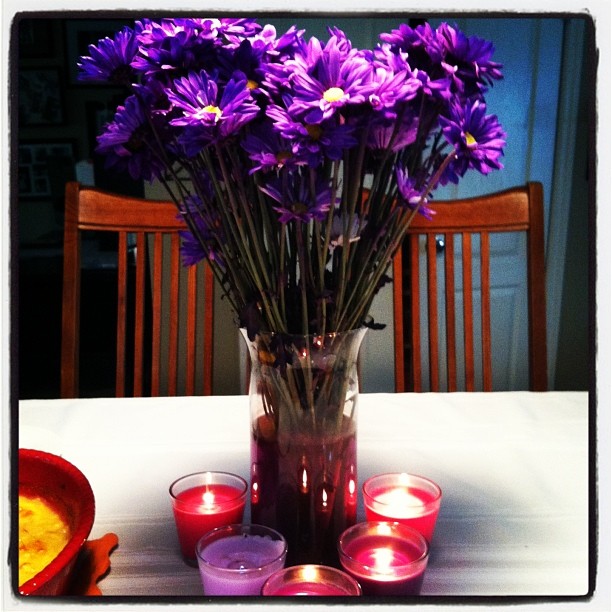
Sayonara Lent 2014. I love the color purple but I won’t miss you a bit.
I will not miss Lent 2014, AT ALL. In fact, Sunday can’t come soon enough, because, for me, this Lenten season was a debacle.
I set out with high standards and even higher hopes, but I stayed put in the reality of my life.
Though I couldn’t articulate it when Lent began, I think I had a subconscious idea of what would happen over these six weeks. By stripping away so many of my “distractions,” I would open up more time and space for silence and contemplation. I would become more centered. My writing would flourish and so would my relationships. I would begin to attain the holy grail of sevens, what enneagram scholar Russ Hudson calls “sober joy;” joy created not by a circus of stimulation, but by the simplicity and beauty of the present moment, satisfied with and who and wherever you are.
There was nothing wrong with the vision, but the goals I set for myself are a life’s work, not something that can be attained on demand, or through a sheer force of will and self-discipline in a pre-set period of time. It took me a while and some help from Tim to see it however.
For the first several weeks of Lent, I had vivid nightmares. The details were varied, but they shared the same theme: bad things were happening and I had no control. I couldn’t fix anything, or affect a positive outcome. I simply had to experience the chaos in a visceral manner. I would begin my days in a cold sweat, mourning the losses I experienced the night before.
Though the dreams eventually abated, the days I thought would open up before me quickly filled with other challenges. I could explain them all here, but the bottom line is that they were just part an every day, ordinary life – the one I didn’t magically escape on my way to my desired “mountaintop” experience.
Last week, Tim and I needed to have a talk. After dinner, we drove to the beach and watched the sun go down and he told me what I already knew. I began this Lenten journey, hoping to become a different person. The problem was that I didn’t consult the person who always journeys with me. This Lent was not a picnic for him. He slept next to me while I tossed and turned at night. He woke with me in the morning and saw the fear in my eyes. He came home at night to someone whose stressful days were unrelieved by the innocent pleasures of a diet soda, two chapters of a good book, or a funny story on Facebook. He lived with a struggling, sadder version of his normally happy wife. The changes were largely of her own making, in the name of her God and ironically, they were intended to make her a more “joyful” person.
Tim reminded me that he loves me “as is,” not that I can’t grow and change, but that I don’t need to be different than I essentially am. Giving up one or two of my “go-to” distractions might be a healthy practice, the equivalent of a Weight Watchers plan for the soul. Giving them all up worked on me like a crash diet. Like an anorexic counts calories, I counted every distraction and every moment I wasn’t soberly joyful as a shortcoming. The guilt and sense of failure continued the downward spiral.
Don’t get me wrong. In every week, there were moments of joy, peace and laughter and I tried my best not to be legalistic about the process. When food poisoning laid me out for 36 hours, I read A Fault in Our Stars, one of Keara’s favorite novels. When Tim and I went out, I would join him in a beer. I looked over Keara’s shoulder a couple times so she could show me a great picture on Facebook.
On Thursday, I continued my Holy Thursday tradition of washing the feet of my family members, while they read a love letter I have written just for them. Here is a portion from the one I wrote to Tim:
“Dear Tim,
What a Lent it’s been! I am so grateful that this symbolic time of struggle, darkness and solitude is almost over, but of course, life isn’t over, so all those things will still be here on the other side of Sunday. But, we will get to remove the little extras we’ve been adding to it and I hope to turn a new page mentally. I look forward to Sunday, to singing “Alleluia,” to being reminded that we are an Easter people. Where there is death – of any kind – there is the possibility of new life and if we trust in and act out of Love, there is the surety of it.”
My Lenten experience is one I won’t soon forget. Like most failures, it was brought on by a confluence of good intentions and arrogance. I thought I could manufacture my own resurrection experience by knocking off some version of me who relied on little things to make her happy. On our sunset walk, Tim reminded me that the world could actually use a few more of those kinds of people; I shouldn’t be in such a hurry to get rid of her. Besides, it doesn’t really work that way. He quoted Richard Rohr who often says, “Don’t try to engineer your own death; it will be done unto you!” Starting tomorrow, I’m going to believe him.
A #Sign of Love I found and held in my hand on Good Friday.
We are just over a week in to Lent 2014, and I have to say, it’s been a rough week, a really, really rough week. Here is a reminder of what I am trying to do without:
My daily Diet Coke
My almost-daily alcohol intake
My multi-time-a-day Facebook check
My weekly novel
My bi-weekly bargain hunting at Target, Costco and other, mind-numbingly overstocked stores for little things I really don’t need
I knew I put a lot of things of things on that list, but I felt called to all of them, because they center on a common theme: distraction. Distraction is a dragon I have to face and I felt encouraged recently after watching an interview with Steven Pressfield, the author of The War of Art. He said that when face our dragons, our greatest fears, they go “poof.” They disappear before our very eyes and we get to the treasure on the other side.
Facing the dragon? Harder than I thought.
Steven, you were wrong. I’m a week into facing my dragon and it hasn’t even blinked. If anything, its hot breath on my neck is starting to make me sweat.
I deleted the bookmarks for Facebook on my phone and browsers, but every time I sit down to work, I am conscious of the fact that only eight keystrokes separate me from a broken promise and the Promised Land. I think of the articles I’m missing and the information I’m having to do without, the pictures of adorable kids I don’t get to “like.” Sigh. I find myself at the market and the library (the two “stores” I’ve let myself enter), perusing each and every shelf for just the right thing, the thing I don’t need, but that would bring me joy to consume. On these unusually warm winter nights, I long for a cold glass of white wine. Finally, and perhaps funniest of all, I find myself daydreaming of Diet Coke. I have actually caught myself fantasizing about pulling through the McDonald’s drive-thru and taking my first sip through their perfectly calibrated straws.
I have felt bereft this week, mourning the loss of my first level addictions, the habits that give me the quickest highs. But I’m also saddened by how quickly and easily I’ve turned to other distractions. Instead of going deeper into my work and writing, I’ve revamped powerpoints I made for classes just weeks ago. I’ve swept and dust-bustered every room in the house. I spent an entire evening researching a new broccoli recipe, and several hours the next day preparing it, and my family doesn’t even like broccoli. Neither do I. What am I doing?
I know exactly what I’m doing. If I want to put a positive spin on it, I’m acting on a desire to keep busy, to find something new, joyful and fun. If I want to be realistic, I’m acting on a compulsion to get out of my own skin. Whatever you call it, it’s something I’ve struggled with for as long as I can remember.
My parents, who have always been seekers, found a book in the late eighties called The Enneagram: A Christian Perspective by Richard Rohr and Andreas Ebert. The enneagram is an ancient tradition that introduces nine patterns of thinking and behavior that most of us, despite all our illusions of being unique, free and mysterious, actually fall into fairly neatly.
The Nine Personality Types of the Enneagram
1. The Reformer. The principled, idealistic type. Ones are conscientious and ethical, with a strong sense of right and wrong. At their best: wise, discerning, realistic, and noble. They typically have problems with resentment and impatience.
2. The Helper. The caring, interpersonal type. Twos are empathetic, sincere, and warm-hearted. At their Best: unselfish and altruistic, they have unconditional love for others. They typically have problems with possessiveness and with acknowledging their own needs.
3. The Achiever. The adaptable, success-oriented type. Threes are self-assured, attractive, and charming. At their Best: self-accepting, authentic, everything they seem to be. They typically have problems with workaholism and competitiveness.
4. The Individualist. The introspective, romantic type. Fours are self-aware, sensitive, and reserved. At their Best: inspired and highly creative, they are able to renew themselves and transform their experiences. They typically have problems with melancholy, self-indulgence, and self-pity
5. The Investigator. The perceptive, cerebral type. Fives are alert, insightful, and curious. At their best: visionary pioneers, often ahead of their time, and able to see the world in an entirely new way. They typically have problems with eccentricity, nihilism, and isolation.
6. The Loyalist. The committed, security-oriented type. Sixes are reliable, hard-working, responsible, and trustworthy. At their best: internally stable and self-reliant, courageously championing themselves and others. They typically have problems with self-doubt and suspicion.
7. The Enthusiast. The busy, productive type. Sevens are extroverted, optimistic, versatile, and spontaneous. At their best: they focus their talents on worthwhile goals, becoming appreciative, joyous, and satisfied. They typically have problems with impatience, impulsiveness and distraction.
8. The Challenger. The powerful, aggressive type. Eights are self-confident, strong, and assertive. At their best: self- mastering, they use their strength to improve others’ lives, becoming heroic, magnanimous, and inspiring. Eights typically have problems with their tempers and with allowing themselves to be vulnerable.
9. The Peacemaker. The easy-going, self-effacing type. Nines are accepting, trusting, and stable. At their best: indomitable and all-embracing, they are able to bring people together and heal conflicts. They typically have problems with inertia and stubbornness.
**These descriptions were excerpted from the Sukha Wellness Center blog in Avila Beach, CA. For longer descriptions of each type, you can go to their blog by clicking on their name.
Although the list at first glance might seem like fodder for cocktail party conversation, or a cheesy pick up line, the enneagram is actually brilliant psychology. Rohr often says in his work that, “We don’t see things as they are; we see things as we are.” In other words, our vision is shaped by our own personal experiences, prejudices, and default settings. Two people can experience the same behavior, the same opportunity, or the same outcome and perceive it completely differently. Too often, we think that means the other is wrong. In contrast, the enneagram offers us a way to see the reactions of others more compassionately. It doesn’t mean you give in to their wishes, or desires (unless you’re a two), but that you understand and acknowledge their position, which is simply the basis of good, interpersonal, communication skills.
My parents were immediately able to identify themselves in the numbers (my dad’s an eight and my mom’s a three) and became more conscious of the choices they were making. In some ways, they literally became different people, because they saw themselves for the first time, as they were, not how they had imagined themselves to be. I assume their conversations also included psychoanalysis of their four kids, but they didn’t project their ideas on us. Rather, they left the book open on their nightstand, which I took as a personal invitation to join in.
When I was seventeen, I thought I might be a nine, because I’m pretty easy-going and flexible. I wanted to be a four, because really, what teenage girl doesn’t think of herself as an artist? But when it came right down to it, I’m a seven at heart. I can turn any time into a good time. Bad things are never really that bad. If something is fun, my first question is, how can we make it funner? (If you need any proof that I am a seven, look no further than my use of that word. I’m an English professor, yet my lexicon would be incomplete with out the grammatically-incorrect adjectives, funner and funnest. Tim says you should look no further than me on the dance floor, our summer vacation plans, or the stash of candy in my car.)
Being a seven has brought me through some of the darkest days of my life, from my mother’s cancer, to my unplanned pregnancy and adoption, to the miscarriage of our first child together and even this long recession that has so decimated our small business. But in every dark night, I discover a patch of moonlight to dance in. I instinctively locate the pinprick of brightness and worm my way in. Once there, I push against the boundaries of the night that try to hem me in. I force back the darkness, sadness and pessimism, with hope and humor and joy, until the ones I love are standing in the light again.
That’s the bright side of being a seven.
The dark side is what I am facing this Lent. Sevens are easily distractible, frequently bored and hard to pin down. We don’t like to make decisions, or stay put for too long. We knew FOMO long before it became a “thing.” It’s in our DNA. (For readers over 40, FOMO is the Fear of Missing Out and it’s sweeping the nation.) If a seven isn’t careful, the consequence of their shadow side is a history littered with abandoned people and projects, a life that stays on the surface of everything, because depths always leads to darkness.
Enneagram teachers make it clear that there is a whole range of health and maturity for each person within their own number. An unhealthy, or unredeemed person of any type does a lot more damage (unconsciously and frequently with good intentions) simply by following their instincts, than someone with more self-awareness and control.
Giving up so many of my favorite things is not about self-denial, asceticism, or weird Catholic guilt. It’s about self-awareness and freedom. When I feel an overwhelming urge to do something new, I want to do it for the right reason, not because I am running away from something else.
One of the highlights of my past week was talking to my little sister. I was telling her how I was trying to give up my distraction patterns for Lent. She laughed at me, since she doesn’t drink Diet Coke and hates to shop. She’s pregnant, so booze is not an option. She is not a seven, so my struggles are not hers. After she had finished teasing me, I asked her what she does when faced with Blaise Pascal’s realities of existence: boredom, inconstancy and anxiety. She is an eight, like my father, so after a moment’s pause, she admitted that she picks a fight with her husband, not consciously of course, but she’ll see what he’s doing and find something to criticize. If nothing appears, she’ll bring up an oldie, but a goodie from the past. She’s not being mean, she’s quick to explain; she’s just looking for an “out,” a place to put her energies. Then it was my turn to laugh, because it would never occur to me to create conflict as a stress-reliever.
But we all do it.
In our own way and in our own time, we act on compulsions that are as natural to us as breathing and as unnatural to others as breathing under water.
Are you curious about yours? This is my best advice when trying to figure it out. Which type do you want to be? That’s for sure not you. Which one gives you a sinking feeling in the pit of your stomach as you read about it? Bingo. You might be on to something there.
At the bottom of the blog are a couple links to websites about the enneagram if you want to learn a little more about it. I can’t recommend them highly, because I haven’t used them on my journey, but they are certainly a place to start. The names I’ve found to be helpful are Rohr, Hudson and Riso, but I am sure there are others, who have come after them. My one caveat is this: working with the enneagram isn’t a parlor trick, or something you do for a feel-good experience. As my dad likes to say, “If it doesn’t bring you to your knees, you’re not doing it right.”
Ash Wednesday is always a big day for me, a day of purpose and change. I feel like it’s a more natural place than New Year’s Day to reflect on our lives and the resolutions we might want to make. To create lasting change, one must consider the alternatives, prepare and be focused. New Year’s Day, coming at the end of a consumer rush and holiday hangover, doesn’t offer ideal conditions. But this day, an ordinary Wednesday at the tail end of winter, seems like a quieter time, more conducive to thoughtfulness and resolve. And this past week, when I have given myself over to thoughtfulness, my questions about my Lenten practice for this year were resolved.
It is in my nature to stay busy, buoyant and engaged, which is good, because that’s what my life requires. (Funny how it worked out that way, isn’t it?) I like to live life “up high,” not in an altered state, but at an elevated one and I can usually achieve it without even trying, or so I thought until recently.
As I went about my business the past few days, I began to see a pattern emerge. When I was feeling low, I noticed how frequently I used certain crutches to get back to my favored high. To be honest, I have quite a collection.
In his Pensees, 17th century philosopher Blaise Pascal defines the human condition with three awful words: boredom, inconstancy and anxiety, which are pretty much the antithesis of how I like to live. Previously, I might have dismissed his observations out of hand, but after watching myself this past week, I think he might be on to something.
As a result, these habits are on the chopping block this Lent.
My daily Diet Coke
My almost-daily alcohol intake
My multi-time-a-day Facebook check
My weekly novel
My bi-weekly bargain hunting at Target, Costco and other, mind-numbingly overstocked stores for little things I really don’t need
None of those habits are bad in and of themselves. They aren’t even bad for me, except for maybe the Diet Coke. I don’t have a drinking, or spending problem and I don’t neglect my family in favor of my fictional friends.
Rather, these are the items and actions I use to distract me. When feeling flat, they pick me up, make me smile, and ease the burden of the boredom, inconstancy and anxiety that Pascal named as the reality of our existence. In other words, they keep me from feeling what I don’t want to feel.
As someone on a spiritual journey, I want to get better at recognizing what I feel and facing it, instead of simply turning away. Instead of changing the subject, I want to stick with it for a while and see what happens. Why am I bored in the midst of my busyness? Because writing is solitary work, because I have a routine, because the 20th paper I grade on the psychology of obedience sounds a lot like the 1st and the 5th and the 17th, because life just is a little boring sometimes. What’s making me anxious? Ukraine, health insurance, college tuition, the pain in my lower back, the little roll of stomach fat that settles around my waistband when I sit at my desk, students who don’t turn in their final papers, not knowing what the future holds. What change is on the horizon that I can’t control? Teenage drivers and a college search, future boyfriends and girlfriends and inevitable heartbreaks, a new school for me, an empty nest eventually. In short, everything. Everything changes and I don’t get to be in charge of how it turns out. As you can imagine, there are countless answers for each of the questions, so it’s no surprise that I seek relief in countless ways.
By giving up my favorite “go-to” solutions, I’m trying to skim a little off the top of my wildly successful, distraction scheme and build up my tolerance a little bit. I’m no fool however; I’ve got more tricks up my sleeve. When I want to get out of my own skin and can’t consume something sweet, or fun, I’ll grab a broom, or clean a closet. I’ll pick up Augustine, instead of Austen. I’ll go to the library and borrow things they won’t let me buy, just for the pleasure of walking out with something “new.”
My second tier distractions are infinitely less thrilling than my top choices. While the items on my Lenten “no-no” list pick me up and bring me higher, these other strategies just help me tread water. Their purpose is to distract me enough to make it through a tough moment, but not so much that I want to stay there. My top tier does that far too well.
I imagine that by the end of Lent 2014, my floors will be cleaner and my closets less cluttered. Hopefully, my heart and mind will follow suit.
My little brain is constantly amazed at how certain themes invade our consciousness at different points in our lives. It’s like we open a Roach Motel in our minds and a breed of previously unrecognized (and perhaps even unwanted) ideas from the Universe just march right in, one after another. As promised, “They check in, but they never check out!” This convergence of divine wisdom changes us; the new ideas find a home and we are never the same again.
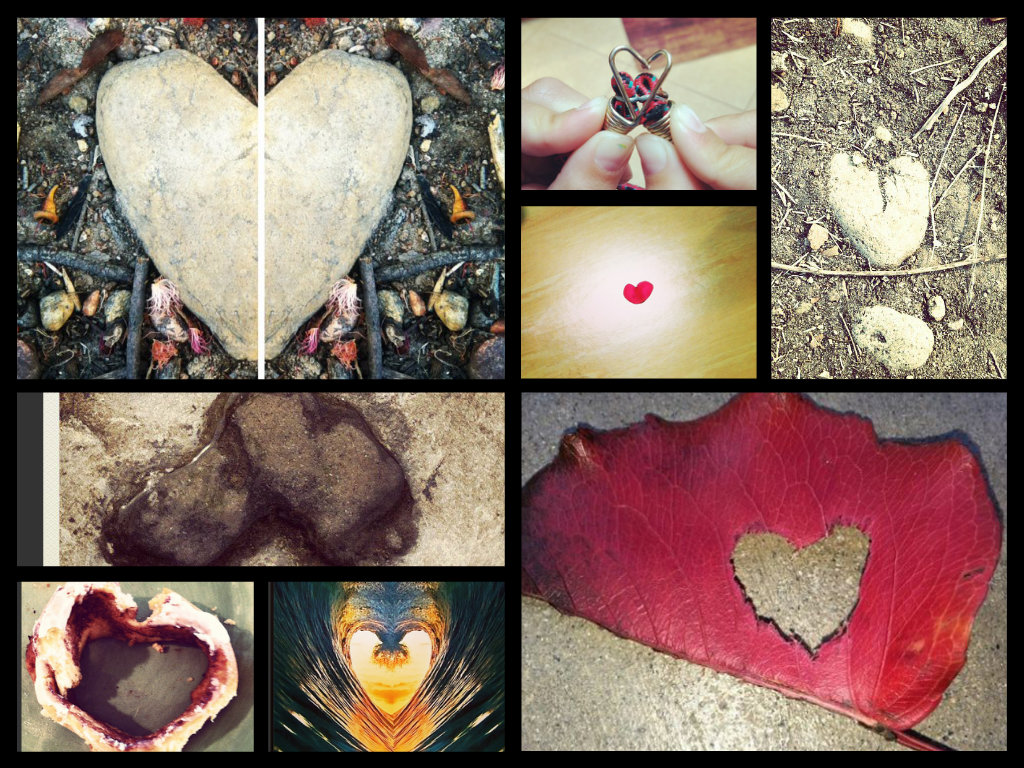
A couple of years ago, I began to see #Signs of Love, every day,all the time. Apparently, Love was what I needed to know. By encountering hearts everywhere, I understood that divine Love animates the world. Recognizing Love in everything from stones to sunlight, I began to love myself, my family, friends, and even strangers more. I had more Love. I was more loving.
Opening my mind to the #Signs of Love changed my life.
However, as time went on, I saw fewer and fewer #Signs of Love. At first I worried about the loss. “Where are my #signs? Where is the Love?” I wondered, but after a while, I got the message: Let go of what you think you need. When we are learning to walk, our parents do 90% of the work. As we get stronger and more independent, we need less “hands-on” assistance. In fact, too much help hinders us, making us dependent on something we don’t really need anymore, retarding our growth.
So I came to accept that although I would really like them, I don’t need daily reminders of the power of Love from outside of me. Rather, with every heartbeat, I am reminded that Love comes from inside of me. I also receive countless #Signs of Love from all over the world, from friends, family and even strangers. They see Love and share it with me on Instagram, Facebook and Twitter. Truly, a divine economy. We share what we have in abundance, so please, keep them coming.
In the last year, new themes have arisen, but they aren’t nearly as photogenic, which makes them harder to share. I’ve mostly kept them to myself, but one in particular has haunted me. No matter where I go – in my life, my reading, my friendships, or my work – I’ve been brought to the same threshold over and over again. In a hundred different ways, in countless locations, in various tones, the question is asked: “What are you going to do with your life?”
It’s disconcerting, because I want to retort, “I am doing something with my life.” I’m raising a family; I’m teaching; I’m writing; I’m volunteering; I’m making a difference in my own little way. But it isn’t a silly, or insulting question, either, because frequently, I’m the one asking it. My life may be half over, but that means I still have a whole half to live. That’s great, but here’s the rub.
When I was ten years old, I knew who and what I wanted to be. I wanted to be a wife and a mom. I wanted to read and write. I thought if I could do those things, I would be happy and I was right. I do those things and I am happy. But apparently, it isn’t enough, because the Roach Motel in my head says I can’t stay here.
The problem is that I have no idea where I am supposed to go. Thirty years ago, the goals were clear. Today, not so much.
For the last several years, I have modeled my search for work based on the quote by Frederick Buechner: “Vocation is where our greatest passion meets the world’s greatest need.” I loved that idea and it has brought me this far, but recently theologian Howard Thurman disrupted my chain of thought. He wrote:
“Don’t ask what the world needs. Ask what makes you come alive, and go do it. Because what the world needs is more people who have come alive.”
That statement floored me. When was the last time you thought about it? “What makes me come alive?” What did you say then? What would you say now?
We should think about it, because according to Brene Brown, it really matters. Meaningful work is a cornerstone of a meaningful life. We can’t be indifferent about it. Squandering our gifts, opting out of what brings us joy and purpose, deadens our souls and the souls of those around us. If we, as parents, bury ourselves alive, we are teaching our kids to do the same. I don’t want to do that. Keara, Finn and Molly are just getting started.
In my journal, I posed the question, “What makes me come alive?” and this is what I wrote:
Loving God, my husband, my kids, my family, my friends; praying; reading and studying about humanity, our struggle and spirit, where we’ve been and where we’re going. Writing and talking about the things that fill my heart and mind. Sharing what I know, what I have, and who I am. Taking time to be well: spiritually, physically, emotionally, intellectually and helping others to be well too. Encouraging, listening,journeying with people who are ahead of and aside and behind me on the way.
Hmm.
Though I looked, I couldn’t really find a lucrative job description in there. If something occurs to you, let me know (really!), because so far, what I’ve come up with is spiritual director, or modern day monk and I don’t think either of those career paths is going to pay the kids’ car insurance, or college tuition.
That is the tension Tim and I haven’t worked out yet. How can I be truly alive,the center of a home that hums with energy and beats with love and contribute more significantly to the family’s financial stability? We’ve been stuck in a reductionist, either/or mentality, believing I have to choose one, or the other: get a job, or keep being alive. We are typically pretty smart people, which makes our lack of creativity on this subject so frustrating, but we are also stubborn, which opens up the possibility that an answer lies before us that we simply refuse to see. The Roach Motel keeps telling me there is a third way we simply haven’t discovered yet.
To that end, we are taking a risk. In the fall, I will be starting a two-year program at The Rohr Institute. It is called the “Living School for Action and Contemplation,” describing itself as an “underground seminary” which empowers students “to live out their sacred soul task in their homes, workplaces, and all relationships, within a more spacious stance that is at once critical, collaborative, and joyful.” The school is based in New Mexico, but most learning is done online, with two weeks a year on campus. I will still be able to teach, to parent, to be present to my life here, while “coming alive” in a more intentional way.
I haven’t shared our decision with many people, mostly because it feels a little foolish. I won’t finish with an additional degree, or improved job prospects. I’m afraid people will think Tim is signing off on it for my sake, that our complex and heartfelt decision will be reduced to “Happy wife, happy life.” I doubt myself and wonder if I am just putting off the inevitable job hunt, buying myself two more years of “not-choosing,” two more years of putting my own desires ahead of those of my children.
They have everything they need and most of what they want, but there are many things left on the table. Some of them are silly like iphones; some are practical like laptops and some of them are so heartbreakingly beautiful, or simple, I want to cry. From attending art school without going into major debt to popping for a full-price movie ticket on a Friday night, I think, “If I could just die to myself, maybe I could make more of their dreams come true,” but then I take a deep breath and remember. My emotions might be real, but the fear is not. We live with an abundance of food, clothing, sunshine, education, opportunity, family and love. Scarcity is not our truth. When the Roach Motel says, “Listen” and I do, I come alive, thinking of all I will learn and experience in the years to come, the ways I will be challenged and changed and I pray that I bring it all back here to better serve the people I love the most (which includes all of you).
Once again, all these questions and doubts lead me back to the threshold and poet Mary Oliver’s wonderfully provocative question, “Tell me, what is it you plan to do with your one wild and precious life?” to which I answer, “I am doing it.”
I am loving and learning, praying and teaching, reading and writing, kissing and hugging and holding. I am breathing in and breathing out. I am moving forward, and falling back. I am reaching high and falling low. I am dreaming big and coming up short, day after day. Meanwhile, I am alive.
If you’ve come to my blog and found a new look, don’t worry! It’s still me. I just wanted to update my look here, since I’ll be adding reading glasses to my repertoire of writing tools.
I went in for my first eye exam in 25 years and though I still have the vision of a fighter pilot – the doctor’s words, not mine – she did say that eye fatigue was getting the better of me and larger, cleaner font would help. So, on the doctor’s orders, I found a template that was a little less pink and a lot easier to read. You’re welcome!
If you click on the funny little black box on the left hand side of the page, you’ll find a menu, which will take you to my other pages – about, starring, #signs, etc. If you scroll down, you will find the “Follow” button, tags and archives. If you’re reading the blog at the top of the home page, you’ve found my latest work.
Thanks for stopping by and I’ll have a new post for you soon.
Philomena was the last film I saw over the holiday season. I kept hearing how good it was, but I was hesitant. As a birth mother, I didn’t know how much it would hurt. Some of the movie really hit home with me. Not most of it, just some. What Philomena Lee experienced as a young, unwed mother took place in a different time and under a different set of circumstances all together.
The scene I related to the most came near the end when she was able to watch a collection of home movies of her son growing up, from the day he was taken from her to the day he died. His joys, his accomplishments, his loves played out on the screen before her, while tears filled her eyes.
Sarah at a few monthsSarah, a few years later
I know that scene. I lived it out for years, over and over again, equally delighted and devastated. In those moments, captured on screen, or in a 4×6 snapshot, you see everything your child has gained by being lost to you: the adoring mom and dad, a beautiful home, pretty clothes. But most of all, what Philomena and I witnessed were the countless opportunities our children had that we could not provide. It seemed they could be anything they wanted to be, unhampered by us, young women unprepared to be a mother.
I watched most of Sarah’s young life unfold through pictures – her days at the beach and preschool graduation, her 1st day of Catholic school and the pride and joy she felt holding her baby sister. To celebrate her fifth birthday, Tim pulled them all together for me in a movie called “Sarah Smiles.” As Hall and Oates crooned the hit song, I watched my baby girl’s life go by in three-second frames. From start to finish, her blue eyes and huge grin never faded though her chubby cheeks and pale pink skin gave way to wispy white hair and a freckled nose. When our “open” adoption became more open and I met Sarah for the first time just before her 7th birthday, I took a hundred pictures in one afternoon. As the years have gone by and we see each other more regularly, I still have to hold myself back from chasing her around with a camera; I don’t want to forget a single moment.
Author and poet Mark Nepo tells the story of a Hindu monk, frustrated by the constant complaints of his student. One day, he told the young man to throw a handful of salt in a cup and drink it. When asked how it tasted, the student said, “Bitter.” The monk then asked him to throw a handful of salt into the lake and to drink from it. He asked how it tasted and the young man said, “Fresh.”
Our life experiences, especially the difficult ones, are the salt in our hands, but whether we taste life’s bitterness, or sweetness depends on the vessel from which we choose to drink. The cup is so much easier, always on hand and socially acceptable. The lake takes an effort; it’s a walk and we have to get down on our knees and reach out to find the sweetness we desire.
In the movie, Philomena found the sweetness. She had been wronged; her child was stolen from her. She endured a lifetime of punishment for a few moments of pleasure. But despite all the church did to prevent her from finding or reconciling with her son, Philomena forgave them. She rejected the cup of bitterness, telling the nun who kept them apart, “I forgive you, because I don’t want to remain angry.” The journalist telling her story thinks she is a fool for doing so. He is angry, drinking cup after cup from her life and wondering why she won’t join him. But what need did Philomena have for a cup when she had made her life the size of a lake?
I had hoped to watch the filmwith Tim, or my mom, someone who had walked through my adoption with me. Maybe we could relive some old memories and talk about the past, but instead I saw the film with Keara and I am so glad I did. As the credits rolled, I realized we were right where we were supposed to be. It was a profound moment, realizing this movie wasn’t about my past; it was about my present.
I looked over at Kiko and tears filled my eyes. I squeezed her hand and thought about how my time and influence with her are waning. She is almost seventeen years old and I don’t think I truly understood until that moment what a privilege it is to parent my own child.
We think we have a right to it; we know we have a responsibility, but do we ever acknowledge what a gift it is?
In the darkened theater, I leaned over and whispered to her:
It has been my privilege to raise you and I have taken it for granted. I am so filled with gratitude for the opportunity to be your mom, to watch you grow each and every day, to experience life through your eyes and to be changed by your choices. Thank you for loving me and for letting me love you the way I do.
As I tucked Finn and Molly in to bed that night, I told them the same thing – how grateful I was for the opportunity to be their mom. It is a gift to hear their voices, to watch them walk through the front door, to go to sleep each night each night with them safely beneath my roof. I have taken it for granted that I could touch their hair, kiss their cheeks, hold their hands, but it’s all a miracle. Somehow, they are mine to care for. Everything I lost when I let Sarah go, I have experienced three times over, which makes it all the more bearable and yet bittersweet.
Parenting is so much salt in our hands. It challenges us physically, emotionally, financially and spiritually and when things are hard, I choose the cup too often. I can cite convenience, busyness, or stress; I can point out how at least one of them is moody, messy, hungry, entitled, or demanding at any given time. I can always find an excuse, but the truth is I don’t want any bitterness, or even indifference in my life. I want the sweetness that comes with gratitude, grace and Love, the freshness that comes from knowing it is all a miracle. So I will continue to take a walk each day, to get on my knees and reach out my hands to the fresh water. I will drink it all in.
With Christmas rapidly approaching, this will probably be my last post before the holiday. I write and wonder how you all are doing. Is your tree up, with lights and ornaments? Are all your presents purchased? Are any wrapped? Have you baked those cookies you plan to deliver to friends and neighbors?
My own answer to those questions would be no, no, not yet and most certainly no, which is pretty typical for the Kirkpatrick family. Between owning a retail business and working in education (me and the kids), the season doesn’t really feel festive until the shop is closed, school’s out and grades are in. We try to get in the spirit early, but meh – the 20th is when we start gearing up for fun.
Tim and the kids are always great about asking me what I want for Christmas and I always have ideas: boots, clothes, perfume, massages, a vacuum. This year though the Universe sent me a little holiday gift and I didn’t ask for it and it wasn’t what I wanted. It came wrapped up in a book with a sky-blue cover and a little red heart on it by Brene Brown called The Gifts of Imperfection.
Sweet title, sweet book, I thought. I was wrong. It is heavy-duty stuff about shame and worthiness, fear, faith and authenticity. I was getting through it though, until I got to page 55 and a chapter called, “Cultivating Self-Compassion: Letting Go of Perfectionism.” I almost skipped that one, because I am not a perfectionist. I have plenty of compassion for myself. I eat dessert every night. I draw myself hot bubble baths of a regular basis. When I’m just not feeling up to the challenge, I have no problem leaving the house looking like a wreck. However, I read on to see if there were any bits of self-love I was leaving on the table.
I wish I hadn’t. I started to read the chapter and within a page or two, my face started to flush, my heart beat faster. I pressed on, hoping it would go away, but it didn’t. Instead, I added nausea to my list of symptoms, as highlighter and pencil lead flew across the page, marking up sentence after sentence. As she described one perfectionist tendency after another, I became more and more mortified. The worst part was that I was totally unprepared! Like any good perfectionist, I hate to be caught off-guard, unaware, or uninformed about anything, especially my own personal business!
There were two things she clarified that struck me especially.
Perfectionism is not the same as striving to be your best. It is not self-improvement.
“Um, yes it is,” I thought, until she explained: Rather, perfectionism is the belief that if we live perfect, look perfect and act perfect, we can avoid the pain of blame, judgment and shame. Self-improvement is about moving in the right direction and I work hard at that, but apparently, people with my problem think that if we do everything right,improve enough, we will never feel those things. Those experiences (blame, judgment, shame) are for other people, so instead of taking the risk of doing big things imperfectly, we tend to do less than we are capable of.
Brown calls this life paralysis;
it’s all the opportunities we miss because we’re too afraid to put anything out in the world that could be imperfect. It’s all of the dreams that we don’t follow because of our deep fear of failing, making mistakes and disappointing others. It’s terrifying to risk when you’re a perfectionist; your self worth is on the line.
I read these ideas and thought of all the book ideas I have stashed in my files, the thousands of pages of written, and unedited work on my computer, the hundreds of speaking leads sitting in a database on my desk, and the teaching job that pays me less than I could make at Starbucks. I live out a perfectionist’s paradox: I might be capable of more, but I’m too afraid to find out I’m not. Instead, I stay where I am, tucked away in my tiny little corner of the world, blogging from my cheetah-print armchair, looking out of my bedroom window at the blue sky and waiting for my family to come home.
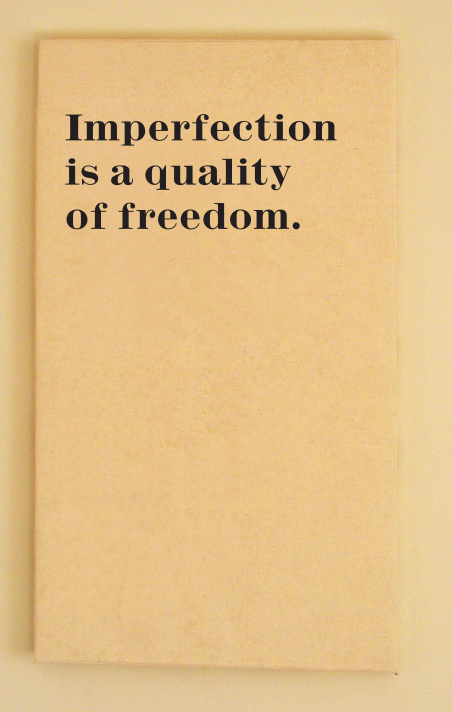
Brown names the gifts of imperfection as courage, compassion and connection. I want to experience more of those, but first, I need to accept the gift of imperfection, the simple ability to forgive myself and move on when I make mistakes, instead of feeling like a failure. I need to not just dream big, but actually work on making those dreams come true, despite my fear of ridicule.
My friend Leslie recently asked me to name a word for 2014. Fearlessness, I said, without hesitation, but the only way I can work on that is to first unwrap the gift of imperfection. Imperfections are not inadequacies, Brown writes, and to believe that would set me free.
This month, my husband Tim is trying to support me in my endeavor to be more still, more present, more aware and more in love.
To that end, he offered to write a blog post for me. He’s offered in the past, in a half-joking way, but this time I actually took him up on it, much to his surprise and immediate consternation. However, he did it and I think he did it pretty darn well. So, without further ado, let me introduce you to the musing of my better half.
First Time/ This Time
I am not a very cultured person. I spend far too much time watching sports and Seinfeld re-runs, and far too little time reading good books or poetry. There is not a lot of wisdom to be gleaned from NBA games or from Jerry, George, Elaine, & Kramer. So I’ll take it where I can get it, and I seem to get most of it from song lyrics and movies.
Which brings me to U2. Bono’s song lyrics are about as close as I get to reading poetry. I’m not sure where he’d rank amongst the all-time greats, like Robert Frost or E.E. Cummings , or any of the other famous poets that I’ve heard of but have never read, but it seems to me like he’s knows what he’s doing.
One of my favorite lines is from a song called “Vertigo.”
a feeling so much
stronger than a thought
Often, Bono’s words have a way of pulling me out of myself and opening me up, allowing something to sneak in through the side door and change my perspective.
Recently I was feeling like I was in a bit of a funk. I have been in one of those “glass half empty” modes for the past couple weeks, months, years, decades (who are we kidding?). I have recently come to accept that, unfortunately, this is my default setting. And although I am aware of my blessings (my wife, my kids, my health, my friends & extended family, my business… the list could go on & on) I spend much more time and energy focused on the things that aren’t quite “right” (the recession, finances, my kid’s behavior, my favorite team’s ineptitude, Homeland Season 3…). The list could go on & on.
I know I am blessed, but I don’t really feel it. And as Bono reminds me, a feeling is stronger than a thought.
This is my ongoing struggle: feeling what I know to be true. Because when I feel it, everything changes. Everything is… better.
“Vertigo’s” lyrics were ricocheting around inside my head when I was trying to find something to watch on TV the other night. As chance would have it (or maybe it’s a combination of divine intervention + the rapidly approaching holiday season), an oldie but a goodie was just starting: Love, Actually (a semi-cheesy, romantic comedy from the 90’s starring Hugh Grant and a bunch of other English people). I’d seen this movie when it came out, and a couple of times since, and always thought it was pretty decent: funny, clever, and sweet, with good looking actors and witty writing. What’s not to like?
The movie opens with montage of reunion scenes at Heathrow Airport, with a voice-over from Hugh Grant, one of the main characters:
“Whenever I get gloomy with the state of the world, I think about the arrivals gate at Heathrow Airport. General opinion’s starting to make out that we live in a world of hatred and greed, but I don’t see that. It seems to me that love is everywhere. Often, it’s not particularly dignified or newsworthy, but it’s always there – fathers and sons, mothers and daughters, husbands and wives, boyfriends, girlfriends, old friends. When the planes hit the Twin Towers, as far as I know, none of the phone calls from the people on board were messages of hate or revenge – they were all messages of love. If you look for it, I’ve got a sneaky feeling you’ll find that love, actually, is all around.”
Now I don’t want to mix metaphors here (or whatever you call it when you reference a different movie in the middle of your story which happens to be about another movie. Cue final scene of Jerry McGuire) but Hugh Grant had meat: “love, actually, is all around.”
With his opening line, he had me. “Love is all around,” I thought. “It’s everywhere.”
For the next couple hours, I re-watched this movie and found myself in tears for most of it. I’m not exactly sure why, as the movie isn’t particularly sad. I think it’s because I was opened up and I was seeing it from a different vantage point.
Sometimes, I think, the major themes in stories elude me the first time through, probably because I am too wrapped up in the plot and how things are resolved. But this time through, I think I finally picked up what the filmmakers were laying down. This time through, I noticed things I had never noticed before.
The first time I saw this movie, I noticed all of the “typical” love stories that were about romantic love. This time, I noticed all of the other kinds of love that were happening between all sorts of different humans.
There is love between siblings: Sarah, played by Laura Linney, chooses to love her brother, who lives in a mental institution, even though it costs her opportunities to pair up with the good looking dude from her office, and will undoubtedly cost her similar opportunities down the road. But she is committed to him and she prioritizes her decision to love him over her own desires. Ali and I often tell our kids there’s difference between love, the verb, and love, the emotion. The emotion fades in and out, and sometimes love is hard. And in those times when it’s hard, you have to choose it. Sarah chooses it, again and again and again.
The first time through, I noticed Sarah’s love for the hot dude from her office. This time through, I noticed her love for her brother.
There is love between a father and his step son: the father (Liam Neeson), whose wife has recently died, notices that his step son is acting strange, so he pulls himself out of his own sadness to try to help the boy. When it turns out that the boy claims to be in love with a girl at school, rather than laughing it off or telling the boy that love will only leave you heartbroken, he decides to help him get the girl. He participates in the love story of the boy, and won’t let him give up.
Near the end of the movie, when the girl is about to get on a plane back to America, he gives him one last push:
“Sam, you’ve got nothin’ to lose, and you’ll always regret it if you don’t! I never told your mom enough. I should have told her every day because she was perfect every day. You’ve seen the films, kiddo. It ain’t over ’til it’s over.”
The boy replies, with the most flawless line in the entire movie:
“Okay, Dad. Let’s do it. Let’s go get the shit kicked out of us by love.”
The first time through, I noticed the cute story about the boy’s puppy love. This time through, I noticed the father’s love.
There is love between friends: the creepy old singer realizes at the end of the movie that “the love of his life” turns out to be his chubby manager.
“And I realized that, as dire chance and… and… and fateful cockup would have it, here I am, mid-50s, and without knowing it I’ve gone and spent most of my adult life with a… with a chubby employee. And… and much as it grieves me to say it, it… it might be that the people I love is, in fact… you.”
He wasn’t coming out of the closet, he simply realized that it was Christmas, and it occurred to him that you are supposed to be with the people you love on Christmas, and the person he loved most in the world was his manager.
The first time through, I noticed the creepy old dude’s love for himself and his career comeback attempt. This time through, I noticed a sweet, older person having a life-altering epiphany.
Of course, there is also romantic love. Between the prime minister and his secretary. Between the sweet young couple that works on the adult movie set. Between the young, single English dude and the Midwestern American girls he meets on vacation. But my favorite love story in the movie is between the writer and the housekeeper.
The writer, played by Colin Firth, is English. When he goes to France to work on his book, he meets a Portuguese housekeeper who comes to clean his cottage every day. They do not speak the same language, and have a tough time communicating. But they slowly begin to fall in love.
It’s easy to see the story on the surface and jump to logical conclusions: boy meets her, girl is young & beautiful, girl is in maid’s costume, girl can’t nag boy because she doesn’t speak English… therefore boy falls in love with girl.
On the flipside: girl meets boy, girl makes minimum wage as a housekeeper and comes from low-income background, boy is an awkward, lanky nerd, but is also very rich and seems like a nice guy… therefore girl falls in love with boy.
But underneath the surface, I saw two people who couldn’t rely on words to communicate, so they had to find different ways. So they communicated with eye contact, and with gestures, and with kindnesses, and with their reactions to things that happened (like when the wind blows his entire manuscript into the lake and she jumps in to try to gather up all of the wet, ruined pages).
It occurred to me that their true selves were falling in love with each other, and that if they had been able to speak, the words would have only gotten in the way. Words have a tendency to do that sometimes.
The first time through, I noticed a typical “falling-in-love story,” the most typical of them all, where physical attraction kicks in and people are powerless to stop it. This time through, I noticed a pure love story, where two people’s souls were able to fall in love because words weren’t available to screw it up.
By the time the credits started to roll at the end of the movie, I felt different. I was in love. In love with my wife. In love with my kids. In love with my friends, and my family, I was in love with pretty much everybody. And I was feeling it, not just thinking it. And I think I remember hearing somewhere that feelings are stronger than thoughts.
How long will this feeling last? I don’t know, but I assume it will fade, and my default setting will be restored. In the meantime, I’m going to enjoy this feeling, enjoy that my glass is, not only half full, but overflowing.
Like I said at the beginning, I’m not very cultured. My life lessons are delivered via pop music and cheesy rom-coms. I should have also mentioned that I’m not very smart. I had to see this movie four or five times before the light bulb went on. But at least it finally went on. Love is, actually, all around us. All we have to do is notice it, choose it, participate in it, and be changed by it.
For me, the 2013 holiday season has begun like an event in the Olympic Games of Stress, hosted by my least favorite city, Crazytown USA. Perhaps it was the late Thanksgiving date and over-hyped Black Friday, or the 800-mile car trip we took over the last four days to visit family in Northern California . Perhaps it’s the week ahead and the ten papers I have to grade, the three soccer games for one kid, the four days of practice for another, the two days of auditions for the third, or the one out of town 40th birthday party coming up on Friday night. Perhaps it’s my mounting anxiety about the presents I haven’t bought, the Christmas card we haven’t created and the last time Tim and I had a date night and any intimate conversation.
I know it can be helpful to make a list of things you have to do, but just writing those sentences sent my heart racing, and not in a good way (except that last item).
Because I was feeling behind, I broke my general rule about shopping on Sundays, and went out early to check a couple things off my list. I came home and decided to do anything humanly possible to avoid shopping on future weekends in December. No matter what I can accomplish, or purchase, it can’t be worth what the experience brings out in me. While I didn’t actually spray mace, elbow people out of the way, or come to blows over a parking space, the truth is I wanted to and that scares me.
I’m taking it as a sign that I’m not quite on track to really mean it when I wish friends and strangers a “Merry Christmas,” or “Happy Holidays” and I figure I can’t be the only one.
Though much of my Catholic guilt has fallen by the wayside, there is one tradition I cherish and I think it might help me out here. It is called the season of Advent and it begins today and lasts for the next three Sundays before Christmas. While Christmas is a time of celebrating, Advent is a time of preparing.
Here is a short video explaining the Advent season. It’s only two minutes long.
When I watched it this morning upon my return from Crazytown, I found myself breathing easier. I remembered that I don’t have to be joyful yet. I’m preparing to be joyful. I don’t have to be ready. I am getting ready. I don’t have to be done. December is just beginning. There is time, even when I’m feeling rushed. There is space, even when my heart is cramped. There is love, even when I am doing my best hard-hearted, Grinch impersonation.
The only way to prepare for Christmas is to make the time and space for Love to appear and I already know how to do that. It’s what I’ve been working on the last couple years on a daily basis. When Love feels far away, I go for a walk in the early morning. I make the time to sit in silence, or read a good book. I write in my journal, hug my children and hold Tim’s hand. I listen to beautiful music, have a cup of tea, or enjoy a glass of wine with a friend (as opposed to tossing one back out of necessity).
I think that is how I will try to prepare for Christmas this year. I will try to anticipate what is ahead of me, without letting it rob me of the moment I am in right now.







 ALISON KIRKPATRICK