“Thirst” by Mary Oliver is written in a very different form than yesterday’s “Mindful,” but they share a similar theme. According to Oliver, nature is our first and best teacher and according to Franciscan theologians, nature was the very first Bible. God did not rely on theologians, logic, scripture, or even Jesus to reveal God’s self to humanity. Knowledge of the Divine has been offered to us all along, since we first had eyes to see and ears to hear.  We need only use them, Oliver reminds us in her poetry.

“Thirst”

Another morning and I wake with thirst

for the goodness I do not have. I walk

out to the pond and all the way God has

given us such beautiful lessons. Oh Lord,

I was never a quick scholar but sulked

and hunched over my books past the

hour and the bell; grant me, in your

mercy, a little more time. Love for the

earth and love for you are having such a

long conversation in my heart. Who

knows what will finally happen or

where I will be sent, yet already I have

given a great many things away, expect-

ing to be told to pack nothing, except the

prayers which, with this thirst, I am

slowly learning.


For the first thirty-plus years of my life, unlike the poet, I was a “quick scholar,” happily hunched over my books. As a child, I spent my recesses in the library, until they shooed me out the door. I never wanted to leave when the bell rang. Books were my way, my truth and my light, but not any more. In the last decades, I have tried to become a “good scholar” like Oliver, learning from the created world and trusting my own experiences as much as anything else. It has not been an easy unlearning, but I persevere, praying for a “little more time” to let Love do its work in and through me.

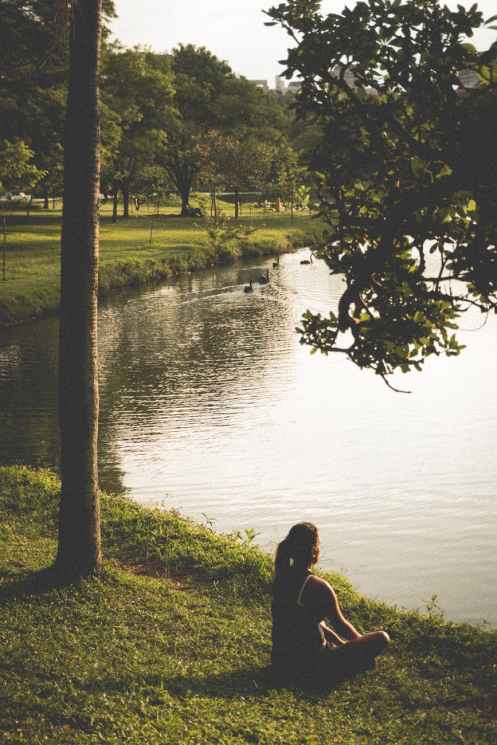
woman sitting on grass by lake
Photo by Kaique Rocha on Pexels.com


April-poetry-month

I cannot believe it is April 1 and National Poetry Month is upon us.

While I want to keep up my annual commitment to sharing a daily poem, it’s going to be a challenge this year. I’m “on the road” thirteen of the next thirty days, but I want to do it if only for myself, because I love poetry. I also want to do it for any readers who love poetry, but also for the ones who don’t love it yet.

I am making one significant shift this year. Instead of trying to include a wide variety of poets, I am focusing on the poets I return to again and again, the ones who have fed my soul and changed my life. I may even include poems I have shared in previous years, because one reading is never enough.


This first week, I am  honoring Mary Oliver, who passed away in January of this year at the age of 83. Known affectionately around our place as “Molliver,” she was a poetic naturalist, more at home outside than in, more comfortable around animals than humans, more inclined to use fewer words than many. In other words, not much like me. And yet, the themes of her poetry speak deeply to me. She too is a seeker and rebel.

“Molliver” also first came to mind because of my son Finn, who shares her love of nature and her deep way of seeing. What she captures in words, he captures in photographs. Like knows like and I have always thought that if their paths had crossed, they would have been great friends. I don’t think it’s any accident that the love of Mary’s life was the photographer Molly Malone Cook. Like knows like – in nature, in life, in love.

So without further ado, here is my first poem in the National Poetry Month series, dedicated to the memory of Mary Oliver and the future of Finn Kirkpatrick.


“Mindful”

Every day

I see or hear

something

that more or less


kills me

with delight,

that leaves me

like a needle


in the haystack

of  light.

It is what I was born for –

to look, to listen,


to lose myself

inside this soft world –

to instruct myself

over and over


in joy,

and acclamation.

Nor am I talking

about the exceptional,


the fearful, the dreadful,

the very extravagant –

but of the ordinary,

the common, the very drab,


the daily presentations.

Oh good scholar,

I say to myself,

how can you help


but grow wise

with such teachings

as these –

the untrimmable light


of the world,

the ocean’s shine,

the prayers that are made

out of grass?

If you can, even for just a moment today, be mindful – of the light around you, the feel of the breeze on your skin, the warmth of the sun on your face, the sound of the birds out your window. Be a good scholar and grow wise – not in the ways of the world – but in the ways of the universe.

IMG_4006
Finn captures the “untrimmable light” of a sunrise rainbow over the Pacific Ocean.


(As always, if the thirty days is too much, feel free to skip away. I’ll be continuing my Lenten reflections, so if you want to tune in for those, just look for that in the title.)

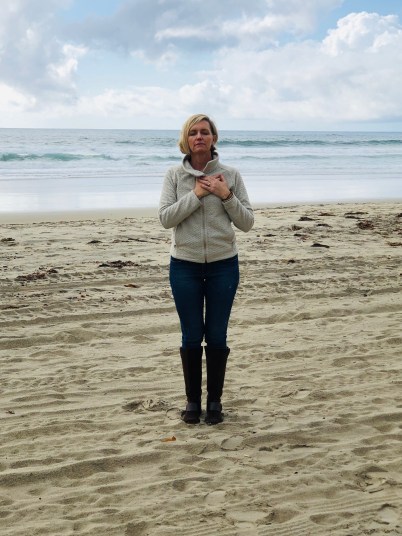
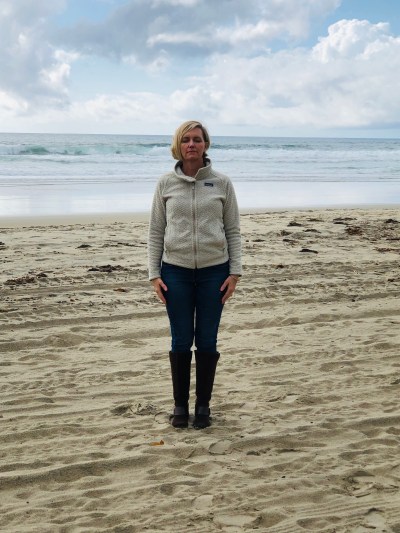
Last year, I adopted a body prayer as a Lenten practice. It’s impact on me was significant, so I continued the practice long after the season was over and decided to return to it this year. It is a simple, but powerful way to bring my attention to the present moment and my purpose in it. I forget those things constantly, so I can’t do it just once a day either. Rather, I set alarms on my iPhone in loose imitation of the monastic hours: 7:00 a.m., 10:00, 1:00, 4:00 and 7:00 p.m. As soon as my “bells” chime, I step outside, (or at least aside), and complete the prayer. Sometimes I have to delay for five, or ten minutes, but one of the greatest powers of the practice is in heeding the call when it comes – prioritizing being present in mind, body and soul – over whatever else I’m doing.


Here is the prayer, step by step.

IMG_3945

1. I stand firmly on two feet, grounding myself. I focus on the stability of the earth beneath me, supporting me, lifting me up, and meeting me where I am. I take a deep breath and still my thoughts from wherever they’ve been, wherever I’ve been, just moments before.

My words: “Here I am, as I am, in this world, as it is.”

This position is my reality check. I came to pray, but I arrive distracted, perhaps even irritated, anxious, or tired. And the world is meeting me, full of its own pain, the never-ending cycle of human suffering. This step of the prayer acknowledges the inherent imperfection of life, but in this moment, it’s enough that I showed up. Pausing here for some deep breaths, I arrive fully. This is my response to Divine invitation to “come as you are” to experience the gifts of presence and connection. Nothing else is required.

2. From standing with hands at my side, I move them to “praying hands” and bow at the waist. I take a few moments to breathe deeply here (and in each position).

My words: “I bow to the wholeness and holiness of which I am a part.”

In this position, I acknowledge the perfection of the cosmos and its Creator, but also my own part in it. The universe is vast and mysterious, but I am not inconsequential to the unfolding of God’s plan. To the extent I am aware and available, I can contribute more productively to it. This is a moment of great humility and deep self-respect. I matter enormously and not at all.

IMG_3942

3. With another deep breath, I move my arms into a V above my head and place my feet closer together. This is a gesture of welcome and receptivity.

My words: “I open myself to receive what the Universe has waiting for me this day.”

All that is good is generously offered to me each and every day: divine energy, love, compassion, grace, mercy, growth. It may not always look, or feel “good,” especially on bad days, or in times of deep suffering, but that doesn’t mean it isn’t true. The very nature of God is a complete and total fountain-fullness of hesed, the Hebrew word for God’s unshakeable, steadfast, generous love. God can’t help but allow good things to rain down on the just and unjust alike.

I want hesed for myself; I want hesed for the world, but I cannot receive it without making room. A cup full of water can hold no wine, which takes me to the next words of my prayer in this position.

My words: “I empty myself of my agenda for this day.”

As I say these words, my mind brings forth all the other things I need to release to make room for God’s gifts and the possibility to love and be loved in surprising ways. My agenda is just my plan for the day, but there are also my attachments – the things I want to be true and the way I want things to go. And don’t forget my projections – who I think others should be, and how I think they should show up in the world. While we’re at it, let’s also release the fears that go around making all sorts of unconscious decisions that limit me, and the certainty that leads me to judge, reject and limit other people.

I can’t possibly welcome the mystery of God’s plan if I think I have everything figured out already, so my body takes the shape of a funnel – wide open to receive from above , while releasing anything that has its origin in my own smallest self.

IMG_3943

4. I place my hands over my heart in a gesture of recollection and tenderness.

My words: “I acknowledge all that I have received.”

This is a moment of deep gratitude and recognition for the gifts I have been given. I feel my heart beat. In this moment, I am alive; I have breath. I have family; I have a home. I am safe and I am loved. I have felt the grace of God in my life and I see the ways it has shaped me. I pause for a moment of peace.

IMG_3944

5. I throw my arms open wide and twist at the waist, back and forth, in a gesture of release.

My words: “I share all that I am and all that I have.”

This position seeks to balance the self-preoccupation of the previous gesture. I am not given those gifts, because I am special, or blessed, or uniquely deserving in anyway. They are not mine to hoard, but to give away, as freely and fiercely as I’m able. Honestly, when it comes to generosity, some days are better than others, but this gesture always reminds me of the poet Rilke’s plea to God: “May what I do flow from me like a river, no forcing and no holding back.”

Let go, let God, let goodness flow. Let me not merely be a recipient; let me be a conduit.

IMG_3945

6. In this final posture, I place my hands at my side, touching my legs. I ground my feet into the earth once again. I feel more deeply rooted, more aware of the energy that flows through me.

My words: “I am here. I am home. I am Yours.”

Usually at this point, I can feel my mind start to wander back to where I was before, or ahead to where I’m going next, but these words stop me in my tracks.  If I cannot be here, stay here, for one more moment, then what was the point?

I am here, as I am – in this world, as it is – and it is okay.

I am home – in my body, in this place, in this moment. Pardon the cliché, but I am exactly where I’m supposed to be.

I am Yours – I don’t have to manufacture my own purpose, or figure everything out today. I simply know I belong – to Life, to Love, to Creation and the Creator of it all.


I know it sounds like a lot of time and effort, and honestly I do rush through the steps often enough, but at least a couple times a day, I go as slowly as I can, my face to the sun. In the video, I’m moving a little quickly, since I’m in a public space and Tim’s filming me. (He does not love public displays of prayer, or New Age-y body movements.) If you’re going to give it a try, find a quiet place where you can practice without self-consciousness! The song playing is called, “Ulysses” by Josh Garrels. I love that song and after hundreds of listens, it will forever call me back to myself.

P.S.    Fr. Richard Rohr says that people ask him how long they should pray. “Pray until you get to YES,” he tells them, “That’s what I do.”
I’ve found this to be a really helpful version of a YES prayer. In each position, I’m invited to come to an authentic YES. I can hurry past it in any one step, but usually by the end, I have come to an acceptance of some truth about myself and how I’m showing up. Then I can decide what to do about it.

At its core, YES is humility.

YES is freedom and choice.

YES is an act of Love.

I want to thank Cynthia Bourgeault and the Wisdom Way of Knowing for teaching me their version of this prayer and their encouragement to “practice my practice” in my own way.

One of the texts I’ve been working my way through this past month (and am committed to completing this Lent) is this

41a3SWJVf5L._SX341_BO1,204,203,200_

As you can imagine, it’s super uplifting stuff.

It’s one of those books you plan to read sooner or later, but somehow never get around to. Instead it sits on your bookshelf for years, pages yellowing in the afternoon sunlight… That probably sounds oddly specific, but that’s what happens to the books I feel like I should read, but don’t actually want to. However, a few months ago I finally wanted to and pulled it off the shelf. While visiting us from Montana, my eighty-one-year-old mother-in-law was rushed to the hospital in respiratory failure. There is nothing like the chaos of a near-death experience (even if not your own) to make you seek out “a Message of Hope, Comfort and Spiritual Transformation.”

Whatever the title led me to believe I was getting, it’s not what I’ve gotten out of this book. I’d heard the author described as a hospice worker, author and public speaker, but cracking open the first page, I was immediately struck by her other qualities, namely a PhD, with an expertise in transpersonal psychology, Sufi cartography, integral theory, and the evolution of human consciousness. Reading this text on death and dying is no Chicken Soup for the Soul, no pabulum to ease the bitterness of death; it’s hard work, but I’m grinding my way through it. And not only is it helping me understand what my mother-in-law may be experiencing, but what we will all experience at some point – the death, not only of our body, which is painful enough, but of our ego, our individuality and our ability to control anything at all, which is excruciating. We know how to medicate and manage physical trauma; it’s often the psychological and spiritual pain that is our undoing. Despite that hard truth, or perhaps because of it, I’ve found some good news in here. She says we can actually start taking some preventative measures now to reduce the psychic pain later.

Here’s one. Our life is full of opportunities to die to some parts of our “selves” we’ve (over)identified with. Every disappointment, every failure, every injury and illness, every break-up with a friend, or partner, every stumble along the way offers us the chance to ask the critical question, “Who am I?”

The best way to prepare for our eventual death is a “perpetual stance of exploration… the continual asking of the question, ‘Who am I?’… At first the answers to the question are the easy and automatic responses memorized during the decades of the mental ego’s identity project.” For example, for the last two decades and more, I have been able to say I am a blonde-haired, blue-eyed, freckle-faced cis-gender, heterosexual woman, wife, mother, daughter, sister, friend, neighbor, reader, writer, student, teacher, runner, swimmer, walker, weightlifter, surfer, snowboarder, baker, seeker, volunteer. Sorry for rambling, but you get the point. I can identify as a lot of things. We all can!

But here’s the kicker. I have failed at virtually each and every one of those things. I have been found lacking and had to die to who I thought I was, or more specifically, who I dreamed I could be in my lifetime in that role. My “self” sometimes really sucks. But in that space of confusion and disappointment in myself and the situation, am I courageous enough to ask myself: “Who am I if I am no longer this?” and the even more piercing and existential question: “Will they love who am I now enough to stay with me?”

When we don’t know the answer to those questions, we get confused and anxious, but in fact, according to the book, “not knowing is good. Not knowing is ‘beginner’s mind.’ Not knowing allows openness to the possibilities inherent in each moment. It is the only space in which wisdom can arise, because it has no preconceptions,” no pre-judgments about what could or should happen. In those moments when we are pierced by the sword of reality that “Reality shines through the holes left by the piercing.” In that crisis of self, a deeper and truer Self can fill in the gaps, preparing us for the final moment when the Self is all we have left. With any luck, and a lot of grace, it just might make the transition a little easier on us and those we love.

A final thought –

It is because you believe that you are born that you fear death.

Who is it that was born?

Who is it that dies?

Look within.

What was your face before you were born?

Who you are, in reality, was never born and never dies.

Let go of who you think you are and become who you have always been.

  – Stephen Levine

The quotes from The Grace in Dying are taken from a section called “Self-Inquiry,” pages 160-165.

On a personal note –

My mother-in-law has steadily improved over the last ten weeks. She has worked hard to be well again, with a kindness and determination that is much commented on by the staff everywhere she’s been. And while this situation has been difficult, it has also allowed her family to come together with love and mutual support. She will be released on Monday to her daughter’s home in Northern California for a few more months of recovery before she returns to her own home in the early summer. This is her hand in Molly’s last week as we visited over dinner.

IMG_3809

Though it has been far too long since I last wrote here, I couldn’t let Ash Wednesday come and go without having a word. Though I had no idea what I wanted to say, I woke this morning with a gravitational pull on my heart to be present here as this holy season begins.

Dozens of my Lents have been spent focused on self-denial and self-discipline, convinced that it was the appropriate time to overhaul who I was and all that was “wrong” with me. Sometimes the results “worked,” getting me a little healthier and humbler, but they rarely made me any holier. And this year, I don’t have it in me to work on my “self,” – not my self-image, my self-indulgences, or even the self-criticism that is my daily companion.

Tim and I have been talking for days about what practices we might adopt during these forty days, but nothing had resonated deeply yet. However, after my sit this morning, I walked over to our family message board, wrote this and sent a picture of it to my kids.

IMG_3787


And followed it up with this text.

It’s Ash Wednesday Team Kirks.  Just a gentle reminder from your mama that we don’t do “old school” Lent. This year, I want to do these things – not sacrificing in ways that don’t bring help and healing to the world in some small way. If Easter is the universal message that out of death comes new life, out of despair hope, out of darkness light, then these last weeks of winter can prepare us to be open to that new life, light and hope. Be brave and be kind today and know deep in your bones that the depth and passion with which I love you is just a fraction of the cosmic Love that Loves us all and has given us this life and chance to be together on the journey.

Fasting, prayer and almsgiving?

Okay, if you insist… but only if they make me more like the Christ who comes, not just on Easter, but each and every day. Giving up Diet Coke hasn’t done the trick and neither has sacrificing that second glass of wine. But some of those reminders on my message board just might  – in my own home, at work, or on the street.


I hope to share a few of the things I’m reading and practices I’m engaging with over the course of the next six weeks. Thanks for welcoming me back into your inbox!


What I want to do this morning is run (away), so what I’m forcing myself to do is sit (still). I want to run away from the anxiety I feel about so many things, not the least of which are the fires raging here in California, the loss of life, home, habitat, and economy. There is also personal, marital, and professional grist for the mill of my unhappy mind, so I found myself doing what I often do on high stress days – (after sweeping of course). I started making a list of all the things I “have” to do today: errands, emails, the gym, banking, cooking, cleaning, but it’s total bullshit.  I don’t have to do any of it, but I would much prefer to do those things than to be present to the world’s pain, or my own. If I stay busy with what is “urgent” then I can ignore what is important.

Is a trip to Vons to buy juice boxes for Molly’s lunch more important than struggling with some life questions that might set me on a new path? Nope, but it’s way easier to check it off my list.

I don’t have to put it in such binary terms. I can do both kinds of things. I can work out, go grocery shopping, put in a half-day at Wavelines and have time for meditation, and journaling, but the temptation is to start checking things off the “urgent” list and never get to the end of it, and therefore never get to the things that are ultimately transformative and life-giving. For all the days I follow that pattern, a beautiful part of what it means to be human – to learn, to change, to grow in life and love – is lost. So today, I am starting with the prayer and meditation, with poetry and writing to all of you and I’ll get to rest later. (Tim, I’m going to be a little late getting to the shop today!)

Let me leave you with this thought.

I want to do something to ease the suffering of those affected by the California wildfires, but I’m too far away to be of any help personally. So I can donate some money, reach out to those I know are hurting and I can pray. I’m not sure exactly what good that last item does, but this poem by Alice Walker in her latest book, Taking the Arrow Out of the Heart, has strengthened my resolve to keep at it.

Screen Shot 2018-11-15 at 9.43.40 AM
pc: finn kirkpatrick

“The Energy of the Wave”

As a child I sensed

but did not

grasp

the power

of prayer.

It was my innocence

of the depths

that kept me unaware.

How could the passion of the heart

sent flying towards others

through humble words

change anything?

Or, rather,

what might this change?

 But prayer is an energy

that crosses mountains and deserts

and continents and seas

and is never stopped

nor even slowed

by anything.

It arrives

at its destination

as a blessing

that says: I feel – though it is but

a shadow of your sorrow –

the suffering

that has befallen

you.

Though far away,

you are securely cradled

 in the safety

of my heart.

I am but a droplet

in what must become

a vast sea

to create the big wave

that washes

away

whatever demons

are harming

you.

Prayer is the beginning: when

we don’t know

what else to do.

It is in this

spirit

of awareness and near impotence

beloved

kin

of butchered Africa

that we stand with you.


Walker dedicated this poem to the people of Africa, but I am confident in its universal application. So let us pray today for all the sorrows in all the hearts in all parts of the world, as far as we can imagine and as close as our own. Let our prayers be a droplet in a wave of compassion, generosity, forgiveness and mercy that this world so desperately needs.

Yesterday, Tim and I celebrated our 25th wedding anniversary with  dinner at the La Jolla Shores Inn. It was a beautiful sunset, like hundreds of others we’ve enjoyed together on that sand.

IMG_2706

After our meal, we headed north towards Scripps to watch the stars come out. That mile of beach has played an important role in our lives for as long as we’ve been together.  It was the site of our first date, (read about that here) and our first whispered, “I love you,” just a few months later. I walked myself into labor with our first child on that stretch. We have spent countless beach days, birthdays, holidays, sunny days and rainy ones too, first as a couple, then as a family. It has been an oceanic witness to our laughter and tears, our joy and pain, our silent thoughts and our deep and sometimes distressing conversations. It made perfect sense to commemorate the quarter century we’ve spent together as husband and wife right there.

As far as Tim knew, we were just going down with a beach blanket to spend a few minutes honoring the occasion, but Molly and I had planned something a little different. While Tim and I were at dinner, Molly and a friend created a romantic place on the sand for us.  A beach blanket and a chair, a dozen candles, photos of us and our family, and a speaker playing some of our favorite love songs. After a quick hug and kiss and she was off, leaving us to enjoy ourselves and reflect on our life together.

IMG_2707


Tim was surprised enough, but I had a couple more tricks up my sleeve.

It’s been a couple years since I’ve worn my wedding rings consistently. Time and genetics have taken a toll on my hands, leaving my rings just wrong-sized enough to make them uncomfortable for everyday living. So in honor of our anniversary, I finally got them resized, and I wanted to invite him to place them on my left hand again.  But first, I had to ask him a few questions. Twenty-five years ago, at 21 and 25, we didn’t know anything except that we loved each other and were committed to making a go of it – declaring in front of God and just about everyone we (and my parents) knew – that we would honor each other all the days of our lives. But would he do it all again, knowing what he knows about the ups and downs, the goods and bads, the triumphs and the tribulations that every relationship encounters after so many decades together? So I asked him:

Do you take this woman to be your wife after twenty-five years of watching her change – physically, emotionally, intellectually, spiritually – knowing that she will change just as much in the next twenty-five and that they probably won’t all be for the better?

Do you take this woman to be your wife after twenty-five years of mediocre housekeeping and sloppy accounting and basic, “same-old, same-old” meals?

Do you take this woman to be your wife after twenty-five years of financially supporting her, while she finds cheap, but temporary emotional support in the clearance aisles of Target and Marshalls and haunts the halls of thrift stores, looking for just the right thing?

Do you take this woman to be your wife after twenty-five years of her continual assaults on your preferred systems of stasis, instead foisting on you, on us, on our family, program after program for improvement and change?

Do you take this woman to be your wife after twenty-five years of watching her bounce from dream to dream, challenge to challenge, school to school, lacking a single focus, (except the one of loving you and creating a loving family) in an effort to accomplish she knows-not-what exactly, but only to “be of service,” and to “love the world,” whatever in the world that means?

Do you take this woman to be your wife after twenty-five years of watching her fall many times and fail at many things that were important to her and having to pick up the pieces, knowing that pattern will most likely continue?

Do you take this woman to be your wife again after twenty-five years, even though she snuck “God” into the relationship in disguise – through her sneaky, overwhelming, passionate, personal, desperate Love for you, which grows “higher than soul can hope or mind can hide”?

In case you’re wondering, he said, “Yep,” to every one of them, just like I thought/hoped he would, (though he did pause for a moment or two after a couple of them).

And this is what I said to him,

I take you too, sweet man. I take you with your fears and insecurities. I take you with all the subconscious ways you try to isolate and disconnect yourself from me, the kids and the world. I take you with your bad singing and beautiful prose. I take you, not just with your love of your job and your business and your fierce independence, but also with your real, and to me incomprehensible, contentment with the 5’x10’ foot cave you call an office. I take you with your physical desires that have kept our love life alive for the last twenty-five years. I take you with all your achy joints and wherever they lead us someday.

The scriptures say that “Perfect Love casts out all fear” and if the last twenty-five years have taught me anything, it’s that you must love me pretty perfectly, not because you never fear when I bring you things, ask you to change, tell you I’m going to change, or that I want to do, or try something new, but because you respond out of that perfect Love and say, “Yes” anyway. You cast your fear out, or at the very least temper it, ask it to stand aside, so that the ones you Love – me and the kids – can become more perfectly ourselves in this world.

Twenty-five years ago, I didn’t know you would love me like this; twenty-five years ago, I didn’t know I would need a Love like this, but I did and I do and I will and I can think of NO ONE on this planet to whom I would say, “I did” and “I do” and “I will,”  besides you and I say it today and always.

So that was that and we spent the next hour or so reminiscing about the times that built us up and broke us down, slow dancing in the sand and looking up at the stars. But life isn’t all romance. The moments were precious, but they were over soon enough. We packed it up and headed home, joining Molly on the couch to watch The Office, before getting in bed for our nightly episode of Jeopardy. We were out, like all the lights in the house, before 10:00 p.m.

That’s what twenty-five years feels like to me. Romance when you can get it, make it, feel it, respond to it, create it, be inspired by it, need it. Companionship, kindness, compassion and curiosity in all the spaces in between. It’s enough to make a life and I’m grateful for all of it.


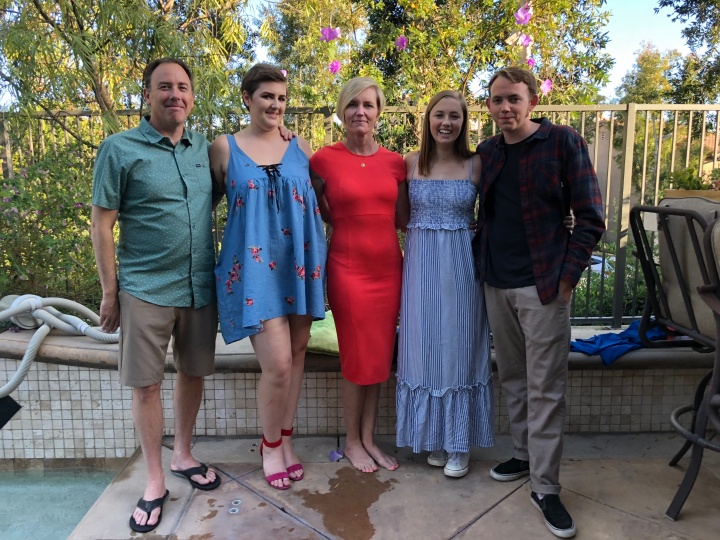
Last week, we dressed up for dinner at my folks’ place with our kids to celebrate the occasion.  Finn pulled out his camera and at my request, they all smiled (sort of).

789


39979420_2061555447209843_4347029304719179776_n

It’s been a long time since I’ve posted on #Signs of Love, not because I haven’t had things to say, but because I haven’t had the time to say them properly. I was working on a funny little “come back” blog, but this topic just keeps coming up – over and over and over again. When that happens, I’ve come to trust that a holy invitation is being offered, one that should be explored, not ignored.

This morning, I opened up my Facebook feed and found this reflection written Collin Packer, a white minister in Dallas, Texas, in response to the killing of Botham Shem Jean in his own home by a police officer. I had heard his name a couple times over the last week, but hadn’t tuned in to the details of the case. I don’t know all the facts, but Packer’s point of view is an important one, as it is written by a peer, a member of the local community and a person in a position of power.

botham-shem-jean

Yesterday, I attended the funeral of Botham Shem Jean. It was one of the most moving experiences I have ever had. Botham was a man of God, a graduate of Harding University, a worship leader, and a brother in Christ. We shared the same city and the same small religious tribe. He attended our church a few times.

8 days ago, Botham was murdered in his home. The shooter was not taken into custody until 3 days later. And yesterday, while I was sitting at his memorial service, those in power prepared to release the results of what often happens when African-American men are murdered: a thorough investigation into the life of a victim to criminalize him and somehow help others come to the conclusion that he, because of some flaw, “deserved” the bullet that took his life in his own home.

We don’t just murder African-American men. We murder their character. And we continue to justify systems that have continually devalued black bodies from the moment they arrived on our shores on slave ships. 

I am a white minister in Dallas. My family has lived here for generations. I have benefited from so much that this city has offered me. But my experience is not the experience of everyone in Dallas.

And I refuse to be silent and complicit any longer. Botham’s memorial service, along with many other events over the past few years, have unstopped my ears and cleared my eyes.

In his “Letter From a Birmingham Jail,” Dr. Martin Luther King Jr. spoke words that still ring true in our day:

“I must confess that over the past few years I have been gravely disappointed with the white moderate. I have almost reached the regrettable conclusion that the Negro’s great stumbling block in his stride toward freedom is not the White Citizen’s Counciler or the Ku Klux Klanner, but the white moderate, who is more devoted to ‘order’ than to justice; who prefers a negative peace which is the absence of tension to a positive peace which is the presence of justice…”

I want to challenge my white brothers and sisters in Christ to be willing to speak up for justice. May we be willing to stand in solidarity. May we be willing to listen without being defensive.

The voice of our brother’s blood cries out to us from the ground. May justice roll down like a river. Let us do what we must to tear down any dam constructed to block the flow of that river.

There is not much I can do to “tear down” the dams of injustice, in part, because I benefit so much from the pools that have gathered behind them. But at the very least, I can acknowledge the dams and some of the ways privilege has flowed my way because of the color of my skin.

Another invitation to examine this issue came just yesterday from Parker Palmer, the Quaker author, activist and teacher. He is a humble man, a wise elder and a gentle soul and his words moved me deeply, starting with the title of his essay, “Owning Up to my Toxic Biases.” I’ll just share a few bits here, but I highly recommend you take the time to read the entire piece.

Palmer begins with the words of a friend:

“Grant me the wisdom to see my own unconscious biases that continue to unintentionally and inadvertently make me complicit in this staggering rise of hate and callousness. May I never forget that hate and callousness have been as much part of this American experiment as joy, hope, and love. That while this experience may be new to my consciousness it has been a part of the lives of my fellow Americans who have lacked the access to money and power that come with privilege.”

Palmer goes on to reflect:

So, for the umpteenth time, I’m trying to come to terms with my own complicity in white privilege and the injustice and inhumanity that flow from it. When white people like me ignore or deny all that, it’s just another way of aiding and abetting it.

Isn’t the evidence clear-cut? A lot of things that are easy and safe for white folks are difficult or dangerous for people of color — from being pulled over for a broken taillight to trying to rent or buy a home in certain communities…

But my confession needs to go deeper than owning up to white privilege. Like many people of my race, I carry unconscious elements of white supremacy. If I want to help stem that bloody tide, I must become conscious of that fact.

No, I don’t belong to or support the KKK and its kin, whose beliefs and actions are evil to the core. But it’s a cop-out to equate white supremacy with its most toxic forms. Doing so takes the onus off people like me to come to terms with reality — our country’s and our own. How could a nation built in part on the enslavement of human beings not have a cultural substrate of white supremacy? How could white people rooted in that ground not be tainted by that toxicity?

If I look at myself closely and honestly, I find a form of white supremacy that’s subtle but pernicious. For a long time, I held an unacknowledged assumption that “white is normal,” that white ways are the “normal” ways.  All other ways are “exotic” at best, often “strange” and even “off-putting,” and sometimes “scary.”

Does all of this make me guilty of something sinister simply because I was born white? Of course not. No one is born guilty of anything. The guilt comes when I deny that being white gives me social advantages and crimps my capacity to see the world clearly and engage it honestly. Denial keeps me from owning my own arrogance, putting on corrective lenses, and fully joining the fight against the pestilence of white supremacy.

Is there any hope for white illusionists like me? As far as I’m concerned, this entire column is about hope — because hope opens up as soon as we gain self-awareness, confess our role in creating injustice, and reach deep for ways to release the better angels of our nature.

I love that phrase “white illusionist,” in part because it makes my own blindness more palatable and therefore easier to admit to and actively address. We can’t see what we aren’t told to look for, so when I look for “white supremacy” in my own life and actions, it’s difficult to see, but when intelligent, invested people pull back the curtain on the “illusion” of color-blindness most of white America hides behind, I am amazed at all the tricks in my subconscious that allow me to enjoy my life “as is.” While I may be consciously poking holes in those “dams of injustice,” I am unconsciously building them up and swimming in the overflow.

So what do I do about it, Palmer wonders?

I wonder about that too, but I think I know at least part of the answer.

1. Be more curious than defensive.

And if you’re curious, start investigating the questions. Look for authors, essayists and activists who will challenge your thinking. Join healthy conversations on the topic. If you’re a Tucker Carlson fan, I’m not saying you should go read Ta Nehisi Coates, but start seeking out authors on the right who are more open to a respectful dialogue on the subject. You might start with David French’s essay, “Why I Changed the Way I Write about Police Shootings.” If you’re a person of faith, or a white mom, try one of the essays of Jen Hatmaker on the subject, or watch her Today show video. If you’re interested in politics of the death penalty, read Bryan Stevenson. I’m currently being enlightened, challenged and disturbed by Austin Channing Brown’s I’m Still Here: Black Dignity in a World Made for Whiteness.

There is so much good content out there, but we need to seek it out and then we need to sit with it, especially when it makes us uncomfortable, or flies in the face of our own experience and what we believe to be the entire truth about ourselves, our nation, or our faith.

2. Be willing to speak up, but be humble.

I can’t think of anything more awkward to speak about than race and my own whiteness, so most of the time, I keep my mouth shut (unless I’m at home; my family hears about it probably more than they’d like). But I’m trying as humbly as I can to be a little braver, to apologize for stupid things I’ve said, or assumptions I’ve made. This blog is a step in that direction. Tim pointed out that most of the words in this essay aren’t my own, but I’m conscious of the fact that other, more educated people are speaking more eloquently on this topic. I have always admired, but rarely adhered to the maxim “If you can’t improve the conversation, remain silent.” In this moment, I’m mostly just trying to point out a couple of the conversations that are taking place.

3. Love, Love again, Love Better.

Every single day, Love yourself, love your neighbor, love the other, love the world in some real, tangible way. Do something that moves us closer to connection, to unity, to grace and forgiveness, even if only by a millimeter. If you can do it by a yard, that’s even better, but most days we aren’t hitting it out of the park. Palmer quotes Sikh lawyer, activist and filmmaker, Valerie Kaur, who advocates for Revolutionary Love, through the metaphor of mothering.

“Mothering, a capacity that exists within each of us, helps us redefine love, not just as emotion but as a form of sweet labor. It calls us to wonder about others, listen to their stories, respond to their needs. We employ many emotions in that labor: Joy is the gift of love. Grief is the price of love. Anger is the force that protects it.

When we practice love beyond the threshold of the home, it has the potential to transform the world around us and within us. But love must be poured in all three directions to be revolutionary. Revolutionary Love is the choice to enter into labor — for others, for our opponents, for ourselves. I believe Revolutionary Love is the call of our times.”

 Amen, Valerie and thanks for saying it better and saying it for me.
 

For the last twelve years, our family would be at La Casa de Maria for Family Retreat this week.  On a normal year, we’d be basking in the glow of family affirmations from Monday night and preparing ourselves to battle it out on opposing teams at pool games this afternoon, a favorite Tuesday tradition. But this year, after the devastating mudslides that hit Montecito on January 9, La Casa de Maria had to close its doors – for a while at least. Family Retreat was left homeless, but not hopeless. In late January, the team got together to grieve and then get to work. It was too late to relocate, but not too late to re-create our time together in what we called “Family Camp Lite.”

We stayed as close to La Casa as we could, taking over a dozen rooms at a local beachside motel and an entire second story deck with an ocean view. We gathered for music and prayers on the sand in the morning, shared several communal meals, celebrated mass on the beach and spent one morning working in the Shalom Garden at La Casa de Maria and touring the property. As we worked in the hot sun, we blessed our beloved spiritual home not only with our sweat, but also with our tears and songs and laughter. The devastation we saw there was both sobering and sanctifying. It is clear that Family Retreat will not be returning to the property any time soon, but equally clear that La Casa de Maria itself will continue its mission of being a holy place of healing and service for the world. We took a lot of pictures, but left some banners of hope in our wake.

One of the traditions the team felt strongly we wanted to continue even at “Family Camp Lite” was time for family affirmations and reconciliation. During a normal week, each of these rituals are given their own sacred time and space, but in our condensed schedule, we only had one chance on Saturday evening and they invited me to share a few words, which I’d like to share here with all of you.


Tonight we are combining two of our most cherished rituals from Family Retreat – affirmations and reconciliation. When we get started, each family will have to decide what they want to emphasize. Do your people need to hear, “I love you and here’s why,” or “I’m sorry and will you forgive me” more? Of course, both of those messages are deeply intertwined and deeply necessary, so maybe there will be time for both.

I want to start by reading just a few short lines of scripture. You just might be familiar with the passage from 1 Corinthians 13. (Sarcasm intended.)

 Love is patient, love is kind and is not jealous; love does not brag and is not arrogant, does not act unbecomingly; it does not seek its own, is not provoked, does not take into account a wrong suffered, does not rejoice in unrighteousness, but rejoices with the truth; Love bears all things, believes all things, hopes all things, endures all things. Love never fails.”

 Let me say those last lines again:

“Love bears all things, believes all things, hopes all things, endures all things. Love never fails.”

How many married couples here had these lines read at your wedding? (A few hands were raised) How many of you have heard these lines at almost every wedding you’ve attended? (Most hands went up) Do they feel trite and commonplace? Probably.

And yet, if we can get past our familiarity with the passage, I hope some tender part of your heart can still be touched by hearing it, is still open to the radical beauty of a Love like this, and still invested in living out this kind of Love whenever humanly possible.

In 1 John, there is a simple, but powerful statement: “God is Love” and “everyone who loves is born of God and knows God,” which means that everyone is born of God and at some point in their lives has known God, because we are all born knowing how to love. We are born knowing how to connect, how to make eye contact and seek comfort in a warm embrace, how to forgive and draw near again. I’m not saying every child in the world is created out of love, or is born in a loving home, but Love is in our DNA. In fact, Love is our Divine DNA. It is only through repeated rejection, difficulty, suffering, hardship (and a thousand other things that happen to us over the first decade, or two of our lives) that we forget how to Love and separate ourselves from God, separate ourselves from our internal awareness of our Divine birthright as daughters and sons of God, made of Love and made for Love.

I think that’s why Family Retreat has become so important to so many of us! We know and have experienced on a deep, deep level what happens when we give up a week of our lives, a week of vacation time, two weeks’ paycheck – all the things we sacrifice to be here – in order to participate in reclaiming and reframing our identity and our family’s identity in Love.

The other 51 weeks a year, though we may spend time with our Bibles, or go to church weekly, or even lead deeply spiritual lives, we are still immersed in a culture that values other things more – productivity, success, consumerism, critical thinking, busyness, sports, appearance, power, security.

It’s a relentless onslaught of not-love, a constant denial, or derailing of what matters most.

So we come here for a week, or a weekend like this one to reclaim the power of Love, to witness what Love can do in our own family and in the families that surround us, to be reminded of and to strengthen the Love that flows between each of us and our Source. God, our Creator, Jesus, our brother, and the Holy Spirit, our Advocate, which simply a fancy word for our defender, or protector.

I want to return to that last line again:

“Love bears all things, believes all things, hopes all things, endures all things. Love never fails.”

One of my teachers, Cynthia Bourgeault, an Episcopal priest and author, takes this passage from Corinthians and offers a new way of looking at it in her book Love is Stronger than Death. It came across my desk just this past week, but I’ve thought a lot about it and how it might change everything we think we know about Love. When we gather with our families in a few minutes, perhaps we can think about how our family can Love like this.

Love bears all things.

For Love to bear something is not just to “grin and bear it,” to put up with something we dislike, or is causing us pain and suffering. It can mean that, but to “bear” also means to give birth to, like a child, or to make fruitful, like a vine, or a fruit tree. Love “bears,” or brings new life wherever it shows up. That’s how you know it is truly Love, not a facsimile. If it isn’t bringing, or sustaining new life, it’s not Love.

Love believes all things.

Paul isn’t talking about magical thinking, about believing in fairy tales, or romantic myths. While it might mean giving people the benefit of the doubt sometimes, Loving doesn’t mean letting people lie to, or manipulate you. But in almost every critical situation, we will have a choice between a response that leads to openness and continuing possibility and one that closes off possibility and leads to cynicism and despair. To believe when we are alive in the spirit of Love means that we try to stay open and imagine the highest, best possible outcome and then work toward making it happen.

Love hopes all things.

Hopecan be a response to a history of positive events. Good things have happened in the past, so we allow ourselves to hope that more good things are coming.  But there is also a deeper hope based in Love, a fountain in the center of our hearts that will not let us despair, at least not for long; it just keeps bubbling up. With Love, in Love, it never runs out. When we Love and are in touch with the source of all Love, hope is the natural outflowing.

Love endures all things.

To endure is to abide, to continue to stand, not rigid like a brick wall, but supple like a willow tree. Love like that allows us to sway in the gales and yet hold our ground: flexible, rooted, injured perhaps, but ready to rise again.

Love never fails.

We could read this to understand that Love never makes mistakes, or that if we do, we must not be loving enough. Or we might believe that if someone fails us, they must not actually Love us, but maybe that isn’t the whole picture. Crops can fail, and not yield a harvest, be destroyed by the weather, or by blight, or bugs.  But Love never fails like that. Love will always rise up; it will always produce a harvest. We might not know what seeds we have sown with our love but Loving will always produce an abundance of something this world needs, even if we don’t get to see the fruits of our labor.

As you gather here tonight and share your Love for one another, perhaps you can think about some of these things. How does your family’s Love bear fruit in this world? How has believing in each other allowed your family to heal? How has Love allowed you to hope, even when things seemed hopeless? What has your family endured, not easily, or without injury, but faithfully rooted in the Love you have for each other?

36794147_10216301525026300_8410455021166002176_n

Overall, “Family Camp Lite” came together even better than the team imagined it might. Families laughed and cried, prayed and played, talked and reconciled. We celebrated what had been and saw a glimpse of what still might be, both for La Casa de Maria and ourselves.

IMG_6321

I spent a fair amount of time this morning, scrolling through my iPhone photos, trying to find a good one to post of Tim in honor of Father’s Day.  I have some of us as a family – at parties and on trips, and some of he and I on dates, or at concerts. But those were just said – Hey, here we are! They were fine, but they didn’t really tell a story about what I like most about Tim as a father. Then I came across some pictures of us at some of this year’s protest marches, including the 2ndAnnual Women’s March and the March for our Lives after the Parkland shootings. Those were better, because it’s one of the things I most appreciate about Tim as a father – the example he has set for our kids that part of being an adult is a willingness to stay open, learn and advocate for others.

But this morning, Tim had a funny request. He wanted to go see the new Mr. Rodgers’ documentary called, “Won’t You Be My Neighbor?” I didn’t see that request coming, but why not? All our kids were working, so we had a couple hours to kill. I highly recommend the film, but there was one moment in particular that brought me to tears.  I won’t give it away, but Mr. Rodgers sings one of his classic songs, “It’s You I Like” with a guest on the show. If you don’t remember, it goes like this and you can listen to him and sing along here.

It’s you I like,
It’s not the things you wear,
It’s not the way you do your hair
But it’s you I like.
The way you are right now,
The way down deep inside you
Not the things that hide you,
Not your toys
They’re just beside you.

But it’s you I like
Every part of you.
Your skin, your eyes, your feelings
Whether old or new.
I hope that you’ll remember
Even when you’re feeling blue
That it’s you I like,
It’s you yourself
It’s you.
It’s you I like.


That’s it, I thought.

That’s why Tim is such a good father. He makes it clear to each of our very different children that he likes them as they are. They don’t have to be perfect; they don’t have to change; they don’t have to be shaped or molded or directed by him. It’s not that he doesn’t parent them, or help them make good decisions, but first and foremost, I think they hear the message, “It’s you I like.” I think that makes him a pretty good father.

Not everyone is lucky enough to have a dad like that, but I hope you do, or did and that it has helped you become the kind of person, who can share affirmation like that with the people you love. I know I did, which is probably part of the reason I married Tim. From the moment we met, I never doubted that, “It’s you I like, the way down deep inside you, not the things that hide you.”

Happy Father’s Day to the man who raised me and the man I’m raising a family with. Don’t ever doubt that “it’s you I like.”

IMG_1460
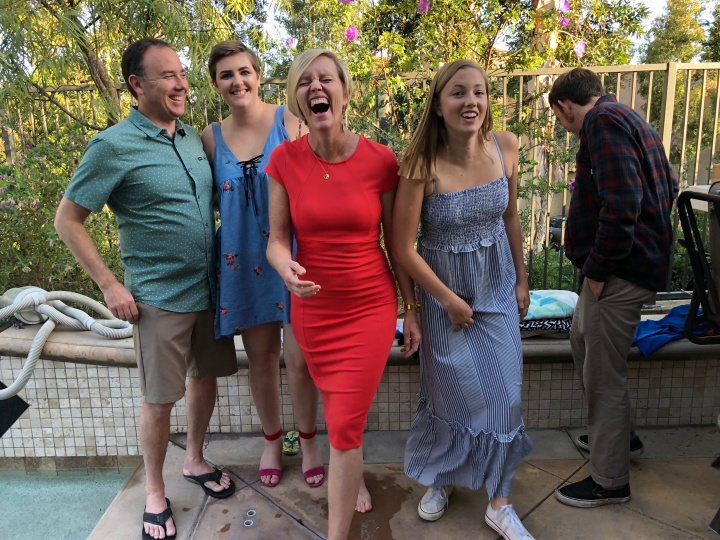
Team Kirks before and after Tim tells a joke 

IMG_1464