As you can probably tell from my lack of posts, this Lenten season has not been a particularly devout one for me. The week before Lent was a blur after Molly’s surgery and Ash Wednesday coincided with her re-admittance to the hospital. The day made no impression on me until late that evening when a hospital chaplain stopped by and offered to pray with us and offer us ashes. Tim and I accepted gratefully, but when Molly indicated she wanted them, I almost knocked the bowl from the chaplain’s hands. Something deep inside me was repulsed by the thought of marking the body of my suffering child with a sign of her mortality. It seemed morbid and inappropriate, but I let it pass and it did Molly no harm. Still, it wasn’t an auspicious beginning to the season.

The next day, however, something my former pastor Nancy Corran preached to our community came back to me. She said, “If your life is a Lent this year, if you are suffering in a desert already – physically, mentally, emotionally, financially – whatever it is, don’t feel like you have to pile more on. Let your life be your Lent and let God Love you through it.” Those were some of the most profound and compassionate words I had ever heard a priest say, but the privilege of my life had always precluded me from taking her up on her offer. This year, however, I decided it was time. My life was Lent enough.

But Holy Week is here and Molly is back at school. She hardly needs any medication and can manage most things on her own. If you weren’t watching closely, you’d never know she was six weeks out from surgery. And so I began to wonder what I had learned during my “life as Lent” experiment. Jesus’ forty days in the desert showed us that a Lenten practice isn’t about a transaction to be completed, but a transformation to be undergone. He went in to the desert a newly baptized man, but emerged a man on a mission. What about me?

While there were no great changes of heart, my sense of mission has deepened this Lent. More than ever, Love is the ground from which I want to ”live and move and have my being.”

Last night, I read the Passion account from the Gospel of Mark and I was struck by the fact that the word “Love” is never mentioned. 1 John 16 may remind us that “God so Loved the world…” but in the eye witness accounts, Love fades away. Instead, fear, betrayal, pain, cruelty, guilt, and abandonment each take their starring turn. Love may be the motivation for Jesus’ actions, but it’s never explicitly stated and if there is one thing I have learned from all my years of study, it’s that we can’t see what we aren’t told to look for and through it all, Love is what we should be looking for. Any time I see a story about Jesus where Love is not mentioned, I know it’s not the whole story and I have to look again. God is Love and so for Jesus to be unloving, or unmotivated by Love was not possible.

Love is what sent Jesus out of the desert ready to serve humanity: Love of God, Love of self, Love of neighbor. They were all one in his heart and mind and it is that Love, that deep internal knowing of perfect relationship that allowed him to walk through the desperate time we call Holy Week. Jesus’ Love is what makes it holy, because he was wholly committed to Loving us and showing us what Divine Love looks like.

This week, it’s so easy to fall into the pattern of worshipping Jesus, for who he was and what he did. But he didn’t ask us to worship him; he asked us to follow him. He didn’t want admirers; he wanted disciples, women and men who were willing to do what he did, however imperfectly, (because that’s the only way we do can anything). Perfection is the enemy of the good and that was never something Jesus wanted to get in our way. We just have to read the post-Resurrection accounts to see that’s true.

I’m not saying we shouldn’t tell the painful and tragic story of Jesus’ death on the cross. I’m not saying we shouldn’t acknowledge our own culpability in his death and ask for forgiveness. I am saying that maybe we could use this Holy Week to try to Love as Jesus did.

On Holy Thursday, how can we humble ourselves before our friends and family as a sign of our Love for them?

On Good Friday, how can we allow ourselves to not need to be right, or defend our positions and reputations?

On Holy Saturday, how can we rest and just let things be as they imperfectly are, instead of rushing to make everything all right already?

On Easter Sunday and every day after, how can we celebrate the truth that death is not the end of the story and that Love conquers all?

Today, I’ll be washing feet. Tomorrow, I’ll be shutting up. Saturday, I’ll be unproductive and Sunday, I will be smiling and singing Alleluia. I hope you’ll join me.

IMG_1508

Here are some of the other posts I’ve written about Lent and Holy Week in year’s past.

“So Long Sad Lent”

“Rethinking Lent”

“The Day Before the Bad Day” 

“It’s Holy Week in Belgium” 


On Saturday morning, I sat down to meditate for the first time in a long time and for the first time in an even longer time, I wanted to sit down and write.

Since Molly’s surgery for scoliosis on February 22, there has been a lot of doing, but not a lot of “sitting,” thinking, writing or anything else really. I have been “in the moment,” instead of worrying about it. And in that way, almost a month had flown by and I found myself wondering where it had gone.

It seems like it just went.

It went into the maze-like halls of the hospital with its fluorescent lighting, and the beeps, whirs and humming sounds that create an otherworldly time and space.

It went into hours of doing simple things that under normal circumstances take only minutes, things like showering, or eating a meal, or going to bed (by which I mean how one spends the night-time hours, not that you actually stay in bed).

It went into days on end of holding hands with a child, who was trying to lose herself in mindless TV, so she wouldn’t have to be present to the pain and anxiety that was present in her body.

It went into afternoons of reading out loud, coloring pictures, telling family stories, listening to music, or imagining the adventure we will go on when all this was over – somewhere warm and sunny and on the water.

In other words, this last month went by just loving Molly Grace.

But finally last Saturday morning, I sat alone, quietly and gratefully, for a full thirty minutes. The house was still asleep; there were no pills to organize, or meals to prepare. There was no place to be. There was just me and a Divine invitation to “be still.”

I sank into my favorite chair with a cup of coffee. From years of habit, my sacred phrase welled up from deep within.

“I am Yours,” my heart sighed and along with it came the reminder, “So is she.”

That was the phrase that came to me, during the long days and nights in the hospital, when I could not stop Molly’s pain, her vomiting, her hot flashes, or her tears. There was no time for formal meditation, but I would find myself sitting at her bedside, breathing deeply and intentionally.

Without a conscious thought, “I am Yours” became “She is Yours.” I would inhale and exhale those words, over and over again: “She is Yours. She is Yours. She is Yours,” a rhythmic prayer of Love and surrender, belonging and grace.

She is not (just) mine. She is not (in any way) alone. She belongs to God and God was holding her more closely in Love than I ever could. But in that prayer of letting go, I also recognized how intimately I was getting to hold on.

stteresaavilaquo


My hands were the ones washing her face, spooning her ice chips, adjusting her pillows. My lips were the ones kissing her forehead as she slept. My voice was the one lulling her to sleep, telling her it was all going to be okay. My heart was the one beating next to hers. What a privilege it was to just be there, Loving her, however the need manifested itself. Though sometimes tired, or scared, or frustrated, my overwhelming emotion was deep, deep gratitude.

We would walk the halls and see children who would be there for weeks and months on end, whose injuries and illnesses were not some temporary disruption from their normal life; it was their normal life. I was grateful we were in the right place for a while and that soon enough, the right place would be home. I was grateful we had such compassionate, gentle nurses there with us and such loving and generous friends and family supporting us nearby.

I can’t tell you how many people were praying for Molly, but I can tell you how much we felt the power of their prayers. We might not have gotten what they asked, or hoped for, but we got exactly what we needed. We felt loved; we felt brave; we had the energy to face the challenges of each day and when we didn’t, we had a soft place to land and a shoulder to cry on. Though we saw only a handful of people in those weeks, we were never alone.

At a difficult time in my life, “I am Yours,” began as a plea to God to not forget me, but it has become a reminder to myself of who and whose I am. When distractions and difficulties arise during my sit (or in my life), “I am Yours” sets me free to return my attention to what I was made for – what we are all made for –to be in Loving relationship.¹ “She is Yours” became my prayer for Molly this past month, but “We are Yours” is my prayer for all of us, not because God has forgotten, but because we have.

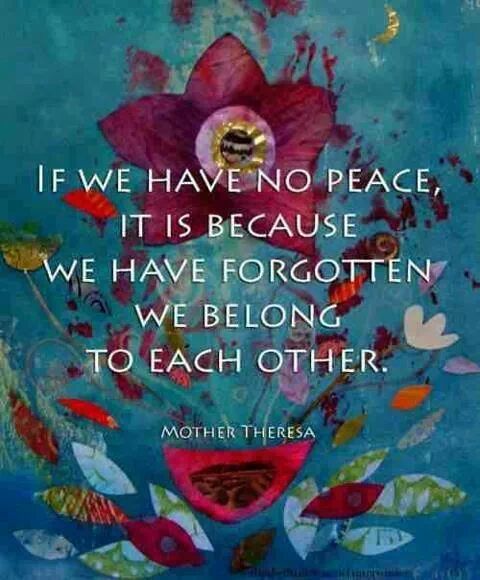
While I was finishing this blog, I heard about the attack in London and it brought to mind the wise words of Mother Theresa: “If we have no peace, it is because we have forgotten that we belong to each other.”

peace1

We are Yours, God, and we are each other’s. Help us to remember.

Amen

  1. My favorite book about the Trinity and how the Divine relationship is the model for all relationship is The Divine Dance by Richard Rohr and Mike Morrell. It’s insightful, accessible and I highly recommend it!

Yesterday was a day for writing love letters, which was convenient, since today is Valentine’s Day. But I don’t mean I was writing obligatory cards. Rather, my heart was just full – full of love and gratitude for a bunch of people in my life. Some of them probably expected to get a card from me, but I imagine at least a half dozen didn’t. I hadn’t written to them before and I don’t know if I will again, but this year, for some reason, I just thought, “I Love them,” so I went ahead and did it.

I think it’s because of the big Love I’m feeling these days for my youngest daughter Molly Grace. In about a week’s time, she will be having surgery to treat scoliosis with a procedure called “spinal tethering.” It’s a couple days in the hospital, followed by a couple weeks at home, followed by a couple months in a back brace. Though it was a difficult decision, we are confident it’s the right plan and that we have the right doctor. Still, as the date approaches, a low-grade anxiety is permeating our home. And when that happens, whenever Fear appears, I try to double down on Love.

Which is why I am so grateful I encountered this yesterday in the center of a book on my nightstand:

FullSizeRender 9.jpg

I don’t remember where I got the card, but I’m glad I kept it. It surfaces every once in a while, seemingly just when I need to be reminded of the Love I need to give or receive myself. In this case, it’s both. I need to help Molly feel ultimately protected, and safe “in the hollow” of my arms, but I also need to trust that I am being held in the same way. We cannot offer to others what we do not have ourselves. So each morning, as I sit in Centering Prayer, I return my attention over and over again to Love, the ultimate source of my existence. I get up knowing that it is the ultimate action I can take, however it manifests itself that day.

It’s pretty easy to know how to Love on Valentine’s Day, a card, a heart, a bunch of flowers, but on other days, those answers aren’t so clear. How can we act in Love when we’re afraid of (and for) the people we encounter, the decisions we make and outcomes that are beyond our control? But today and every day, I try to come back to this:

Fear does not get to have the final word.

Next week, when I watch my girl go into surgery, I know I will be afraid. Fear will be sitting in the waiting room with me, making small talk with Tim and pacing the halls. But I also know we offered ourselves the antidote to that fear when we named her fifteen years ago: Molly Grace.

Grace.

Outpouring Love. Undeserved forgiveness. Divine presence and strength. Inner beauty.

Love stronger than Fear.

Today, Love in a way that is easy and light, but tomorrow, try to Love into a place that has been dominated by fear. You don’t know where it will take you, but I promise it will be better than where you are.

img_2516
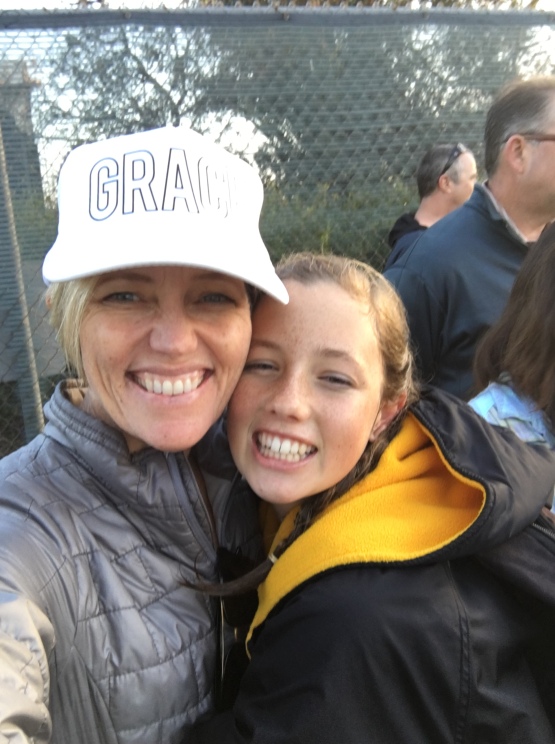
Molly Grace and I at her final water polo game last week. 


It will come as no surprise to most of you that I spent last Saturday morning at the Women’s March. If you were at a march as well, I’d love to hear about your experiences. Where were you? Who did you march with? And finally, the big one: Why did you march?

That’s the question, isn’t it? Why did we march?

While the organizers of the Women’s March on Washington did an excellent job of laying out a positive and comprehensive platform, I think every person participated for their own reasons.

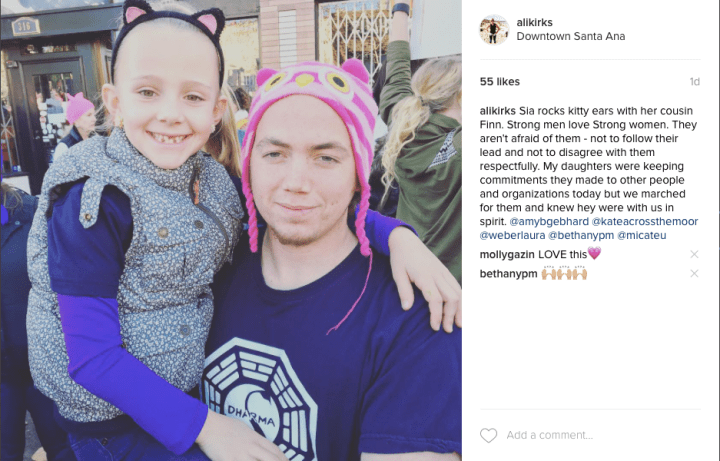
Here are some photos I posted on Instagram that day, where I explained some of mine.

screen-shot-2017-01-23-at-4-05-44-pm

screen-shot-2017-01-23-at-4-05-27-pm

screen-shot-2017-01-23-at-4-04-24-pm

Obviously, I was proud of Finn for rallying with us that day and being such an active participant. I didn’t set out to raise a feminist son, (and he still doesn’t love the title), but his actions speak louder than words.

Here are some other signs, photos and groups I saw and enjoyed that day.

screen-shot-2017-01-26-at-12-29-37-pm


img_2312

screen-shot-2017-01-26-at-8-34-06-am


Here’s part of Tim’s take, which if you follow him on Instagram, you’ve already seen. If you don’t follow him, you probably should.

screen-shot-2017-01-23-at-4-40-27-pm

An armchair quarterback, whom I love and respect deeply, posted this article from The Guardian the day after the march. (I call him an armchair quarterback because he’s really good at critiquing the plays, even when he’s not in the game himself.) The author argued that the organizers and participants in the march need to capitalize on the energy of the event and translate it into concrete goals and actions. Too many rebellions start with a bang and end with a whimper. His point was well made, so a friend immediately shared the 100-Day Action plan supported by the organizers of the march to keep the momentum going.

If you haven’t taken a look at it, especially if you marched, please do. What I most appreciate about Step One – The Sending of Postcards – is that they leave space for each person to fill in what is of greatest concern to them. They are not trying to make a blanket statement, or speak for everyone.

screen-shot-2017-01-23-at-4-44-53-pm

postcard-back

For some, the march was about women’s equality, for others, respect and kindness in our civil dialogue. For many it was about women’s reproductive rights. I saw signs in favor of earth care, the ACA, common sense gun laws, LGBTQ+ rights, Black Lives Matter, respect for science, and Love Wins. I’m not saying Trump is personally against all of those things, but the voting and governing coalition he put together certainly is as a whole. I did see more than a few signs about our new president and his disparaging comments about women and his coalition’s desire roll back women’s healthcare access, but they were by no means the dominant message.

For me, the march was about all of those things and more. That doesn’t mean I agree with every single person in the march, but I wanted to lend my voice, time, body and energy to a movement of women – for women, by women and supported by men.

screen-shot-2017-01-26-at-8-36-17-am
This sign was courtesy of Elizabeth Gilbert on Instagram.

I want women of all ages, colors and faiths to have a bigger seat at decision-making tables, starting with those in their own homes. Don’t tell me they haven’t earned it, aren’t ordained to it, or don’t care enough about it. None of that is true, except through the filter of those who feel threatened by it.

So, onward sisters and brothers of all political persuasions. Stay in relationship with one another. Keep Loving, keep talking, keep trying to find your way to common ground. It may seem further away than ever this week, but I’m not giving up hope and I pray those on the other side of the aisle won’t either.

Post Script:

Over the past week, the Women’s March on Washington has been fetèd and critiqued. I’ve read essays about how wonderful it was, how white it was, how effective it was and yet ultimately, how it won’t change a thing. I don’t pretend to know what the effect of the Women’s March will be on political policy as a whole. I only know what I experienced and how it will play out in the choices I make and those are all good.


news-081516c-lg

Without intending to be a cliché, I took Molly to see Hidden Figures on Monday. Countless friends had said, “See the movie!” reporting reactions that included tears, awe, and pride. As I watched the film, I was entertained and impressed, but I also felt a deep sadness. Maybe it was because we were celebrating Martin Luther King Jr.

Before the movie, I had just read this post by Rachel Held Evans, which pointed out the complacency of much of the white Christian churches during the Civil Rights Movement. (Please don’t point out the exceptions. That’s what we always talk about to make ourselves feel better.) I had also read a comment on my friend Kate’s wall:

“I read this post from Naomi Schulman this morning and haven’t stopped thinking about it: ‘Nice people made the best Nazis. My mom grew up next to them. They got along, refused to make waves, looked the other way when things got ugly and focused on happier things than ‘politics’. They were lovely people who turned their heads as their neighbors were dragged away. You know who weren’t nice people? Resisters.’”

Hidden Figures has lots of “nice” white people in it, but the film makes it clear that they really aren’t that “nice” at all. Kevin Costner’s Mr. Harrison pulls a few dramatic stunts in order to make maximum use of Katherine Goble’s genius mind, but he does it to help NASA, not her, or the black community. Motivated by empathy, a Jewish engineer from Europe encourages the brilliant Mary to continue her education. He knew what it was like to be part of a despised race. But apart from those two men, the “nice” people were simply polite, almost cruelly so.

Though working as a supervisor for almost a year, Dorothy Vaughan is repeatedly denied the title and compensation due to her. Mrs. Mitchell, Dorothy’s white supervisor, washes her hands of the discrepancy, blaming it on slowness of NASA and the inconsistency of the computing work. “What can one do?” she tells her self and Dorothy. Apparently, a lot if one really wants to. The moment Mrs. Mitchell needs Dorothy to have the title and position for the sake of her own white staff, the promotion miraculously occurs.

Someone “helpfully” provides a Colored coffee pot, so that Katherine won’t use theirs and decorum can be preserved. When Katherine needs a bathroom, the only other woman in the room says she doesn’t know where Katherine’s bathroom might be. (It was a half-mile away.) I can imagine she thought: “Well, it’s not my problem. I didn’t make the rules; I’m just following them.” She might have even thought she was being “nice” by implying that Katherine shouldn’t use the White Ladies room, lest she break the law. For the most part, Katherine is ignored by her peers in the space lab. She is a “computer,” brilliant, but nothing more than a woman and a colored one at that.

Hidden Figures prompted me to examine how I have been complacent to and complicit in systems of injustice, but they did it subtly. There was no overt attempt to produce white guilt, but I found myself thinking. When have I been polite, but not helpful? Verbally supportive, but physically inert? How often have I ignored the suffering and difficulties of others that were within my ability to address?

That’s what I found so compelling about Hidden Figures. While other films have dealt with the subject matter of racism, they usually offer a sympathetic white character with whom white audiences can identify. When we can imagine ourselves as one of the “good” people, we can dismiss the others as unlike ourselves. The Help had Emma Stone as Skeeter Phelan and who wouldn’t want to be that courageous, beautiful woman? A Time to Kill had Matthew McConaughey’s sexy Jake Brigance. Selma had the mostly, unnamed freedom riders and clergy. It doesn’t matter the size of the role; our ego will attach to virtually anything that allows us to remain unchallenged. Personally, Hidden Figures offered me no such decoy. Even as the white characters soften towards the women, the recognition of their skill, much less their unique humanity, is far too long in coming.

The talent and backbone of these women is incredible; the support and sacrifice of their families is admirable, but the way we hindered them was unconscionable and that is the message that stays with me today. Please, do go see the film. It’s worth watching. It celebrates hard work, determination, and intelligence. Glass ceilings are broken, while traditional values of family, faith and love are upheld. But when you go, don’t just see the story of these women; be willing to see a story that continues to this day as we struggle to achieve equality for all citizens, no matter their color, creed, gender, or orientation.


screen-shot-2017-01-18-at-12-54-17-pm
Meme courtesy of Djrarela on Instagram.  


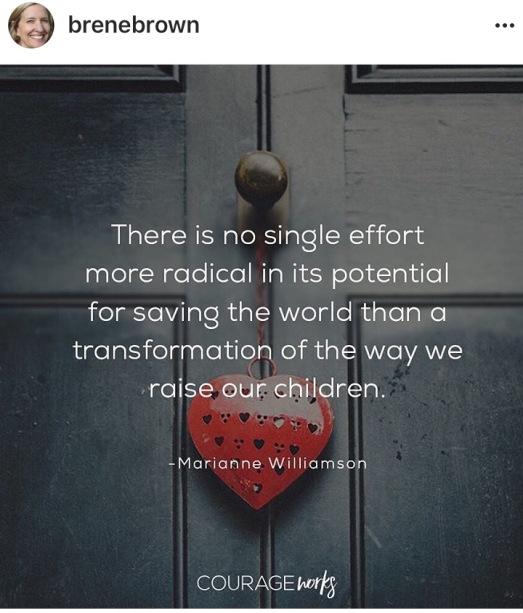
The first week of January, Brene Brown posted this image.


fullsizerender-8

This year, she said, she’s committing a whole lot of her energy to focusing “on how we raise courageous children and build messy, beautiful, wholehearted families.”

Emboldened by the fact that Brene and I have the same thing on our minds to start the new year, I’m going to stay on the parenting topic for another week or two. I hope you don’t mind.

The day after Christmas, I headed up to Mammoth Mountain to go snowboarding with Finn and Molly, Maddie and Nick, my niece and nephew, as well as Jack and JT, two of Finn’s friends I’ve known almost since birth. That’s right – me and six teenagers for four long days – and it was awesome.

On one of those beautiful days, we piled into the gondola and headed to the top. The sun was shining; the snow was light and our spirits were high, right up until a skier, a man in his late fifties, joined our car. He looked around at all of his snowboarding companions and asked, “How high can a snowboarder count?” Without waiting for an answer, he shouted out, “Two, since that’s all that ever get on a chair lift together!” He chuckled to himself – the joke being that snowboarders are stupid.

No one else laughed, but I gave him a small smile anyway, just to be polite.

Apparently it was enough, because he plowed on.

“I’ve got the best story for you,” he said, looking directly at me.

“I was riding on a chair with this couple on snowboards and they told me that they had two kids. These parents taught their kids to ski when they were small, but when the kids were ten or so, they wanted to learn to snowboard. After a couple years, the parents thought it looked like a blast. They learned to snowboard too, so they could hang out with their kids, but as soon as the parents learned, the kids went back to skiing! They wanted nothing to do with the old folks! Anything to get away from the parents, right?” He laughed and repeated again, “Isn’t that the best story?”

I looked at him, and around the car at my own six teenage companions, and said, “Oh, I don’t know about that. I kinda think it’s the best when your kids want to hang out with you. It’s a lot more fun that way.”

That kind of killed the conversation, but we were almost at the top anyway. After enjoying the view, our crew strapped on our boards and were off, hooting and hollering our way down the peak.

But his story stayed with me and got me thinking. Why do people cling to the negative stereotypes about teenagers? Why do they relish stories about dysfunctional relationships between parents and kids? Why do so many people find those narratives satisfying, instead of sad, which is how they always come across to me?

My experience is that teenagers – my own and others – are like everyone else going through a difficult time. They are sensitive and emotional, prone to exuberant highs and tragic lows; they seek support and solace wherever they can find it. Hormonal, social and cultural changes hit teens full force, along with a morass of competing agendas and advice. They have to navigate those transitions mostly on their own. They only have the skills we’ve given them (for good and bad) and the support we offer. But if we haven’t earned their trust, they aren’t going to seek those out very often. Instead, they are going to turn to other sources like their peers, social media and celebrity culture and that just exacerbates the bum rap “kids these days” get.

Here’s another example. A couple weeks ago, Tim told me about a video that many of his friends had shared on Facebook about workplace behavior, and smartphone etiquette and personal relationships. When he asked if I had seen it, I wondered if it was a big rag on Millennials, because that was the video firing up my Facebook feed. No, he said, it’s not bagging on them. It’s about them, but it’s about all of us, really.

Here are the different ways that the video was presented. Guess which one was going to have a greater appeal to my gondola companion?

I had refused to watch the video on the right, though it had popped up on repeatedly, because the title was so insulting to the generation behind me. When Tim showed me the “clean” version on the left, I was glad I watched it, but why do we have to throw kids under the bus to make ourselves feel better?

When I heard that story about those parents, I didn’t know what troubled me more – that their children wanted nothing to do with them, or that the skier thought the story was “the best,” a qualifier he repeated at least six times in the telling. Later that night when I was talking to my dad about it, he mused, “We have no idea the depth of people’s injuries and how it shapes their world view. The sadder part is that they don’t know it either. They think it’s normal.” When separation and rejection are the models you’ve been given for family conflict, stories like that make you gleeful. They confirm your deepest suspicions about what a crock love and family really are. You can’t imagine that disagreements and hurts can be solved with grace, or that forgiveness and generosity really are assets in any situation.

But that woundedness doesn’t stop with family life. No matter what the subject is – relationships, religion, economics, politics, education – few of us can admit that our deepest assumptions about life and human nature might be flawed, a result of our own limited experiences. It’s painful to concede that a different approach might lead to a better outcome. It’s even more painful to consider that by clinging to those assumptions, instead of shedding them for healthier perspectives, we’ve created much of the pain in our own lives.

I wish that man hadn’t gotten into the gondola with us that day. Before he hopped in, there was laughter, storytelling and selfie-taking. After his clueless contributions, there was awkwardness and impatience, but he did teach me a lesson, (besides reminding me to read my audience better.) When I am feeling cynical about a group of people, or unhappy with a set of circumstances, I need to check my assumptions, and look for the bigger picture. Who am I judging and do I know the whole story? What part have I played in creating the mess? And besides critiquing it, how can I make it better?

Which brings me right back to parenting, especially parenting teens and my last blog. I took it as a huge compliment that all those kids spent all that time with me, but I think it goes back to what I talked about in the Contemplify podcast about being conscious of your own projections and expectations. If you haven’t been able to give it a listen, I hope you will.

Contemplify: Episode 17: Alison Kirkpatrick on Conscious Parenting and Mark Longhurst on The Brothers Karamazov 

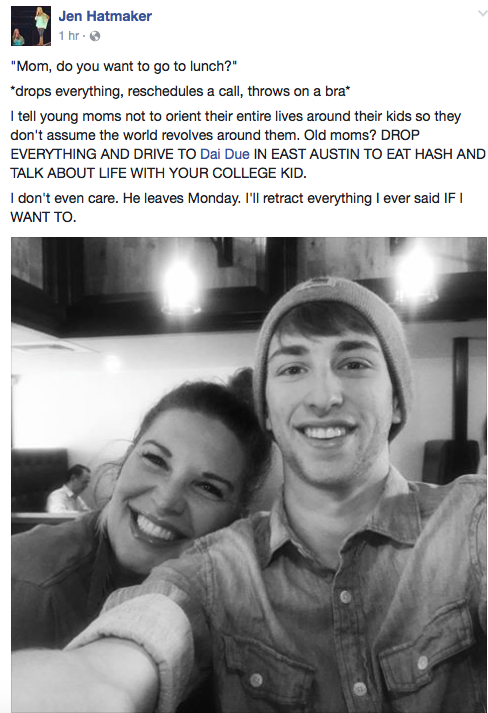
Just today, as I was working on this post, Jen Hatmaker, author, speaker and extraordinary mother, posted this status update on Facebook.

Amen, sister!

screen-shot-2017-01-12-at-1-02-31-pm


In these early days of January, most of us have made resolutions for the year ahead. Some will last weeks or months, while others have petered out already. But every once in a while, we make a resolution that lasts a lifetime. However, those changes don’t usually start on January 1. Those types of transformations require a clarity and conviction rarely available to us in our post-holiday haze.

More often, it is in moments of crisis (though sometimes just out of the blue) that we have a vision of how things might be different, how we ourselves might be different, and how that difference just might change everything. And suddenly, more than anything, we want that change. We want to be that change. Suddenly, that resolution isn’t something we have to do anymore; it’s something we can’t help but do. We are resolved, no matter how difficult it is, or what the task asks of us. We change our habits and our way of operating in the world. We fail repeatedly, but we don’t give up. The vision of what’s possible holds us fast, because it really is that good.

In the course of my life, only a few resolutions have taken hold of me in this way, but I’m grateful for each and every one of them.

  • There was the resolve to become a birth mother, 26 years ago this month.
  • Marrying Tim, 23 years ago.
  • Becoming a Weight Watcher, 6 years, 2 kids and 20 pounds later.
  • Joining the YMCA, 10 years ago.
  • Writing as a spiritual practice and starting this blog, 9 and 5 years ago respectively.

screen-shot-2017-01-05-at-8-40-57-amLast month, I had a chance to talk about one of these resolutions (or “course-corrections” as I think of them) on the podcast Contemplify. Paul Swanson, the host, asked me to reflect on a book that had significantly impacted my spiritual journey. I immediately went to my list of “greats” – Merton, Rohr, D’Arcy, Keating, Bell, Bourgeault – the people I have read over and over again. But no one book had inspired the type of metanoia, or complete and total shift that I was looking for. Though they have re-shaped the contours of my heart, their influence has been steady and incremental, more than seismic.

And then I remembered the last big resolution I made and the book that inspired it. In the spring of 2013, I came across The Conscious Parent by Dr. Shefali Tsabary. Keara had just turned sixteen years old and I was so far from the being the mom I wanted (and she needed me) to be. For all my spiritual work, my daily disciplines and practices, I had been blind to how I was failing to truly love the person (and all the little people in my home) who needed my love the most. I was loving them to the best of my ability, which is to say, not nearly enough. In that moment, I resolved to love them better, more fully and consciously.

It is a resolution I am still committed to, though I fail to keep it each and every day. My hope is that my kids see me trying and that the effort itself will inspire the grace and forgiveness we’ll need to grow old together in love.

That’s all I’ll say here about the resolution, because I hope you’ll tune in to the podcast. If you’re a parent, grandparent, or even have a few “parent issues” you’re still working out, I think you’ll find the podcast interesting and maybe even inspire you to check out the book!

You can download the episode on Itunes. It can be found under Contemplify, Epidsode 17.

Or listen at Contemplify.com.

Episode 17: Voicemails – Alison Kirkpatrick on The Conscious Parent

Few of you have had a chance to listen to my voice, or seen me speak in person, so I hope you’ll enjoy the alternate experience!


khalil-gibran-quotes-9-1024x746

“Get up! Go into the world and live in the flow of Love. Forgive, show mercy, be compassionate, care for the poor, tend to the earth as family; find your inner wholeness in the Love of God, and create new wholes in your midst, in your communities, your workplaces, at shopping malls, and jazz fests. Live in the energy of the Spirit; let yourself be led…. Stop playing with your toys, your electronic gadgets… Do not lose yourself to consumer products that blind your vision, or distract your attention from the whole. Get up because you are too old to be asleep… Grow up because it is time to move on. The world is begging for new and more abundant life. The life of the world is your life, and your life belongs to the whole of Life. Stop trying to preserve yourself; lose yourself in something more than yourself…Live to the point of tears and don’t be saddened by sin, misunderstanding, weakness, and hate. Omega Love [God] is in our midst, and this Love is our power, our hope and our future. Remain in this Love…Be the co-creator you are made to be; emblazon the world with the grandeur of God.”

Ilia Delio

Okay, admittedly, it might take me a little longer than this Advent season to live into this call, but as I wrapped up Ilia Delio’s brilliant Making All Things New: Catholicty, Cosmology, Consicousness this past week, I knew I had found my marching orders for 2017 and beyond.

In the face of so much division and adversity in our nation, it can feel overwhelming to figure out, “What is mine to do?” the question I asked last month. But that’s what I love about Delio’s list. Anything that takes you out of your comfort zone and adds Love, life, energy, goodness and wholeness (understood as healing and holiness) to the world is yours to do! The only thing we can’t do is shrug our shoulders and go on with business as usual. Delio’s exhortation reminds me of Joan Chittister’s response to people who ask her what they should do to make the world a better place. “Do something!” she pleads.

It’s as simple and as difficult as that.

This season, if you are waiting in expectant hope for something new or better to come along, keep this call in mind. Print it out. Tape it on your bathroom mirror. Stick it over your coffee maker, or tea kettle. Read it every morning. Reflect on it every night and realize:

We are the something better we’ve been waiting for.

Merry Christmas! Happy Hanukah! Joyous Kwanzaa to you, my dear friends! And if none of those apply, Happy Holidays! I wish you an abundance of whatever it is that warms your heart, tickles your fancy, fills you with gratitude, and encourages you to start anew.

f5205ef9a91f49fd5b4123ee87d0428f
Image from Amnesty International Christmas cards, 2016


elephant-modern-illustration-free-vector-jpg-graphic-cave-1080x628
Image courtesy of GraphicCave.com

This election cycle has brought to mind a classic parable. I’ll share a version from the poet Rumi, translated by Coleman Barks.

Some Hindus have an elephant to show.

No one here has ever seen an elephant.

They bring it in at night to a dark room.

One by one, we go in the dark and come out

Saying how we experience the animal.

One of us happens to touch the trunk

A water-pipe kind of creature.

Another, the ear. A very strong, always moving

Back and forth, fan-animal. Another, the leg.

I find it still, like a column on a temple.

Another touches the curved back,

A leathery throne. Another, the cleverest,

Feels the tusk. A rounded sword made of porcelain.

He is proud of his description.

Each of us touches one place

And understands the whole in that way.

The palm and the fingers feeling in the dark

Are how the senses explore the reality of the elephant.

If each of us held a candle there

And if we went in together, we could see it.

Politics is always about the part of the elephant you’re touching, but Rumi’s description is particularly apt this election season. A friend commented on my last blog: “We know what we know. We know what we don’t know. The problem is that we don’t know what we don’t know.” We may be humble enough to admit a lack of expertise in a few areas,  but we generally can’t imagine the vast expanse of our own ignorance.

We get ourselves into trouble when we believe our own frame of reference is the only one and fill in the blanks with our own assumptions instead of using our collective knowledge to get a bigger picture. He pointed out the trouble, but like the rest of us, he isn’t exempt. We all do it – in our politics and personal lives. Listening and empathizing with another person’s perspective and pain is one of the most courageous and difficult actions we can take as human beings.

Sometimes, our part of the elephant is the only one we’re willing to touch. And that’s okay – for a while, maybe even a long while – but eventually, if we want to make progress as a family, community, or nation, we’re going to have to enter the darkness with our shared light. Think of it as “group enlightenment.” Entering that space together, we’ll no longer be 100% right, but we will have fuller understanding of reality.

Another friend posed the question: “Will America stop listening to the media and start listening to each other?” I don’t know. I hope so, since it’s the only way forward, but I think it’s way too soon for a lot of people who are deeply wounded and defended on both sides. If a respectful conversation isn’t possible this holiday season, maybe it’s okay to take a year off. So much still needs to come to light, from within and without.

Where are you finding light these days and how are you manifesting that light in the world?

Some people are really good at being spotlights, pointing out what needs to be seen. Some are blowtorches, using their heat to skillfully craft something new. Unfortunately, too many of us are still forest fires, burning out of control, destroying everything in our path. But all is not lost! Even forest fires make way for new life in the spring.

I don’t know what kind of light I am. I just know I am called to return again and again to the source of Divine Light. I found one call to action from a wisdom teacher Matthew Wright especially helpful.

Listen deeply, friends. I am no fan of militaristic metaphors used for the spiritual life. Nevertheless, a battle is coming, and is now here. Our weapons are light (sharp, clear-seeing), love (non-judging, compassionate awareness), resistance (refusing to fall backwards into complacency, instead joining the forward movement of evolution on its messy way through struggle and pain), and relationship (holding our hearts open–within our capacity–so as to allow for authentic connection, born of deep and vulnerable listening). As Jesus constantly says in the Gospels – be sober, be vigilant, be watchful. But do not fear.


Light.

Love.

Resistance.

Relationship.

Courage.

Pick up your “weapons,” friends and enemies alike, because if we commit to fight with these in our arsenal, we will find ourselves on the same side of the battle more often than not.

c06092da549a740b19bc094bd8589b3b
Poetry is a constant source of light these days. This quote is from Ranier Maria Rilke and is currently up on our family quote wall.  


I’ve been pretty quiet here the last week. I started quiet, because I didn’t want to add my voice to the post-election cacophony. So many good and powerful and true things were being said. For the first few days, I felt what was mine to feel, but I didn’t feel the need to share it with the public. I’m grateful, however, for all the people who did, including two men I love.

My husband spoke up, and I was proud of him. Tim Kirkpatrick is a man who feels things deeply and I have a ton of respect for men like him, who are willing to express their vulnerability, especially when those emotions include a deep compassion for “the other.” A couple months ago, when the election was heating up, he started posting a series of funny, 30-second videos of him singing (badly) and riffing on all things from surfing to business to comedy. This last week, however, he stopped joking and posted some more somber reflections on the election outcome. Here is a link to his two most recent posts: “Tracks of My Tears” and “Sunday Bloody Sunday.”

But there was a new voice too, one that hasn’t spoken up before and I am very proud of him too. My son Finn posted this commentary on Facebook on Wednesday night. (He asked permission to correct the grammar and add a couple lines).

I’m new to politics. And historically speaking this is weird place to join the convo. However, I thought I’d share this clip about Trump talking about the “good old days.” He says he loved the days when protestors would be “taken off on a stretcher.” This clip is showing footage from Civil Rights movement protestors (Brown vs Board of Education and more) and then modern-day protestors. He encouraged others to inflict harm on protestors of today. This clip made me sad. Yes, I know this clip comes from a documentary with an agenda. What documentary these days doesn’t? Yes, it was intended to make Trump look bad. Still, it has some truth to it.

This clip comes from the documentary, 13th, a doc about the mass incarceration of black men in America. They cover how little progress has really been made. First, the US had slavery. Then we had Jim Crow laws. Now we have a mass incarciration of black men. When the 13th Amendment was passed, it banned slavery, with the exception of crime, so then they just made them criminals. More and more laws were made to get more and more people in jail. Now the prison system is another example of institutional racism. It’s hard for me to explain. Anyways just watch the doc on Netflix; it will blow your mind/ reassure you how corrupt our whole political system is.

But back to Trump. This made me sad, sad for all of those who Trump has diminished and put in harm’s way with his words (shown in the video). Sad for my sister and the rest of the LGBTQ+ community, for the minorities and all who Trump has already put in harm’s way. Most of my friends, being Trump supporters, tell me that he doesn’t mean what he’s saying, or that we need to give him a chance. But as far as I’m concerned, whether or not Trump believes his rhetoric, it still empowers other groups take action. And give him a chance? …Yeah, we should forget everything he’s said.  But I am still hopeful for the future. If you actually read this, thanks for listening; hopefully it makes sense.

I had originally embedded the clip in this post, but I am trying to be aware of adding more violent rhetoric to the atmosphere these days. However, it is a powerful statement on the impact of Trump’s language on his supporters. If you are able to watch, or interested, you can find the clip HERE.

As a newly registered Independent voter, Finn’s observations aren’t tied to a political party. It isn’t about being a Republican, or Democrat. It’s about how one young man is trying to keep his eyes open, and share what he sees with others. It’s what he does as a photographer and a budding film-maker as well. Most of his friends are Trump supporters, but he had the courage to speak up, to show them what he sees when he sees them wearing their “Make America Great Again” hats.

My heart broke a hundred times this week, beginning on Election night when I got this text from Keara:

img_1715

More than anything, I wanted to hold her in my arms and tell her it was all going to be okay, but I couldn’t, because I just don’t know. Trump has flip-flopped on his LGBTQ+ stance. I know that. He hasn’t been openly hostile to the gay community, and yes, he has even appointed a gay cabinet member, but Pence has consistently worked to disenfranchise, disrespect and demonize the gay community for decades. For many Trump supporters, putting the gay community “back in its place” was a huge part of the appeal. Ultimately, I believe it will be okay, but the long view wasn’t what Keara was looking for. I had to let her feel what she feels, but a week later, I have to help her look for hope.

In the aftermath of this election, I’ve frequently thought of Mister Roger’s mom. When something scary was happening, she would tell him: “Look for the helpers. You will always find people who are helping.”

That is what I’ve been doing this past week. I’ve been looking for helpers: those who could help me grieve, those who could help understand and those who could help me move forward.

The first category was amply supported by my husband, my sister, many friends, my Facebook feed, and late night talk show hosts. Lots of people out there are feeling my pain.

The second category was assisted in part by this article on Cracked by David Wong and this interview with Michael Moore on Morning Joe. I actually have a much deeper understanding and compassion for Americans in deep poverty, who have been asking for attention and assistance for decades, only to be ignored by both parties year after year, despite campaign promises. This vote was the biggest “F*ck You!” to Washington they could muster. If it f*cked over a lot of other Americans, so be it. It was still their best shot to be heard once and for all. The Michigan vote, home to Flint, the filthiest water in America, makes more sense now.

The third category, the one that inspired me to write today, was this TED talk by Jonathon Haidt. No matter whom you voted for, I highly recommend you watch it. Today. Multiple times. It could be critical to the success of your holiday season and maintaining future relationships with family members, even though they voted differently than you.

It was given a serious boost by this hour-long conversation between Rob Bell and philosopher Pete Rollins. Like Haidt, they are progressives, but balanced. They don’t demonize “the other” and they offered me a larger framework for what’s happening in America right now and how we can move forward. As a side note, Pete grew up in Belfast during The Troubles, so this isn’t just an academic exercise for him.

I could probably stop now, and maybe I should, but I’m going to push my luck.

While I started off quiet to allow other voices to speak, I’ve stayed quiet, because I couldn’t write anything that wasn’t a lament, or a tirade, and there are plenty of those out there already. I have several unpublished essays where I go from being vulnerable and centered to angry and raging. While that may be how I feel, I’m pretty sure it’s not helpful.

Screen Shot 2016-11-14 at 7.26.17 PM.png

I was amazed with Liz Gilbert’s ability to immediately focus on what she needed to do, asking “Who Do I Want to be in this Situation?”

I was impressed with Glennon Doyle Melton’s call to action.

While these ladies were out there encouraging the world, I was at home in a fetal position. I’m not finished crying yet, but this is what I have to offer as of today. Some tirade, some lament, some progress, hopefully.

I’ve heard a lot about the “echo chamber” the progressive elites were sitting in during this election and I’ll admit, I was there. But I will counter that many Trump supporters have been sitting in their “echo chamber” for the last eight years, watching Fox news and reading Breitbart, as blissfully unaware of the alternative point of view as we were. In our “echo chambers,” we are ignorant of each other’s pain and fear, (which we always cover over with righteous anger) and it is easy to assume the worst.

The clip Finn shared is a glimpse into the progressive “echo chamber.” If you haven’t yet, please take a moment to watch it, especially if you’ve been sitting in the other one (and if you aren’t deeply concerned by this election outcome, you haven’t been in my “chamber.”) We are all – every single one of us – in some “chamber,” breathing the air of our own confirmation bias. It makes us human, but not as wise as we could be.

For all of you who voted for Trump, who said it was about the economy for you, Hillary’s past, the need for change, or the “sanctity of life,” know that for a fair part of Trump’s base, it wasn’t just, or only about those things. It was about this! THIS is what fired them up and what they hope to see more of in a Trump presidency. It may, or may not happen on a policy level, but it is already happening on the streets and Trump, their candidate, told them it was okay. In this video, in his own voice, he waxed nostalgic for it.

If you don’t believe me, look at the feed of Shaun King who is collecting data and reports about these types of incidents. If a millennial civil rights activist isn’t a reliable source for you, here is Dan Rather on the subject. And if you don’t trust him either, look for the honest reporting of it in your own go-to news sources. If it isn’t there, know that your “echo chamber” is alive and well. (And yes, I have seen at least one video of it going the other way. I have also sought out inflammatory videos about Hillary, so I could experience the other echo. I am trying to do my homework.)

If you are a part of my life, I believe your vote wasn’t about this. I know you aren’t supportive of this type of behavior or rhetoric. I believe you aren’t racist, or homophobic, or xenophobic. You wouldn’t be part of my life if you were. A few of you have even reached out to reassure Kiko of your support. I trust that you want justice to prevail for ALL Americans.

But know that if you wear your victory on your sleeve, this is part of what you are clothed in, along with misogyny and a whole host of other qualities that I know you do not teach your children. You wouldn’t tolerate Trump’s behavior in a classroom teacher, or even a volunteer soccer coach. I KNOW you. I’ve seen you speak up and activate for your own kids. Trump would be fired the first time he made a comment about your daughter’s performance based on his impression that she was “bleeding out of her you know, whatever.” But we didn’t fire him; we hired him.

So if your child is spouting Trump’s rhetoric, or rocking a “Make America Great Again” hat, perhaps you could talk to them about all that it implies. Show them the video clip (and the one where Trump talks about grabbing a woman by the p*ssy) and encourage them to make a statement about what you (and presumably he, or she) actually stand for – an end to the insider’s hold on Washington, an end to abortion, a more conservative immigration plan, a business man in the White House? Whatever it is, don’t offer Trump a blank check to speak for you.

And this is where I want to be clear about my own culpability.

Every time I raise my hand to point a finger at you, three fingers are pointing back at me. I know that. There’s a good chance  you see me in the same way.

I know my support of HRC was incomprehensible to many Americans, especially people who share my faith. I imagine you see me clothed in her sins as well. So let me be clear, as I am asking you to be. I did not support all of her policies. I am fully aware of the many unethical choices she’s made over the course of her thirty-year political career. I may be sporting a whole host of obnoxious sartorial choices you find unfair, and unfaithful. She would not have been my first, second, or even third choice for a president, but against Donald Trump, she was my ONLY choice.

I will wear a pantsuit and hold my head up high if that’s what it takes to say that women, the disabled, the immigrant, and the oppressed be treated fairly, with dignity and due process. Hillary’s sins were many, but mostly politics-as-usual as far as I’m concerned, ones that men have used for centuries to get ahead. The corruption of the DNC was despicable and their inability to grasp the consequences of their actions in real time contributed to a truly horrific outcome for all Americans. I wear it all, not with pride but with humility, conscious of the fallibility of the candidate and our political process.

I’m pointing my three fingers back at me. I KNOW what was wrong with my candidate and many of her positions, but Trump’s character, actions, standards and campaign rhetoric are beyond the pale for me. There was no formula by which I could have voted for anyone else but the one woman who could have beaten him, who did in fact beat him in the popular vote.

You can call me a hypocrite, a sore loser, a false Christian. I don’t know; I may be all those things, but I’m also an American and at the moment, I’m heartbroken and concerned about the safety and civil rights of my fellow citizens. Even if the system works, and the Trump/Pence ticket is limited by the checks and balances of Congress and the Supreme Court, I am disappointed for my daughters, that they heard again at the largest scale possible that men can say and do whatever they want to women and get away with it, as long as they have enough power, money, or charisma.

Donald Trump is my president. I support the demonstrations that are happening around the country as a protest against his campaign strategies, but not against his rightfully won position. I condemn the violence and awful, inflammatory statements made by some protestors. I absolutely believe in our election process and the peaceful transition of power. I am extremely proud of the way both Secretary Clinton conceded the race and President Obama began the transition. In fact, I am blown away by Elizabeth Warren and her clear offer to work with Trump on many of his election platforms. You can read it here. They are true politicians, and I mean that in the nicest way, and I didn’t even know it had a nice way. Even Trump has sounded presidential a few times since the election, civil and conciliatory. If he keeps it up,  disavows his earlier rhetoric and condemns the violence it has spawned, that hope we so desperately need just might rise.


This was a really difficult essay for me to post. I SO wanted to get to a place of total peace and acceptance before I published anything, something like the Dalai Lama. If nothing else, this election has truly humbled me, showing me how much work I have to do to become the person of peace and unity and Love I want to be. But people have told me many times over the past week that they have reread my last post and asking themselves, “What is mine to do?” So, finally, I came to terms with this essay.

This is mine to do: to grieve, to educate myself, to share my process, honestly and with as much Love as I can muster. I am hoping this essay helps you do a little bit of that too. I know this has been a long post, with a lot of additional information, so I appreciate it if you made it to the end.