Screen Shot 2018-04-16 at 3.01.53 PM
Keara Moses

“She Walks in Beauty”

I.
She walks in beauty, like the night
Of cloudless climes and starry skies;
And all that’s best of dark and bright
Meet in her aspect and her eyes:
Thus mellowed to that tender light
Which heaven to gaudy day denies.
II.
One shade the more, one ray the less,
Had half impaired the nameless grace
Which waves in every raven tress,
Or softly lightens o’er her face;
Where thoughts serenely sweet express
How pure, how dear their dwelling place.
III.
And on that cheek, and o’er that brow,
So soft, so calm, yet eloquent,
The smiles that win, the tints that glow,
But tell of days in goodness spent,
A mind at peace with all below,
A heart whose love is innocent!
Lord Byron (1788- 1824) was one of the premiere poets of the Romantic era. If you’ve never heard of him, you probably studied his more staid contemporaries, like Wordsworth, “Lines Composed Above Tintern Abbey,”  or Coleridge, “Kubla Kahn.  However, Byron was wildly popular in his day, both as a man and a poet. He was wealthy, handsome, defiant, and in some ways the embodiment of what would become known as the “Byronic hero,” which still pops up in television, film and literature to this day.
This is a classic love poem from that period, which we rarely see the likes of any more. Rhyme schemes, especially simplistic ones like we see here (ababab), have gone out of style, so it might sound strange to our modern ears. Also in classic fashion, the author overstates the perfection of his beloved. In each stanza, he heaps on more praise that can’t possibly be true. A pure dwelling place? A mind at peace with all below?  It’s over the top, right, so why include it?
Call me sentimental, I guess.
I fell in love with Byron’s work when I was a teenager, fresh out of high school and newly immersed in great literature as an English major. I had a fantasy of finding my own Romantic hero someday and this poem was the epitome of tenderness and devotion I hoped one day would come to me. While I did find my hero shortly thereafter, he wasn’t one for poetry, but I knew he loved me better than a man like Lord Byron ever could, who would have taken this perfect creature and left her a disgraced and fallen woman. That was his more likely pattern.
But this poem has always stayed with me and when it came time for Keara’s senior high school yearbook page, I was able to use the first lines to honor her:
She walks in beauty like the night
Of cloudless climes and starry skies;
And all that’s best of dark and bright
Meet in her aspect and her eyes:

kneeling-francis-product

“God Would Kneel Down”

I think God might be a little prejudiced.
For once He asked me to join Him on a walk
Through this world,
 
And we gazed into every heart on this earth,
And I noticed he lingered a little bit longer
Before any face that was
weeping,
 
and before any eyes that were
laughing,
 
and sometimes when we passed
a soul in worship
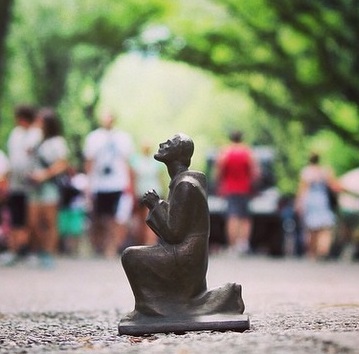
God too would kneel
down.
 
I have come to learn: God
Adores His
Creation.
 
St. Francis of Assisi, translated by Daniel Ladinsky in Love Poems from God. St. Francis did not write formal poetry, but in Ladinsky’s collection, he translates spiritual masters and mystics across centuries, cultures and faiths, and reframes their prose as poetry.
St. Francis came from a very wealthy family, and early on, enjoyed that wealth, but when he was a young man, he had a radical vision from God and it completely reoriented the trajectory of his life. He famously and sincerely became a disciple of Jesus, aligning himself with the poor and those marginalized by society. Rather than becoming a hermit, or an outcast himself, hundreds of young people were inspired to follow him and his ways. To this day, Franciscans are a charismatic and powerful order that works hard for the “least of these.”

wave-photography-ray-collins-30__880
Photo by Ray Collins

“Belly Song”

1.

And I and I / must admit

that the sea in you

   has sung / to the sea / in me

and I and I / must admit

that the sea in me

  has fallen / in love

  with the sea in you

because you have made something

out of the sea  

that nearly swallowed you

And this poem

This poem

This poem / I give / to you.

This poem is a song / I sing / I sing / to you

from the bottom

   of the sea

     in my belly

This poem / is a song / about FEELINGS

about the Bone of feeling

about the Stone of feeling

  And the Feather of feeling


4.

And now—in my 40th year

  I have come here

to this House of Feelings

to this Singing Sea

and I and I / must admit

that the sea in me

  has fallen / in love

with the sea in you

because the sea

that now sings / in you  

is the same sea

that nearly swallowed you—

  and me too.


Etheridge Knight was an African-American poet, born in 1931. He fought in the Korean war and was badly wounded. When he came home, he began to use drugs and was sent to prison for armed robbery.  He wrote: “I died in Korea from a shrapnel wound and narcotics resurrected me. I died in 1960 from a prison sentence and poetry brought me back to life.”


This morning, I woke with a little bit of dread, knowing the amount of work I wanted to get done. It involved a lot of cleaning, organizing, responding, reacting, writing, etc. It did not involve a lot of fun. I’m not going to lie; I was a little grouchy.

And then the sun was shining and the surf was pumping and Tim and Molly were packing up to go.  Come with us, they asked. I declined. Come on, Molly said, tugging on my hand. We’re “fish people,” remember? they said, so I went. It’s totally thrown me off my game and I’ve been way less productive than I wanted to be, but there is always tomorrow…

This week, we watched Fish People, a beautiful documentary on Netflix about people who love the sea: divers, swimmers, surfers and artists. Though old and young, male and female from around the world, they all shared a deep connection with the ocean. In the water, they found beauty, peace, wisdom, space, sustenance. In short, in the sea, they found themselves and they found themselves at home.

The Kirkpatricks relate. In times of stress, sadness, grief, worry, romance, celebration, joy, or boredom,  the five of us head to the shore, together, individually, or with friends. Sometimes, just seeing the water is enough, but other times, a full-immersion experience is necessary to heal our minds and rejuvenate our souls. The sand, the salt, the smell, the sensations, the silence, the swell, the soul of the sea.

And so this is a love poem for my family, and all the other “fish people” out there.

The sea in me will always love the sea in you.


P.S. In all honesty, this is not actually a love poem in the sense that I’ve used it. My interpretation is a classic case of cultural appropriation, or “fake news.” Knight wrote the poem to the Daytop Family program that helped him recover from drug addiction in 1970. I excerpted the first and last stanzas, but want to honor the integrity of the whole poem by offering you a link here. 


a885f0125020ee133b9250aeb1bddd0e

“Your Mother and My Mother”

Fear is the cheapest room in the house.

I would like to see you living

In better conditions,


For your mother and my mother

Were friends.


I know the Innkeeper

In this part of the universe.

Get some rest tonight,

Come to my verse again tomorrow,

We’ll go speak to the Friend together.


I should not make any promises right now,

But I know if you

Pray

Somewhere in this world –

Something good will happen.


God wants to see

More love and playfulness in your eyes

For that is your greatest witness to Him.


Your soul and my soul

Once sat in the Beloved’s womb

Playing footsie.


Your heart and my heart

Are very, very old

Friends.


It’s hard to believe that I made it thirteen days before I introduced a poem by Hafiz, the masterful, 14th century Persian poet and Sufi mystic. I knew once I started I would never want to stop. Thirty days of Hafiz would be a pleasure for me.

Hafiz can make me laugh and cry, feel totally understood and totally bewildered, but never, never bored. The Gift, a collection of his poetry translated by Daniel Ladinsky, is my frequent companion. It sits on my bedside table and goes on just about every trip I do, dog-eared, penciled, highlighted, and full of mementoes from various locations. Hafiz’s mystical playfulness resonates deeply with me; I am always looking for a way to joy,  to fun and laughter, to companionship with the people around me and with God. I love how Hafiz refers to God as “Beloved” and “Friend, “and calls his readers by those names as well. We’re all in this together his poems seem to say.

In this poem, I love how Hafiz portrays himself as an ancient real estate broker, looking out for a special client who has fallen upon hard times. (Who among us hasn’t?) “Fear” has become their habitat and Hafiz can’t bear to see it and is confident God will feel likewise. We cannot “witness” when we are in fear, rather only when “love and playfulness” radiate from our eyes. Can we trust Hafiz to get us relocated? I think so; after all, our souls once played footsie in the “Beloved’s womb.” Having just seen pictures of a friend’s newborn baby, I can honestly say, I believe that’s exactly where she came from.

Something that might be missed in a quick reading of the poem is the line that Hafiz delivers, almost sotto voce, a little secret about prayer: “If you/ Pray/ Somewhere in this world –/ Something good will happen.” In these little lines, in the middle of this little poem, he upends everything we’ve been taught about prayer and at the same time, redeems it. From our very first moments, we are taught petitionary prayer, to ask for things, or for things to happen. Inevitably, we are disappointed when they don’t, but what if our prayers were answered, somewhere and for someone? What if the energy, intention, love, devotion and faithfulness we put into our prayers enter the Divine womb to heal and help in ways we never know about?

That’s what my friend, Hafiz, does so well: offer encouragement, wisdom, compassion and love, each and every time.


8551_1

“Keeping Quiet”

Now we will count to twelve
and we will all keep still.

For once on the face of the earth,
let’s not speak in any language;
let’s stop for one second,
and not move our arms so much.

It would be an exotic moment
without rush, without engines;
we would all be together
in a sudden strangeness.

Fisherman in the cold sea
would not harm whales
and the man gathering salt
would not look at his hurt hands.

Those who prepare green wars,
wars with gas, wars with fire,
victories with no survivors,
would put on clean clothes
and walk about with their brothers
in the shade, doing nothing.

What I want should not be confused
with total inactivity.
Life is what it is about;
I want no truck with death.

If we were not so single-minded
about keeping our lives moving,
and for once could do nothing,
perhaps a huge silence
might interrupt this sadness
of never understanding ourselves
and of threatening ourselves with death.
Perhaps the earth can teach us
as when everything seems dead
and later proves to be alive.

Now I’ll count up to twelve
and you keep quiet and I will go.


Pablo Neruda was a 20th century Chilean poet, diplomat and Nobel Prize winner. He is most famous for his love poetry, but was deeply involved in politics as well.

Instead of spreading out the two poems about war and peace, I wanted to join O’Tuama’s poem with Neruda’s. One counts the cost of violence; one offers a solution. It may be a fantastic one we are tempted to scoff at, but still, he creates an inviting picture of what the world might look like if we simply went silent together. A count of twelve? It’s a place to start. Would it accomplish anything? I don’t know, but I wouldn’t dismiss it out of hand. It’s never been done. Who knows how it might affect our global consciousness to have all 7 billion of us make a choice to be at peace for a period of time, however brief?

But I will move away from the “woo woo” aspect of the poem and get to the nitty-gritty of it, because eventually Neruda does get to the root of the problem, the cause of the violence, war, and aggression that haunts our world. Perhaps” If we were not so single-minded/ about keeping our lives moving,/ and for once could do nothing,” it “might interrupt this sadness/ of never understanding ourselves.”

It’s a simple, but great wisdom to understand that “hurt people hurt people,” and that “if we do not transform our pain, we will transmit it,” usually to the most vulnerable people around us, our children and spouses, our employees and those on the margins who serve our needs. And don’t forget all the ways we daily declare war on ourselves for some minor “transgression” that any one else could easily forgive. This is the sadness we would face in our “count up to twelve,” but as badly as it might hurt, it wouldn’t hurt as nearly as badly as we’re hurting the world and everyone in it by refusing to face it. Neruda’s reference to the resurrection mystery embedded at the heart of the universe,”when everything seems dead/and later proves to be alive,” is the wisdom we must seek when seeking for peace.

While I can’t offer you a recording of Neruda reading this poem, I can suggest you listen to the one of my favorite Buddhist teachers, Sylvia Boorstein, read it to a live audience. Her warm, husky voice is soothing and wise. She makes me believe that “Keeping Quiet” might just be a possibility.

P.S. As I was getting ready to hit publish, I saw that Parker Palmer, a Quaker activist, author and teacher, had just published this same poem in his blog on On Being. Apparently, something in the universe is calling many of us toward this radical idea.


Unknown

“Pedagogy of Conflict”

When I was a child,

I learnt to count:

one, two, three, four, five.

But these days, I’ve been counting lives, so I count

one life

one life

one life

one life

one life.

Because each time is the first time that that life has been taken.

Legitimate Target

has sixteen letters

and one

long

abominable

space

between

two

dehumanizing

words.


Pádraig Ó Tuama is a poet, theologian, and the leader of Corrymeela, a spiritual community in Northern Ireland, which was instrumental in the peace process that brought a ceasefire to their nation. Don’t let the big word in the title intimidate you. “Pedagogy” is an academic term, which simply means the method of instruction. Here, the poet is suggesting we might find peace if this was what we taught our children about the cost of conflict.

I grew up in a time of peace, in a country at peace. There might have been a few “conflicts,” or “scandals”, but by the time I got to high school even the Cold War was thawing and walls were falling down. I used to look around the world and feel sorry for all those “other places,” including Ireland, where violence was an everyday fact of life that took place in the streets and schools and shopping malls.

But then the Oklahoma City Bombing happened (1995) and Columbine (1999) took place and 9/11 (2001) brought foreign terrorism to my everyday consciousness and there were no more illusions that things like that happened to “other people” in “other places.” They happen here in places I frequent and frequently love like churches and schools and concerts and nightclubs and places of business. It happens to people who look like me and to people I might know and love: white, latinx, African-American, Asian, straight, gay, old, young, Christian, Muslim, Hindi, Buddhist, rich, poor, conservative, liberal, immigrant, or American.

In the hours following the Parkland shooting this year, O’ Tuama’s poem haunted me:

One life

one life

one life

one life

one life

I was “counting lives” seventeen times that day for each of those fourteen children and the three adults who dedicated their lives to serving them. I wept in grief, but also in gratitude for  every single day my kids have come home from school alive. Each school shooting deepens my understanding that what I took as a right feels more like a privilege and deepens my sorrow that we as a nation seem unwilling to find solutions to prevent that from becoming more and more true. Perhaps if we started counting as O’ Tuama does, we’d change that.

This is one of those poems that must be read aloud to experience the full impact. Read it aloud while you hold the faces of victims of gun violence, of any kind, in your mind’s eye.  And finally, you can hear the poet read it himself  here.


pexels-photo-216630

“Drifting”

I was enjoying everything: the rain, the path

wherever it was taking me, the earth roots

beginning to stir.

I didn’t intend to start thinking about God,

it just happened.

How God, or the gods, are invisible,

quite understandable.

But holiness is visible, entirely.

It’s wonderful to walk along like that,

thought not the usual intention to reach an answer

but merely drifting.

Like clouds that only seem weightless

but of course are not.

Are really important.

I mean, terribly important.

Not decoration by any means.

By next week the violets will be blooming.

Anyway, this was my delicious walk in the rain.

What was it actually about?


Think about what it is that music is trying to say.

It was something like that.


Mary Oliver from Blue Horses, 2014.

This is the second of Oliver’s poems on the subject of meditation that I wanted to share, but if you missed the first, here’s it is.

Few people have a dedicated meditation practice, but many have experienced the “drift” that “Moliver” describes in this poem, a stream of thoughts that wander from where we are to somewhere else, for better, or worse. Meditation, at least the type I practice, is not so different from that. According to the teaching I have received, thoughts will come and the practice is to let them go, allowing them to pass by, like clouds in the sky. They may be stormy thoughts, full of rain and rage, or wispy ones that tempt you to linger and imagine all sorts of good things. It doesn’t matter that they come; don’t judge them (or yourself); just let them drift away, so you can return to the entirely visible holiness of the present moment. Remain there, until you find find you’ve drifted away again, “watching the clouds.” Then, just come back to the “invisible” Presence of God.

This past weekend was a whirlwind of activity for Molly and me: 48 hours of flights and field hockey games, shared hotel rooms and food-on-the-go, lots of time for laughter, but little for silence. However, in the midst of it all, there was the inevitable “drift” towards holiness and gratitude.


Clear, blue sky after a rainy night

Bright yellow mustard fields blooming roadside

Smell of sweet white alyssum, catching me by surprise on a morning walk

Wild turkey in a field

Cow in a pasture next to a parking lot

Hugs from a sweaty girl, sometimes in triumph, sometimes in defeat

Girls of every size, shape and color on the field, playing their hearts out


Yes, indeed, Mary Oliver, “God, or the gods” may be invisible, “But holiness is visible, entirely./ It’s wonderful to walk along like that.”


frg0070d
“Woman Looking in a Mirror” by Faith Ringgold

“Love After Love”

The time will come
when, with elation,
you will greet yourself arriving
at your own door, in your own mirror,
and each will smile at the other’s welcome,

and say, sit here. Eat.
You will love again the stranger who was your self.
Give wine. Give bread. Give back your heart
to itself, to the stranger who has loved you

all your life, whom you ignored
for another, who knows you by heart.
Take down the love letters from the bookshelf,

the photographs, the desperate notes,
peel your own image from the mirror.
Sit. Feast on your life.

Derek Walcott is a Caribbean-born poet and playwright, a winner of a Nobel Prize for Literature. Walcott’s most famous poem is his epic, Omeros, but this poem seemed perfect for a Sunday morning.

This is one of the most gentle poems on the subject of self-reflection I’ve ever encountered, So often, I associate self-reflection with self-criticism. When I take a look in the mirror, literally, or figuratively, I am trained to point out flaws and the voice I use is neither kind, nor compassionate.

I think Wolcott’s poem is made to be read in mid-life, after we’re done hustling for the love of another and when we’ve begun to realize that all our self-improvement projects, while not useless, will never bear the results we once hoped for.

Can we forgive ourselves?

I hope so. I’m working on it. Wolcott gently reminds us that at forty, fifty, sixty, it is time to fall in love with ourselves again. When I read this poem, I see in my mind’s eye, the freckle-faced girl, the budding young woman, the struggling first-time mother, and I can smile at the mistakes they made. I can feed myself on the sacrament of my best moments, and the good intentions that drove all my decisions, the ones that worked out and the ones that didn’t. What better way to “feast on your life”?


Basketball-Hoop-Height

“The Cadence of Silk” excerpt

…I was hooked on the undulant ballet
of the pattern offense, on the set play
back-door under the basket, and, at times,
even on the auctioneer’s pace and elocution
of play-by-play man. Now I watch
the Lakers, having returned to Los Angeles
some years ago, love them even more than
the Seattle team, long since broken up and aging.
The Lakers are incomparable, numerous
options for any situation, their players
the league’s quickest, most intelligent,
and, it is my opinion, frankly, the most cool.
Few bruisers, they are sleek as arctic seals,
especially the small forward
as he dodges through the key, away from
the ball, rubbing off his man on the screen,
setting for his shot. Then, slick as spit,
comes the ball from the point guard,
and my man goes up, cradling the ball
in his right hand like a waiter balancing
a tray piled with champagne in stemmed glasses,
cocking his arm and bringing the ball
back behind his ear, pumping, letting fly then
as he jumps, popcorn-like, in the corner,
while the ball, launched, slung dexterously
with a slight backspin, slashes through
the basket’s silk net with a small,
sonorous splash of completion.

Garret Hongo is a Japanese-American Pulitzer-Prize winning poet and academic.

I was in graduate school when I heard my first “sports poem,” (besides the obligatory “Casey at Bat.”) Being a typical literary snob, I had low expectations when a fellow student got up to read a “poem about baseball” he’d written. Instead, I was transfixed and transported to a game in media res (in the middle of the action). Since that time, I’ve always kept an ear out for good sports poems and when it comes to sports poetry, the ear is key. To be fully appreciated, it must be experienced out loud. Give it a go with the poem above, and watch how the rhythm and cadence bring the action to life. Sports poetry is the best – bar none – at using onomatopoeia. (Of course that’s just a fancy word for saying that the word sounds a lot like the sound the word is describing. Listen for it in the lines above!)

I gravitated towards “Silk,” since I grew up watching Lakers basketball in its heyday, the “Showtime” Hongo describes in this poem. It is one of the strongest associations I have with my dad: his devotion to NBA basketball and the Lakers in particular. Magic, Kareem, Worthy, and Byron felt like friends who could have dropped by for dinner any night and I still recall classic lines from Chick Hearn, their play-by-play man. In the time before DVRs, Netflix and a TV in every room, my Dad would commandeer the family room and whether we were paying attention or not, we would be captivated by the smack of a blocked shot, the screech of rubber soles on the varnished floor, the thump of the dribble, the swish of a perfect shot, the shrill whistle of a ref’s call , or even the silent flash of Magic Johnson’s enormous grin. This poem reminds me of the countless hours I spent watching a sport I loved, but never had the skills to play. (For the record, my dad did. His ability to still dunk in his forties gave me all sorts of street cred on the playground.)
We often associate poetry with love, vulnerability, and softness, but it wasn’t always that way. All the first poets were men, writing about war and violence, immortality and tragedy. Remember The Iliad and The Odyssey, the epics we were supposed to understand in high school? I’m glad the genre expanded, but I’m also glad that sports poetry carries on, highlighting the beauty and grace of bodies in competition.  


kiceF4uoUT9BudDiaLhjmbja.crop_547x410_0,3.preview

“Funeral Blues”

Stop all the clocks, cut off the telephone,
Prevent the dog from barking with a juicy bone,
Silence the pianos and with muffled drum
Bring out the coffin, let the mourners come.

(In this stanza, the narrator is asking for standard funeral conventions of his time to be followed.)

Let aeroplanes circle moaning overhead
Scribbling on the sky the message ‘He is Dead’.
Put crepe bows round the white necks of the public doves,
Let the traffic policemen wear black cotton gloves.

(Here he is asking for over-the-top, impractical public displays of grief.)

He was my North, my South, my East and West,
My working week and my Sunday rest,
My noon, my midnight, my talk, my song;
I thought that love would last forever: I was wrong.

(And here he reveals what the deceased truly meant to him.)

The stars are not wanted now; put out every one,
Pack up the moon and dismantle the sun,
Pour away the ocean and sweep up the wood;
For nothing now can ever come to any good.

(Finally, he articulates the depth of his grief and his vision of what a world without his beloved should look like.)


W.H. Auden is 20th century English poet and literary giant, someone who might show up as an answer to a Jeopardy question. I don’t often relate to his work, but this poem is the exception.

I thought of “Funeral Blues” when I was writing about John O’Donohue, but reading it again brought to mind my many friends who have lost important men in their lives: husbands, fathers, sons. This poem perfectly captures the grief I’ve witnessed in their faces, bodies, eyes, lives. For the most part, their losses were unexpected and so too was the level of disorientation that affected them for months, and sometimes even years, afterwards. The loss of an essential loved one causes us to lose something essential within ourselves as well. How could it not if we share hearts, history and sometimes even DNA?

How does life go on and anyway, why does it?

It takes a long time to answer those questions and each of us must come to our own conclusions. We have to navigate our own way through the unfamiliar topography that is our life after a great loss. Who knows their way around a world with starless nights and sunless days, an oceanless shore and treeless woods?  Sometimes, poetry is our best map and guide in those liminal spaces, when we exist between two worlds and find our home in neither of them. What a blessing to have good friends like Auden and O’Donohue, Rilke, Rumi and others to help us find our way.

This poem was brought to widespread popularity by its use in the movie, Four Weddings and a Funeral. If you want to hear a dramatic reading of the poem by Scottish actor, John Hannah, tune in here.