A great act of non-violence

I woke early for a Saturday morning (6 a.m.) and though I longed to stay in bed, I got up and went right to work on the things I had left undone last night. I folded laundry, started a new load, did some dishes and organized a soccer uniform before I poured my first cup of coffee and sat down to read and meditate. I opened my daily tome, The Book of Awakening by Mark Nepo, came across this passage and almost choked on my coffee.  I hope you enjoy it as much as I did.

“To allow oneself to be carried away by a multitude of conflicting concerns, to surrender to too many demands, to commit oneself to too many projects, to want to help everyone in everything is to succumb to violence. The frenzy of the activist neutralizes his or her work for peace.” Thomas Merton

Nepe continues:

Merton wisely challenges us not just to slow down, but, at the heart of it, to accept our limitations. We are at best filled with the divine, but we have only two hands and one heart. In a deep and subtle way, the want to do it all is a want to be it all, and though it comes from a desire to do good, it often becomes frenzied because our egos seize our goodness as a way to be revered.

I have done this many times: not wanting to say no, not wanting to miss an opportunity, not wanting to be seen as anything less than totally compassionate (and I would add capable and competent). But whenever I cannot bring my entire being, I am not there. It is like offering to bring too many cups of coffee through a crowd. I always spill something hot on some innocent along the way.

It seems an old adage is a good place to start: Do one thing and do it well. Though I would offer it as: Do one thing at a time and do it entirely, and it will lead you to the next moment of love.

While I am not the peace activist Merton was referring to, I read this and thought of my actions and the many things I have scheduled for today, the way I already have my next eight hours plotted out in half hour increments, knowing where I must be and what I must be doing and who and what I am responsible for. I thought of tomorrow and the eight more things that are on my list of things to do. I thought of how any disruption of my plans could lead to violent thoughts: annoyance, disappointment, frustration. Though they may not lead to violent acts, those emotions certainly don’t promote peace in my heart, my life, or anywhere on the planet I can think of.

I had coffee with my friend T yesterday. She is one of the busiest women I know, on-the-go from 5 a.m. until I don’t know what time and up and at it again the next day. I asked her what her secret was, how she can seem to go non-stop without growing weary and she echoed Nepo’s words. She said, “I stay in the present moment. I don’t think about the past. I can’t worry about the future. If I just stay right where I am, I have enough. I am enough.”

One of my favorite things about her is that when I am with her, I never feel like I am  getting splashed with hot coffee. I love to spend time with people like that, people who know how to say, “Yes,” to just one thing at a time. I am pretty decent at it myself, except with my kids and Tim and you know, the people who actually matter the most. They see me too rarely face-to-face and eye-to-eye, hand-to-hand and heart-to- heart. They see me in profile, driving the car, doing the dishes, typing into the computer, reading a book, taking care of business. I am there, but my ego is in charge and my heart is dormant.

As I race to get these thoughts written down in the midst of making breakfast, finding shin guards and packing for a 24-hour trip out of town, I consider the thought that all this multi-tasking might just be the most common and unrecognized act of violence of all.

I’ve just finished reading Pastrix: The Cranky, Beautiful Faith of a Sinner and a Saint by Nadia Bolz-Weber, a Lutheran pastor and general bad-ass. This isn’t meant to be  a book review. I liked the book – okay, I loved it – but that doesn’t mean you will. She’s a recovering alcoholic and swears like a sailor. In fact, she reminds me a little bit of Anne Lamott (if St. Anne had gone to seminary and taken up Cross-Fit). The only thing more fascinating than Nadia’s 6 foot-tall, tattooed body is her beautiful and gritty theology.

Pastrix3Nadia, like me, like all of us if we admit it, are slow-learners. We might have gotten straight As in school, have college degrees, be able to complete the New York Times crossword puzzle (at least the first half of the week), but when it comes to the really important stuff, like life and death, change, anger, love and just general human challenges, we generally don’t rise to the occasion. Most of us (all of us really, but if you want to keep pretending this doesn’t include you, that’s okay) just keep repeating the same mistakes over and over again – whether its going out with the wrong guy, losing our temper, saying ‘yes’ to too many things to make ourselves feel better, or having “just one more drink” when we should have stopped two drinks ago.

Chances are that at one point in our lives, we learned our lesson well; we made the mistake, faced the consequences in an emotionally, physically, or fiscally painful manner, and thought, “I am never going to do that again.”

And we don’t.

For a while.

And then we do.

We let our guards down; we think we’re different people, or that the experience changed us on some cellular level. Sometimes it does, but often as not, when the pain fades away, the old scripts and habits resurface and we are back to where we started – dating the jerk, yelling at our kids, drinking the vodka, or handing over the credit card.

There have been seasons in my life when I have beat myself up over my apparent need to have certain “Life Lessons” repeated ad nauseam. They almost always have to do with how to love someone better (usually my husband, my kids or myself), or how to forgive more quickly and completely (usually my husband, my kids or myself). I seem to be continually enrolled in Love and Forgiveness 101.

Nadia’s book helped me understand that there is no shame in this repetition; it’s part of the human condition, but it’s not completely unavoidable either. We usually have a choice. We can race through life, insisting on learning our lessons the hard way, crashing and burning, leaving us, our loved ones, and even society scarred in the process, or we can watch for the warning signs and make adjustments. (Congress, take note. We’re in a downward spiral here.)

Now Nadia is not one of those crazy, “God directs everything I do” kind of people and neither am I. I do plenty of things that God isn’t directing and in fact, probably isn’t crazy about, but when I remember that I am still a student – that I haven’t, in fact, graduated to perfection just because I’m a grown up – I can be attuned to the lessons I still need to (re)learn. Throughout her memoir, Nadia describes the experience like this:

“God comes and gets us, taps us on the shoulder and says, ‘Pay attention, this is for you.’ Dumb as we are, smart as we are, just as we are.”

Unfortunately, it’s too easy to ignore the tap and miss the lesson. The universe is full of opportunities to learn, but we have to be open to the interruption. Every day, we hear and see things that could remind us who and how we want to be in this world. We encounter stories and people and problems, songs and articles and traffic jams and most of the time, we don’t pay attention to what they might have to teach us. We simply take them at face value, as entertainment, or annoyance. They go in one ear and out the other. They fly across our screens with a flick, or a click of a finger and they are gone, hardly registering. The moment is lost.

I hate that.

I hate that most of the time I’m too preoccupied to pay attention when God says, “This is for you.” Someone in my home loves to sing in the shower and I could share the joy, but instead I think about how much water is wasted.  Listening to Kiko play the ukelele could relax my heart and soul, but instead I fret about the homework that still needs to be done. When Tim stops me for a hug after work, it could remind me that I am loved, but it could also annoy me if I’m in the midst of something else. I wish I weren’t too busy, too anxious, too wrapped up in my own little world to see the very things that could get me to slow me down, so I don’t crash and burn.

But I’m trying. Nadia’s stories have inspired me to stay in the classroom a little longer each day. Whether I’m in Love and Forgiveness 101, Silence and Stillness for Beginners, or Holding Your Tongue for Dummies, I’m trying to take more notes and listen when the teacher say, “Pay attention, this is for you.”


Keara and Finn dressed for school.

This morning, I watched my sixteen-year-old get in a friend’s car and drive to school, in her Catholic school uniform with her hair a freshly-died, espresso black and her lips painted purple. A few minutes later, I dropped the Lad off for his first day of high school, watching him walk on to campus, looking just like my brothers did at his age, all skinny legs and freckles and big ears. I came home to pack lunch for my baby starting her first day of middle school, where she will sit shoulder to shoulder with boys who can grow mustaches and girls who shave their legs. And then I came home and sat in awe at the passage of time.

I won’t say that time travels fast. That’s too simplistic and it doesn’t always ring true. Sometimes, time travels slowly. There were years and years when it didn’t feel like anything ever changed. There was the almost six year season of pregnancy and breastfeeding, one baby after another.  And I’ll never forget the era of bodily functions – almost ten solid years of changing diapers and wiping bottoms. It’s been over fifteen years of the same dinner and bedtime prayers and the kiss and hug goodnight before turning out the light. Keara ushers in a new era and Molly brings it to its conclusion.

But the epoch of having a young family is coming to its natural end. I generally talk a good game about looking forward to what’s coming up ahead, but today I was faced with reality. Despite my sadness at the passage of time, I believe I will love my adult children with the same passion I loved them as babies. I am endlessly fascinated by who they are becoming and what makes them tick. I watch the little decisions they make and the comments they let fly and I smile, praying that I have done enough to earn a place in their life when they become adults and have the ability to chose who they want to spend time with. I have several more years to work on that, of course; I know its not over, but still, there is something significant about this year. Instead of a family made up of two adults and three kids, we are now a family of five: two adults, two young adults and one pre-teen, who is somewhere in the middle. There are no chubby cheeks left to kiss goodbye and no hands begging to be held. There are hand waves, high fives and quick hugs and I am grateful for every one of them.

IMG_0089I was doing fine today, leaving Molly at De Portola Middle School, a little nostalgic perhaps, but nothing that was going to slow me down, that is, until I got in the car and turned on the radio. Coming out at me from across the airwaves was Lionel Richie’s “Easy Like a Sunday Morning” and I had to pull over, because I started to cry.

It isn’t the lyrics; it isn’t the tune; it isn’t even Richie’s velvet voice that brings me to tears.

It’s just that that song holds the essence of longing to me, the finality of goodbye.

Twenty-two years ago this month, I said good-bye and left my first-born daughter at Mercy Hospital in the arms of a social worker, who would place her in the arms of her parents the next day. The nurse took me out in a wheel chair and I got in my mother’s car. I purposely turned on the radio, knowing that the song playing would forever be linked to that moment for me and I heard Lionel Richie sing,

“I know it sounds funny but I just can’t stand the pain.

Girl, I’m leaving you tomorrow.

Seems to me girl you know I’ve done all I can.

You see I’ve begged, stole and I borrowed,

That’s why I’m easy, easy like a Sunday morning.”

The song went on that day and it went on today as well and I let it wash over me. I let my heart feel what it wanted to feel, before I let my head get involved and clean up the mess.

Maybe the timing of the two songs, decades apart, was a coincidence, but maybe it was an invitation from the universe, then and now, to say goodbye. I never experienced with Sarah the first era, the one I am saying farewell to now with the three children I am privileged to raise. Time never went slowly with her; our day together was gone in the blink of an eye, but I cherished every moment of it, so maybe today I was given a reminder to be grateful for the long slow crawl through poopy diapers and messy art projects, as well as the one I am embarking on now of intellectual and moral questioning and challenges.

Coincidence, or fate, I am thankful that song came on, bringing me back to myself, to my life and my choices, my past and future. It reminded to not cling to what was, nor insist on what has not yet unfolded. It centered me in the Now, the day before me with my family, friends and work.

I hope yours is as good one as mine is surely turning out to be.

Fruitvale

Thomas Merton famously describes a mystical experience he had on a street corner in Louisville, KY on a normal weekday afternoon. Seemingly out of nowhere, he suddenly felt his absolute connection to every human being around him. He writes,

 In Louisville, at the corner of Fourth and Walnut, in the center of the shopping district, I was suddenly overwhelmed with the realization that I loved all those people, that they were mine and I theirs, that we could not be alien to one another even though we were total strangers. It was like waking from a dream of separateness… This sense of liberation from an illusory difference was such a relief and such a joy to me that I almost laughed out loud. And I suppose my happiness could have taken form in the words: “Thank God, thank God that I am like other men, that I am only a man among others.” …They are not “they” but my own self. There are no strangers! Then it was as if I suddenly saw the secret beauty of their hearts, the depths of their hearts where neither sin nor desire nor self-knowledge can reach, the core of their reality, the person that each one is in God’s eyes. If only they could all see themselves as they really are. If only we could see each other that way all the time. There would be no more war, no more hatred, no more cruelty, no more greed…I suppose the big problem would be that we would fall down and worship each other.

In other words, his heart broke open and what poured out was Love. There were no separation between himself and The Other. They were all one and it was the closest he had come to experiencing the face of God.

As many of you know through previous blogs (Remember “Working Out My Heart”?), I tend to keep my heart under lock and key. I am not prone to Merton-esque revelations. My conscious mind is a far safer vantage point from which to view life’s experiences, so when Tim invited me to go see the newly-released Fruitvale Station last night, I thought that was the perspective from which I would see it: my logical mind, my heart under wraps. It was about a subject with which I have no experience and only vaguely remembered from the papers a few years back.  I thought it would be a perfect film for my head to be educated while my heart remained safe. I was wrong.

Fruitvale Station broke my heart open.

It found the key and threw the doors open wide. What poured out was not guilt, or shame, or anger. What poured out was Love and so I had to remain in the darkened movie theater long after the movie ended, the credits rolled and the lights came up. I had to remain until I could walk out and not fall down and worship someone.

I don’t write movie reviews and I won’t try to describe how, or why it affected me so deeply. It would sound foolish and give you all sorts of unreasonable expectations about the film, but I will ask you to go. Go for your mind; go for your heart. Learn what happened to Oscar Grant III, a young man with a good heart and a bad temper, that fateful New Year’s Day, 2009.

In my writing classes, my students’ first assignment is a personal narrative. They often roll their eyes, thinking of it as juvenile work, something they did in 3rd grade, but this is what I tell them. You can’t write what you don’t know well and what most of us know well is our own lives. But more importantly, I tell them, is this: we are a storytelling people. From the beginning of time, it is how we, as human beings, have made sense of our lives and our world.  We may tell other people our stories, but the stories we tell ourselves are the ones that really matter. They are the ones that tend to separate us, that make us right and others wrong, that prop up our prejudices and beliefs and reinforce our own worldview. When exposed to a new set of circumstances, or facts, we can either reject them outright, or adapt the stories we tell ourselves to account for the new information.

The only way our stories change is through experience and since we can’t experience everything, we have to rely on other people to help us along. Telling a story, I remind my students, is a privilege, because it is an opportunity to change how someone else tells their own. A good story changes the protagonist, but a great one changes everyone.

Help me along, I ask them.

Tell me something true.

Tell me something that matters.

Change me.

Fruitvale Station does just that.

It gets an A in my book.

Last Sunday, Keara saw a personalized license plate and said with a smirk on her face, “You know mom, Mother’s Day is coming up. What if we got you a plate that said COOLMOM. Would you use it?”

Now, lest you think my daughter actually believes I’m cool, she doesn’t. It’s our little inside joke.  We recently saw a play together where a “cool mom” showed up. In the first act, a tour group leader was taking attendance. When he called out, “Mom,” a dorky, fanny pack-wearing woman stepped out of line, threw her thumbs up like Arthur Fonzarelli, gave a couple serious hip-thrusts and said, “I’m not a mom; I’m a cool mom.” I almost died laughing, as my kids rolled their eyes and looked at me. Like the woman on stage, I’ve been known to rock a fanny pack on occasion. It’s cutting edge fashion.

1341719324267_3815346

But in all seriousness, I think I’m a middle-of-the-road cool mom. It’s not like my kids particularly want to hang out with me, or introduce me to all their friends, but they don’t avoid me either. I am good for all the typical mom things, plus I surf and keep a stash of candy in my car. Those are bonuses to be sure, but I also dance and sing in front of their friends too often.

This week however, I got a new label at a book club meeting. Many of the parents were sharing stories about how stressed out their teens were and how hard they have to work to keep their grades up. I share their pain, or I did until one dad complained that he didn’t know how his daughter got anything done between Twitter on her IPhone and The Kardashians on TV. On impulse, I shared our strategies and then, I wished I hadn’t. For Keara, there is no TV during the week; all tech gets checked in at 10pm, phones and computers included and if a grade falls below the agreed-on standard, there’s no Itouch, or laptop until it comes back up. Keara might not like the rules, but she gets them. She knows tech is the distraction. It keeps her from sleeping, studying, and socializing with real human beings. We don’t look at it as a punishment. We look at it as a way of helping her manage her responsibilities. When she is managing fine, she has all the freedom in the world. When she isn’t, we help her out. For my contribution to the conversation, I got labeled, “The Mean Mom” by the host, and I’m not sure she meant it in a good way.

How funny is that? I am the “Cool Mom” to my kids and the “Mean Mom” to my peers.

Just last night, at a school open house, a dad made a comment about his 16-year-old son who is really giving him a hard time and rolled his eyes towards K, assuming we were in the same boat. I told him we were doing pretty well actually.

He looked almost disappointed. “Do you want to trade with me?” he asked.

“Naw,” I shrugged. “We’re good.” And I woke up this morning thinking about why that is.

I think it’s about balance. My friend at book club might be a little too lenient. She didn’t have the stomach for a fight with her precious little girl, so she had let her run her own program. But other parents are too tough, too fixated on their own point view. On book club night, a dad and I were talking about our girls. When he heard that Keara was interested in music, art and fashion design, he said, “My daughter wants to go into fashion too.” I thought we were about to bond on the best schools and internships we’d found, but he followed it up with, “but she’s going to engineering school.”

Oh. Well, that’s another way to go with your child’s dreams.

We’ve all heard that perfect love drives out all fear, so I am guessing that most of us love our children very imperfectly. It seems to me that we parent out of fear most of the time. We fear they won’t love us if we disappoint, or discipline them, so we let them spin out of control and run roughshod over us. But forcing our own agenda and point of view on our maturing kids is simply another fear-based method. We fear for their future and what other people will think of us if our kids don’t meet a certain standard of success, so we ram our plans down their throats. I’ve parented out of fear most of my life, in both extremes.

When the kids were small, I was the softy, which was tough on my relationship with Tim, but when Keara hit the teenage years, I became hard as nails, which was destroying my relationship with her. Thankfully, I got some good advice last spring that saved us all.

While on retreat in Santa Barbara, the director asked us to bring to mind a painful relationship in our lives and I thought of Keara and all the ways she was driving me crazy. I could find fault with virtually everything she did and didn’t do and I felt totally justified in my hardness, because I was just trying to make her better. As her mom, it was my job to help her grow up “right.”

I don’t know what I expected the director to say next, but it wasn’t what I heard.  She asked us to close our eyes and consider a simple series of questions: “How does this person see me? Who do this person think I am? Who am I in this person’s eyes?” She asked us to drop our defenses and see those answers as truthfully as we could. In that moment, I broke down and cried, because I was horrified at what I saw. Through Keara’s eyes, I saw judgment and criticism. I saw pursed lips and raised eyebrows. I saw a mama on a warpath, who said “I love you” with her mouth, but almost never with her eyes. And I saw our future relationship and it hardly existed at all. When given a choice, do we ever willingly spend time with someone who treats our hopes and dreams, talents and beliefs with so little respect, or appreciation? I came home from that weekend and apologized for parenting her out of fear, instead of love.

As her mother today, I want most of the same things for her I wanted a year ago. I want her to be healthy and well. I want her to be good. I want her to have self-discipline and drive. I want her to succeed in whatever she is passionate about. But more than anything, I want her to be loved. I want her to know she is beloved of me, of her father, of God. If she doesn’t know that, then she doesn’t stand a chance in this world. That is the one thing I could never fully communicate to her when I was afraid.

Fear made me want to “perfect” her. Love reminds me that she is already perfect.

One of the hardest things about parenting is coming to understand that Loving our kids doesn’t always mean what we think it does. When they are small, Love means protecting them because they are vulnerable, but as they grow, Love means being vulnerable ourselves. It means dropping our defenses and agendas. It means admitting when we are wrong. It means trusting in their budding self-awareness and helping them to become the best they can be, (which might not line up with who we’d like them to be). At the risk of sounding like a cliche, love means letting go, but we can’t do it if we are afraid. We can only do it  if we are in Love.

People can think of me as a cool mom, or a mean mom, but the one thing I want to be is a fearless one.

c823c5d8b6d6823af4ccc8b26be93ffe

7125995_origThis is Holy Space/ God is here – you are welcome/ This is your space to be with God/ And God’s space to be with you/ Make yourself at home/ Be yourself/ Be real/ There is no rush/ Let God love you

Just over a year ago, I began my walking meditations in the morning. I went outside and “walked” my prayers, because I needed to remove my head (read: my ego) as the primary operating system for my spiritual life. My mind, intellect and will had taken me about as far as they could go on that journey. I had knowledge; I had discipline; I had something to show for all my hard work: hundreds of pages of prayers and journals and an annotated reading list a mile long. But the fact of the matter was that little to none of this “spiritual” work was actually reaching my spirit any more. So when I had an opportunity to ask a wise woman how to change that, she told me to take a hike, literally. And so I did, every day, for months.

And my head was happy, because she still got to be in charge of directions and my heart was sad, because she had to actually feel what I was feeling. Instead of watching from a distance, my heart experienced disappointment, frustration and sadness. Sometimes, she felt lonely and confused. Previously, I could direct those emotions to my head where my ego would take over, fix the glitch and reason it all away. Our hearts have no such tools. To contain the paradoxes of our lives, they must soften, expand and adapt. In our hearts, we discover that our lives are not something to be solved, but rather something to be lived. By placing my head beneath my heart, I knew pain, but I also experienced authentic joy, connection and wisdom.

Switching the GPS for my spiritual journey from my head to my heart had some unexpected fall out. Simply put, I felt lost. All the maps I had used were obsolete; my best shortcuts took me to dead ends and dark corners. I could no longer get where my ego had been telling me I needed to go for the first forty years of my life. I didn’t realize it at the time, but my final destination had changed.

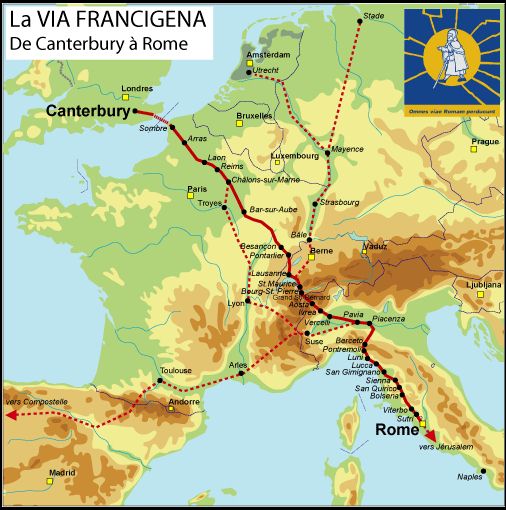
I had always thought of my life as a journey. The ultimate destination was heaven, but there were a lot of stops on this side of the grave. I witnessed the lives of my parents and their friends. I watched TV shows and movies; I read lots of books and they all seemed to say this: Life is about having a goal. Make a plan and make progress. Go to school, get your degree, get a job. Fall in love, get married and have kids. Raise your kids, work hard and retire. You’ll die, but you’ll rise again on the other side, better than ever. In this schema, life is about forward motion. You could expect some ups and downs on the journey, maybe even some detours, but you always knew where you were headed, because you had a plan. “Life as a journey” looked something like this.

mappa_via_francigena

If Rome is the birthplace of Western Civilization, picture Canterbury as heaven. For a scholar of British literature like myself, it’s not such a stretch. Can you see how it works? Though the way may be far, the journey is all mapped out for you. Anytime you get sidetracked, you can just get back on the road and head to your next destination. There are lots of people with you, safety in numbers and all, so you can never truly be lost.

But over the last few years, between the Great Recession, career changes, teenage children, and a dark night of the soul, the way disappeared. However, I didn’t know how to travel any differently. Even though I had switched operating systems, I just kept trying to make “progress.” It’s what our culture expects us to do. Make something happen. Keep something from happening. Set a course. Stay on course. Find a new course. Move on!  I had done it pretty successfully too, but as I listened to my heart, I finally had to admit that the “life as a journey” metaphor just wasn’t working for me any longer. It’s hard to move forward when you don’t know where you’re headed. So instead of a map, I found this image to rely on.

labyrinth1

In the center of my labyrinth is God and somewhere in the midst of the maze, I am. For the life of me, I couldn’t tell you where. I don’t have a map, or a plan; I have no idea where my next stop will be, or how long I’ll stay there. However, I am also no longer plagued by the question, “Am I making progress?” In a labyrinth, who can tell? When it seems like you are at the furthermost point, you can take one more turn and walk right into the heart of it all.  When you’re confident you are almost “there,” you can pretty much count on being wrong and finding yourself back in the outer ring once again. It is the way a labyrinth works.

Though the image would have terrified my ego, “life as a labyrinth” makes perfect sense to my heart. I may not be able to see where I am headed, but I know I’m never lost. There are simply no wrong turns. There is only one winding path and it leads directly to the heart of God. I cannot go astray as long as I am heading in the right direction. If I ever wonder what direction that is, I simply sit in silence and stillness until I find myself pulled in the direction of Love. And if I ever get scared, turn my back and start walking the other way, all is not lost. The labyrinth is my life; I can never walk out of it. I’ve just made the walk home a little longer.

*The poem is an excerpt from www.labyrinth.org.uk. The heart image is from talented artist, Whitney Krueger.

If they are honest about it, most writers want to say really important things, to have each story, paragraph and line convey something deep and meaningful. To be honest, I am one of those writers and my desire for significance frequently tempts me to say nothing at all. This week was no exception; I wanted to say something holy and  grace-filled as Easter approached, but I found my heart silent, until I saw this…

Since the video is five minutes long, I will keep my commentary short.

After morning carpool, I watched this video in my driveway and tears began to stream down my face. I don’t know why they came, but I have learned that when tears come unbidden, we are in sacred space. Our hearts are hearing a divine whisper and our body is responding in kind, but all too often, we shut it down and wipe them away. We actually run from the holy.

Poet Mark Nepo wrote, “Our ear is only a petal that grows from the heart.” What my ear heard in those five minutes, my heart loved. What my eyes saw, my soul celebrated. And as the crescendo played out before me and the children danced, I imagined the joy of this coming Sunday morning and the Alleluia choruses that will be sung the world over. I heard Rob Bell speak at USC last night on his new book, What We Talk About When We Talk About God, and strangely enough, he spoke of Nepo’s truth as well. Real seeing, he said, “happens when our eyes and our heart are looking at the same thing.” 

Whether we celebrate Easter or not, we are like the symphony in the square. We each have our own instrument to play, our own voice, talent and energy. My hope is that you will use yours this Sunday morning as you gather with your people – whoever and wherever they are – in Starbucks, in church, or in the middle of an Easter egg hunt. Let your ear be the petal of your heart. See the flash mob of joyful, exuberant love that surrounds you. Be brave and begin like the cello player, setting the process in motion. Be aware of the miracle of it all. And if the tears come, let them fall where they may. You are in sacred space.

As most of you know, I love to find intersections between the head and the heart, the moment and the infinite, the spiritual and the secular. The sacred is everywhere if we allow the possibility and so today, I offer you “The Spirituality of Spin.”

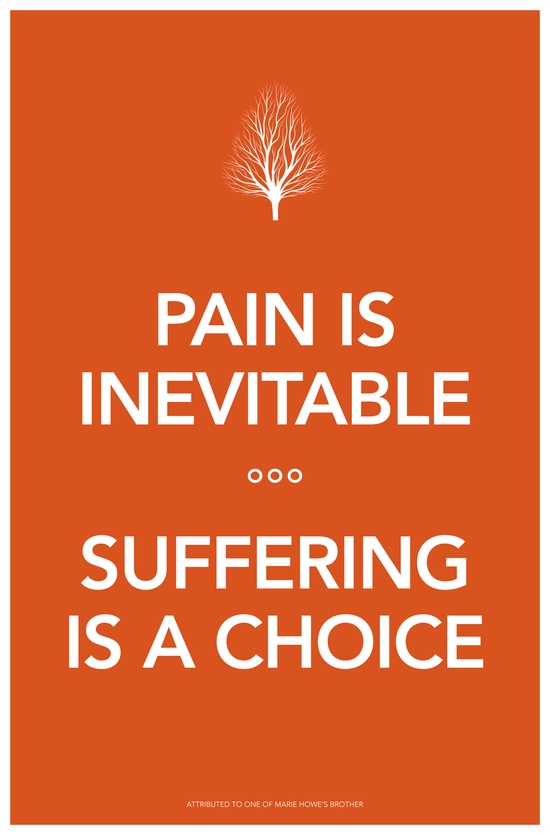
“Pain is inevitable; suffering is a choice.”

These are words of wisdom a friend shared with me recently when I was in a lot of pain. At the time, I wanted to haul off and hit him, but he was just out of reach and I was locked into my pedals anyway. The pain was real and physical, but he also was the one putting me through it. His name is Rich and he is my spin instructor, but I secretly think he was a Zen master in a former life. You’ve got to love a guy who can seamlessly bring Buddhist philosophy, 50s doo-wop music and prodigious amounts of sweat into the same moment.

spin

For many years, I avoided the spin room at my local YMCA. People who “spun” were intense. Whenever I walked by, the lights were dim; the music was pumping; the instructor was yelling, and the cyclists were staring at a glowing LED-display, mounted between their handlebars. They appeared transfixed, as if on ecstasy in a techno-fueled nightclub. Not my scene, thank you very much. I also happened to cherish sitting normally after a work out. Spin will never win, I thought smugly.

But about a year ago, one of my good friends defected to the dark side of the gym. She didn’t become an addict exactly, but two days a week, I’d see her in there, huffing and puffing and pedaling away. She invited me to come with her; I demurred. She told me what a good work out it was; I scoffed. She promised me my butt would adapt; I doubted it. But I couldn’t completely dismiss her perspective; I trust her. She’s a fit, successful, serene, 50-year-old woman who would never tolerate bad music, or macho bullshit. If she chose to spend an hour in a spin class, there must be something to it after all.

So I gave it a try and after a couple misses with bad music (the dreaded techno music) and worse instructors (pompous donkeys who sat up on their bikes and played air guitar while talking about how high a gear they were pushing), I finally made it to Steph’s cherished, Friday morning class and found my “spin” home.

Like any new exercise routine, or spiritual practice, spinning felt a little awkward at first. It was Catholic calisthenics all over again. We sat; we stood; we did a strange hover over the seat for 20 seconds at a time. I was always looking at my neighbor to gauge my posture and proficiency. I couldn’t tell if I was trying too hard, or not hard enough. I couldn’t seem to find the rhythm, when everyone else moved like an old pro. But the instructor Rich began that first class, and every class since with a gentle reminder: For the next sixty minutes, we simply need to be present to ourselves, to acknowledge what we feel and do what we can do. For the next hour, there are no problems to solve, or people to fix, so we can focus on why we are there: to transform our bodies and our selves. His stated goal as our teacher is to push us beyond our comfort zones, which is where all genuine improvement lies.

Though my ego and body didn’t love my first spin class with Rich, my soul immediately responded to his coaching style: creative and engaging, humble, but tough. It took only a few classes for me to begin to see how I could take his words into my spiritual life. Can you imagine a priest, pastor, or rabbi beginning every service that way? Asking us to breathe deeply, to center ourselves and let go of outside concerns? To be fully present to the Presence within us and open to the (sometimes painful) transformation that can take place if we allow it? Though they don’t usually ask, since I began spinning, I try to do it anyway.

Rich reminds us that if we wanted easy, we would be on a treadmill next door and I often think of that as I walk, sometimes reluctantly, into church. If I wanted easy, I’d be back in bed, munching on a donut and sipping my latte. I’m at church for a reason. Walking through life at a comfortable pace isn’t going to change me.

When our lungs and legs are burning, Rich calls out, “This is the feeling of improvement!” In all my years, during the many times I have been on my knees in prayer, in frustration, in desperation for things to be different, I had never thought of it that way. Our hearts and souls are no different than our bodies. Positive change never comes easily. Each step is just beyond our reach and the only way to get there is to do the very thing we don’t think we can do. In those moments in the classroom, Rich reminds us, “Somewhere inside of you is the person who can do this hard thing.” I want to believe he’s right, so I keep pedaling and push on, whether I’m on a bike, or in the midst of my life.

Finishing up a tough hill, Rich asks us to imagine our 80-year-old selves, thanking us for what we are doing right now at the age of 30, 40, or 50 and as I hold Tim’s hand at night, apologize for an unkind word, or let go of a petty grudge, I imagine the same thing. I am doing it for us now, but I’m also doing it for our 80-year-old selves. We plan to be together for another forty years at least, but that’s not going to happen if I don’t take care of business today.

One day when the hills were extra long and the incline steep, it seemed like the hour would never end. No matter how good the music, or how fine the company, I just didn’t have it in me to finish hard. I wanted to back off and quit, but sensing the mood of the room, Rich tried another tactic. He made sure we knew we were in this together. “Every one is feeling what you are feeling,” he likes to say and you can tell by the effort in his voice that he is no exception. He reminded me that solidarity is the key to enduring any difficult experience. Knowing we are not alone in our pain allows us to transform it. Great leaders, spiritual or otherwise, embrace the trials of their people and the burdens of their community. A great Leader is with you on your journey, in your effort and pain. She isn’t standing in the Promised Land, waiting for you to hurry up and get there. He doesn’t pretend that the journey didn’t cost him something as well.

Great leaders aren’t impatient. They don’t shame and blame, judge, compare and compete. They meet people where they are. They care and then they cure. I don’t know if Rich does all that in two, sixty-minute spin classes each week, but I do know I leave there better prepared to face my day, more sound in body and mind.

Pain

The most Zen of Rich’s words are where I began. Though they were spoken in the sanctuary of the spin class, they have resonated with me every day since. When I encounter frustrations, big, or small, I am reminded that the choice is mine. The pain may be inevitable, but the suffering is not. I still choose to suffer more than I’d like, but because I signed up for improvement, I’m willing to work on it. I breathe deeply, relax my hands, and drop my shoulders. I feel what I am feeling and then I move on. I know I will be glad I did it today and perhaps even more grateful down the road. And ultimately and perhaps most importantly, I know I’m not alone. I have a great Leader.

FatherKnowsBest_S2

This morning I attacked Tim with a “Plan of Attack” for tomorrow. We have a 7:00 am departure time for one carpool, a 7:30 drop off for another, the Lad bringing up the rear with a 9:00 start time. We have an 11:45 dismissal, a 4:30 pick up across town, and a soccer meeting at 6:30. I leave for work at 4:00, so Tim is on his own for those last two items on the agenda, plus dinner and homework.

This is a fairly typical Wednesday.

Tomorrow is also Ash Wednesday, the beginning of the Lenten season, so I threw some mass times at him as well. The local church bulletin listed services at 8:00 am, 5:30 and 7:00 pm.

“Which one can you make?” I queried. “Kiko is going at school; Finn and I can go to 8:00 am. Can you make it to the 5:30 with Molly, after your 4:30 pick up and before the 6:30 meeting?”

He looked at me like I was insane and I bristled. He wasn’t raised in a Catholic home, so I just knew what he was going to say. We don’t need to go tomorrow. We have a crazy schedule; let it go. You sound like your mother.

I was wrong.

He said, “Can we pull Molly from school in the morning? I’ll go into work late and we can go as a family at 8:00.” I must have looked surprised, because he clarified, “If we all go separately, whenever it fits, then it feels like something we ‘have to do.’ I want it to feel like we mean it, like it’s sacred space and time.”

Gulp. I was being religious, but not spiritual.

In my last blog, I spoke about people who honor rules and traditions more than their meaning. In this blog, I wanted to show you how easily it can happen. In the busyness of my life, in my planning and organizing mode, I lost sight of the holiness of the ritual, the significance of it all. While I was thinking “Get it done,” Tim was thinking, “It’s only worth doing if we do it right.” Have I mentioned lately how grateful I am to be married to this man?

As someone who is spiritual and religious, I seek the balance between the two. I don’t want to follow a set of instructions mindlessly, but I don’t want to throw them out either.  It seems to me that Tim’s wisdom is something I need to carry into this 40 day season of Lent as well.

Some years, I get lucky. On just the right Wednesday in February, my mind and heart are open to experience the movement of the Holy Spirit in my life. Some years, I don’t. Whether from stress, or illness, or just plain busyness, I am less prepared to recognize an invitation to Love. This is where religion can be our best friend, or our worst enemy. Following traditions and worshipping as a community can open us up when our hearts are closed down, but if we go through the motions without engagement and intention for too long, then we lose their meaning entirely.

Tonight, our family will celebrate a G-rated Mardi Gras. I don’t have to teach, so I’ll make a nice meal and we will sit around the table, listen to music and tell stories. I bet we’ll laugh and probably bicker as well. We’ll talk about Lent and what it means to be in the desert, to be scared and tempted and lonely, but we’ll also talk about what waits for us on the other side, if we trust in the power and presence of Love.

Though the kids might discuss what to ‘give up,’ I’m going to share how the tradition got started in the first place. I don’t want them worrying about “getting it done,” because “It’s only worth doing if we do it right.”   Apparently, in this case, their father knows best.

I’ve been doing a lot of “F-ing” around lately.

Get your head out of the gutter.

I’m talking about feeling.

I’ve been Feeling with a capital F and you all know how I feel about that.

I’ve been Feeling frustrated, as if I am in free-fall. I am failing and flailing.

When I admitted my feelings to my genius-friend Steph, she promptly pooh-poohed them.

While I may feel fallow, in her opinion, I am actually flourishing.

For weeks now, she said, I’ve been glowing; she said I must be growing. She said something BIG is happening.

I’m not buying it.

Nothing is happening; that’s the problem.

Apparently God agrees with Steph, because the Universe keeps sending me invitations to see this time of my life in a positive way, but it is sooo hard to do. I see the invitations to be patient, to trust and to wait. I say yes to them on one level, but my ego wants no part of this patience party. My ego wants results.

And so I keep feeling the way I do, and the Universe keeps inviting me to feel differently.

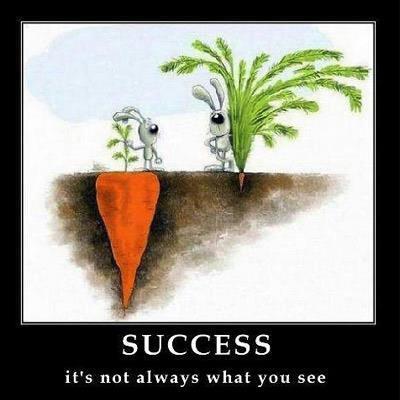
My dear Aunt Beth posts a lot of things on Facebook. Some are profound, some sweet, some silly. I put this one in the silly category, but it turns out that was a bit hasty. Seeing it for the first time, I didn’t think twice. Walking recently, I saw this image for what it was – another invitation.

Success new vision

I want to be the rabbit on the right. I want to have something big and green and leafy in my hand. I am supposed to be building a brand, making a name for myself, getting “gigs” as a writer and speaker. I do what I can to make that happen and then I breathe and I pray. I write and teach, mother and wife, love and laugh and mourn. All these actions are good and necessary, but in the eyes of the world (and I guess my own too much of the time), they don’t amount to much.  They aren’t producing the kind of  “greens” I’d like to see.

In contrast, God is inviting me to see myself as the rabbit on the left, the one standing by the shabby, little sprouts. The invitation is to be patient. The invitation is to trust that something good is growing. It may be buried deep; it may be under a lot of manure. But that something, whatever it is, is worth waiting for. The rabbit on the left will be much happier in the long run, if she doesn’t give up and abandon her garden. Sometimes, for this rabbit, that feels like a big if.

Sometimes, this rabbit thinks she should get a job at McDonalds.

In case you haven’t guessed, I am a terrible gardener. I have little patience for seeds and the nurturing they require. I only plant flowers in full bloom and when they die, it’s at least a year, or two before I can muster up the energy to replace them. Perhaps that is exactly what this season of my life is here to teach me: to be a good gardener of my soul.

The seeds of our dreams were planted deep in our hearts in childhood. They began with gifts we were given and were shaped by the experiences we lived. They were nurtured by love, or warped by indifference, ridicule, or fear. But eventually, given time and even a ray of sunlight, those dreams begin to grow. For some of us, the harvest may come early; for others, it may come very, very late, if at all. I imagine the fruit of our labor may not even be what we thought we were growing all those years. In my case, I hope it will be even sweeter for the surprise.