It will come as no surprise to most of you that I spent last Saturday morning at the Women’s March. If you were at a march as well, I’d love to hear about your experiences. Where were you? Who did you march with? And finally, the big one: Why did you march?

That’s the question, isn’t it? Why did we march?

While the organizers of the Women’s March on Washington did an excellent job of laying out a positive and comprehensive platform, I think every person participated for their own reasons.

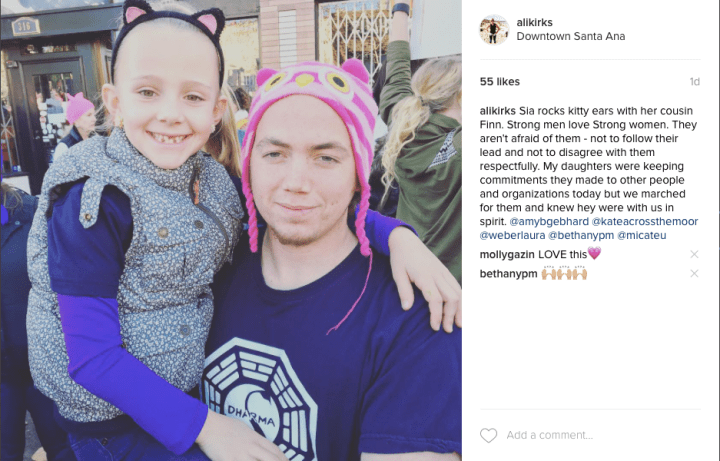
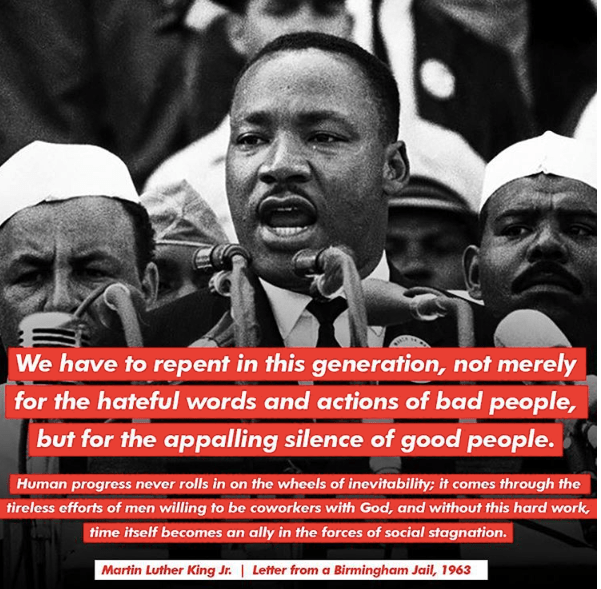
Here are some photos I posted on Instagram that day, where I explained some of mine.

screen-shot-2017-01-23-at-4-05-44-pm

screen-shot-2017-01-23-at-4-05-27-pm

screen-shot-2017-01-23-at-4-04-24-pm

Obviously, I was proud of Finn for rallying with us that day and being such an active participant. I didn’t set out to raise a feminist son, (and he still doesn’t love the title), but his actions speak louder than words.

Here are some other signs, photos and groups I saw and enjoyed that day.

screen-shot-2017-01-26-at-12-29-37-pm


img_2312

screen-shot-2017-01-26-at-8-34-06-am


Here’s part of Tim’s take, which if you follow him on Instagram, you’ve already seen. If you don’t follow him, you probably should.

screen-shot-2017-01-23-at-4-40-27-pm

An armchair quarterback, whom I love and respect deeply, posted this article from The Guardian the day after the march. (I call him an armchair quarterback because he’s really good at critiquing the plays, even when he’s not in the game himself.) The author argued that the organizers and participants in the march need to capitalize on the energy of the event and translate it into concrete goals and actions. Too many rebellions start with a bang and end with a whimper. His point was well made, so a friend immediately shared the 100-Day Action plan supported by the organizers of the march to keep the momentum going.

If you haven’t taken a look at it, especially if you marched, please do. What I most appreciate about Step One – The Sending of Postcards – is that they leave space for each person to fill in what is of greatest concern to them. They are not trying to make a blanket statement, or speak for everyone.

screen-shot-2017-01-23-at-4-44-53-pm

postcard-back

For some, the march was about women’s equality, for others, respect and kindness in our civil dialogue. For many it was about women’s reproductive rights. I saw signs in favor of earth care, the ACA, common sense gun laws, LGBTQ+ rights, Black Lives Matter, respect for science, and Love Wins. I’m not saying Trump is personally against all of those things, but the voting and governing coalition he put together certainly is as a whole. I did see more than a few signs about our new president and his disparaging comments about women and his coalition’s desire roll back women’s healthcare access, but they were by no means the dominant message.

For me, the march was about all of those things and more. That doesn’t mean I agree with every single person in the march, but I wanted to lend my voice, time, body and energy to a movement of women – for women, by women and supported by men.

screen-shot-2017-01-26-at-8-36-17-am
This sign was courtesy of Elizabeth Gilbert on Instagram.

I want women of all ages, colors and faiths to have a bigger seat at decision-making tables, starting with those in their own homes. Don’t tell me they haven’t earned it, aren’t ordained to it, or don’t care enough about it. None of that is true, except through the filter of those who feel threatened by it.

So, onward sisters and brothers of all political persuasions. Stay in relationship with one another. Keep Loving, keep talking, keep trying to find your way to common ground. It may seem further away than ever this week, but I’m not giving up hope and I pray those on the other side of the aisle won’t either.

Post Script:

Over the past week, the Women’s March on Washington has been fetèd and critiqued. I’ve read essays about how wonderful it was, how white it was, how effective it was and yet ultimately, how it won’t change a thing. I don’t pretend to know what the effect of the Women’s March will be on political policy as a whole. I only know what I experienced and how it will play out in the choices I make and those are all good.


news-081516c-lg

Without intending to be a cliché, I took Molly to see Hidden Figures on Monday. Countless friends had said, “See the movie!” reporting reactions that included tears, awe, and pride. As I watched the film, I was entertained and impressed, but I also felt a deep sadness. Maybe it was because we were celebrating Martin Luther King Jr.

Before the movie, I had just read this post by Rachel Held Evans, which pointed out the complacency of much of the white Christian churches during the Civil Rights Movement. (Please don’t point out the exceptions. That’s what we always talk about to make ourselves feel better.) I had also read a comment on my friend Kate’s wall:

“I read this post from Naomi Schulman this morning and haven’t stopped thinking about it: ‘Nice people made the best Nazis. My mom grew up next to them. They got along, refused to make waves, looked the other way when things got ugly and focused on happier things than ‘politics’. They were lovely people who turned their heads as their neighbors were dragged away. You know who weren’t nice people? Resisters.’”

Hidden Figures has lots of “nice” white people in it, but the film makes it clear that they really aren’t that “nice” at all. Kevin Costner’s Mr. Harrison pulls a few dramatic stunts in order to make maximum use of Katherine Goble’s genius mind, but he does it to help NASA, not her, or the black community. Motivated by empathy, a Jewish engineer from Europe encourages the brilliant Mary to continue her education. He knew what it was like to be part of a despised race. But apart from those two men, the “nice” people were simply polite, almost cruelly so.

Though working as a supervisor for almost a year, Dorothy Vaughan is repeatedly denied the title and compensation due to her. Mrs. Mitchell, Dorothy’s white supervisor, washes her hands of the discrepancy, blaming it on slowness of NASA and the inconsistency of the computing work. “What can one do?” she tells her self and Dorothy. Apparently, a lot if one really wants to. The moment Mrs. Mitchell needs Dorothy to have the title and position for the sake of her own white staff, the promotion miraculously occurs.

Someone “helpfully” provides a Colored coffee pot, so that Katherine won’t use theirs and decorum can be preserved. When Katherine needs a bathroom, the only other woman in the room says she doesn’t know where Katherine’s bathroom might be. (It was a half-mile away.) I can imagine she thought: “Well, it’s not my problem. I didn’t make the rules; I’m just following them.” She might have even thought she was being “nice” by implying that Katherine shouldn’t use the White Ladies room, lest she break the law. For the most part, Katherine is ignored by her peers in the space lab. She is a “computer,” brilliant, but nothing more than a woman and a colored one at that.

Hidden Figures prompted me to examine how I have been complacent to and complicit in systems of injustice, but they did it subtly. There was no overt attempt to produce white guilt, but I found myself thinking. When have I been polite, but not helpful? Verbally supportive, but physically inert? How often have I ignored the suffering and difficulties of others that were within my ability to address?

That’s what I found so compelling about Hidden Figures. While other films have dealt with the subject matter of racism, they usually offer a sympathetic white character with whom white audiences can identify. When we can imagine ourselves as one of the “good” people, we can dismiss the others as unlike ourselves. The Help had Emma Stone as Skeeter Phelan and who wouldn’t want to be that courageous, beautiful woman? A Time to Kill had Matthew McConaughey’s sexy Jake Brigance. Selma had the mostly, unnamed freedom riders and clergy. It doesn’t matter the size of the role; our ego will attach to virtually anything that allows us to remain unchallenged. Personally, Hidden Figures offered me no such decoy. Even as the white characters soften towards the women, the recognition of their skill, much less their unique humanity, is far too long in coming.

The talent and backbone of these women is incredible; the support and sacrifice of their families is admirable, but the way we hindered them was unconscionable and that is the message that stays with me today. Please, do go see the film. It’s worth watching. It celebrates hard work, determination, and intelligence. Glass ceilings are broken, while traditional values of family, faith and love are upheld. But when you go, don’t just see the story of these women; be willing to see a story that continues to this day as we struggle to achieve equality for all citizens, no matter their color, creed, gender, or orientation.


screen-shot-2017-01-18-at-12-54-17-pm
Meme courtesy of Djrarela on Instagram.  


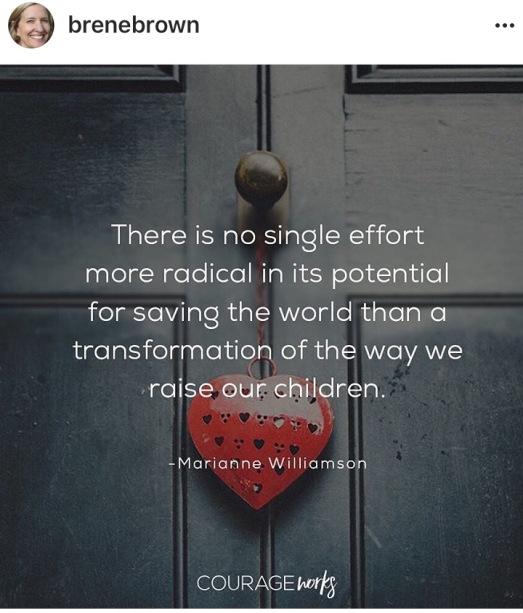
The first week of January, Brene Brown posted this image.


fullsizerender-8

This year, she said, she’s committing a whole lot of her energy to focusing “on how we raise courageous children and build messy, beautiful, wholehearted families.”

Emboldened by the fact that Brene and I have the same thing on our minds to start the new year, I’m going to stay on the parenting topic for another week or two. I hope you don’t mind.

The day after Christmas, I headed up to Mammoth Mountain to go snowboarding with Finn and Molly, Maddie and Nick, my niece and nephew, as well as Jack and JT, two of Finn’s friends I’ve known almost since birth. That’s right – me and six teenagers for four long days – and it was awesome.

On one of those beautiful days, we piled into the gondola and headed to the top. The sun was shining; the snow was light and our spirits were high, right up until a skier, a man in his late fifties, joined our car. He looked around at all of his snowboarding companions and asked, “How high can a snowboarder count?” Without waiting for an answer, he shouted out, “Two, since that’s all that ever get on a chair lift together!” He chuckled to himself – the joke being that snowboarders are stupid.

No one else laughed, but I gave him a small smile anyway, just to be polite.

Apparently it was enough, because he plowed on.

“I’ve got the best story for you,” he said, looking directly at me.

“I was riding on a chair with this couple on snowboards and they told me that they had two kids. These parents taught their kids to ski when they were small, but when the kids were ten or so, they wanted to learn to snowboard. After a couple years, the parents thought it looked like a blast. They learned to snowboard too, so they could hang out with their kids, but as soon as the parents learned, the kids went back to skiing! They wanted nothing to do with the old folks! Anything to get away from the parents, right?” He laughed and repeated again, “Isn’t that the best story?”

I looked at him, and around the car at my own six teenage companions, and said, “Oh, I don’t know about that. I kinda think it’s the best when your kids want to hang out with you. It’s a lot more fun that way.”

That kind of killed the conversation, but we were almost at the top anyway. After enjoying the view, our crew strapped on our boards and were off, hooting and hollering our way down the peak.

But his story stayed with me and got me thinking. Why do people cling to the negative stereotypes about teenagers? Why do they relish stories about dysfunctional relationships between parents and kids? Why do so many people find those narratives satisfying, instead of sad, which is how they always come across to me?

My experience is that teenagers – my own and others – are like everyone else going through a difficult time. They are sensitive and emotional, prone to exuberant highs and tragic lows; they seek support and solace wherever they can find it. Hormonal, social and cultural changes hit teens full force, along with a morass of competing agendas and advice. They have to navigate those transitions mostly on their own. They only have the skills we’ve given them (for good and bad) and the support we offer. But if we haven’t earned their trust, they aren’t going to seek those out very often. Instead, they are going to turn to other sources like their peers, social media and celebrity culture and that just exacerbates the bum rap “kids these days” get.

Here’s another example. A couple weeks ago, Tim told me about a video that many of his friends had shared on Facebook about workplace behavior, and smartphone etiquette and personal relationships. When he asked if I had seen it, I wondered if it was a big rag on Millennials, because that was the video firing up my Facebook feed. No, he said, it’s not bagging on them. It’s about them, but it’s about all of us, really.

Here are the different ways that the video was presented. Guess which one was going to have a greater appeal to my gondola companion?

I had refused to watch the video on the right, though it had popped up on repeatedly, because the title was so insulting to the generation behind me. When Tim showed me the “clean” version on the left, I was glad I watched it, but why do we have to throw kids under the bus to make ourselves feel better?

When I heard that story about those parents, I didn’t know what troubled me more – that their children wanted nothing to do with them, or that the skier thought the story was “the best,” a qualifier he repeated at least six times in the telling. Later that night when I was talking to my dad about it, he mused, “We have no idea the depth of people’s injuries and how it shapes their world view. The sadder part is that they don’t know it either. They think it’s normal.” When separation and rejection are the models you’ve been given for family conflict, stories like that make you gleeful. They confirm your deepest suspicions about what a crock love and family really are. You can’t imagine that disagreements and hurts can be solved with grace, or that forgiveness and generosity really are assets in any situation.

But that woundedness doesn’t stop with family life. No matter what the subject is – relationships, religion, economics, politics, education – few of us can admit that our deepest assumptions about life and human nature might be flawed, a result of our own limited experiences. It’s painful to concede that a different approach might lead to a better outcome. It’s even more painful to consider that by clinging to those assumptions, instead of shedding them for healthier perspectives, we’ve created much of the pain in our own lives.

I wish that man hadn’t gotten into the gondola with us that day. Before he hopped in, there was laughter, storytelling and selfie-taking. After his clueless contributions, there was awkwardness and impatience, but he did teach me a lesson, (besides reminding me to read my audience better.) When I am feeling cynical about a group of people, or unhappy with a set of circumstances, I need to check my assumptions, and look for the bigger picture. Who am I judging and do I know the whole story? What part have I played in creating the mess? And besides critiquing it, how can I make it better?

Which brings me right back to parenting, especially parenting teens and my last blog. I took it as a huge compliment that all those kids spent all that time with me, but I think it goes back to what I talked about in the Contemplify podcast about being conscious of your own projections and expectations. If you haven’t been able to give it a listen, I hope you will.

Contemplify: Episode 17: Alison Kirkpatrick on Conscious Parenting and Mark Longhurst on The Brothers Karamazov 

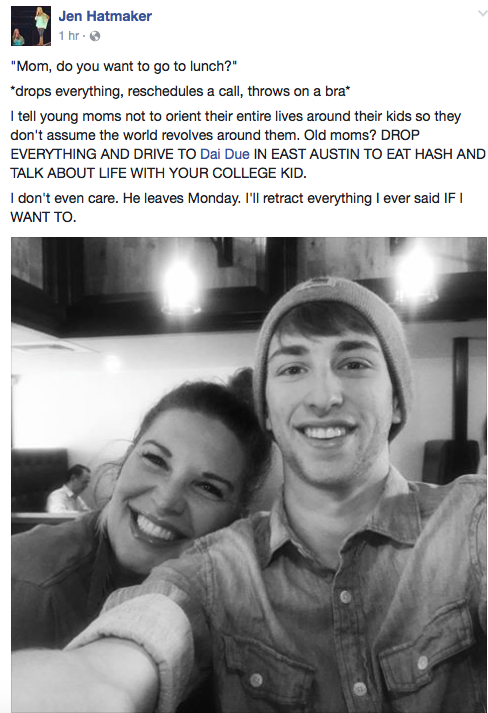
Just today, as I was working on this post, Jen Hatmaker, author, speaker and extraordinary mother, posted this status update on Facebook.

Amen, sister!

screen-shot-2017-01-12-at-1-02-31-pm


In these early days of January, most of us have made resolutions for the year ahead. Some will last weeks or months, while others have petered out already. But every once in a while, we make a resolution that lasts a lifetime. However, those changes don’t usually start on January 1. Those types of transformations require a clarity and conviction rarely available to us in our post-holiday haze.

More often, it is in moments of crisis (though sometimes just out of the blue) that we have a vision of how things might be different, how we ourselves might be different, and how that difference just might change everything. And suddenly, more than anything, we want that change. We want to be that change. Suddenly, that resolution isn’t something we have to do anymore; it’s something we can’t help but do. We are resolved, no matter how difficult it is, or what the task asks of us. We change our habits and our way of operating in the world. We fail repeatedly, but we don’t give up. The vision of what’s possible holds us fast, because it really is that good.

In the course of my life, only a few resolutions have taken hold of me in this way, but I’m grateful for each and every one of them.

  • There was the resolve to become a birth mother, 26 years ago this month.
  • Marrying Tim, 23 years ago.
  • Becoming a Weight Watcher, 6 years, 2 kids and 20 pounds later.
  • Joining the YMCA, 10 years ago.
  • Writing as a spiritual practice and starting this blog, 9 and 5 years ago respectively.

screen-shot-2017-01-05-at-8-40-57-amLast month, I had a chance to talk about one of these resolutions (or “course-corrections” as I think of them) on the podcast Contemplify. Paul Swanson, the host, asked me to reflect on a book that had significantly impacted my spiritual journey. I immediately went to my list of “greats” – Merton, Rohr, D’Arcy, Keating, Bell, Bourgeault – the people I have read over and over again. But no one book had inspired the type of metanoia, or complete and total shift that I was looking for. Though they have re-shaped the contours of my heart, their influence has been steady and incremental, more than seismic.
And then I remembered the last big resolution I made and the book that inspired it. In the spring of 2013, I came across The Conscious Parent by Dr. Shefali Tsabary. Keara had just turned sixteen years old and I was so far from the being the mom I wanted (and she needed me) to be. For all my spiritual work, my daily disciplines and practices, I had been blind to how I was failing to truly love the person (and all the little people in my home) who needed my love the most. I was loving them to the best of my ability, which is to say, not nearly enough. In that moment, I resolved to love them better, more fully and consciously.

It is a resolution I am still committed to, though I fail to keep it each and every day. My hope is that my kids see me trying and that the effort itself will inspire the grace and forgiveness we’ll need to grow old together in love.

That’s all I’ll say here about the resolution, because I hope you’ll tune in to the podcast. If you’re a parent, grandparent, or even have a few “parent issues” you’re still working out, I think you’ll find the podcast interesting and maybe even inspire you to check out the book!

You can download the episode on Itunes. It can be found under Contemplify, Epidsode 17.

Or listen at Contemplify.com.

Episode 17: Voicemails – Alison Kirkpatrick on The Conscious Parent

Few of you have had a chance to listen to my voice, or seen me speak in person, so I hope you’ll enjoy the alternate experience!


khalil-gibran-quotes-9-1024x746