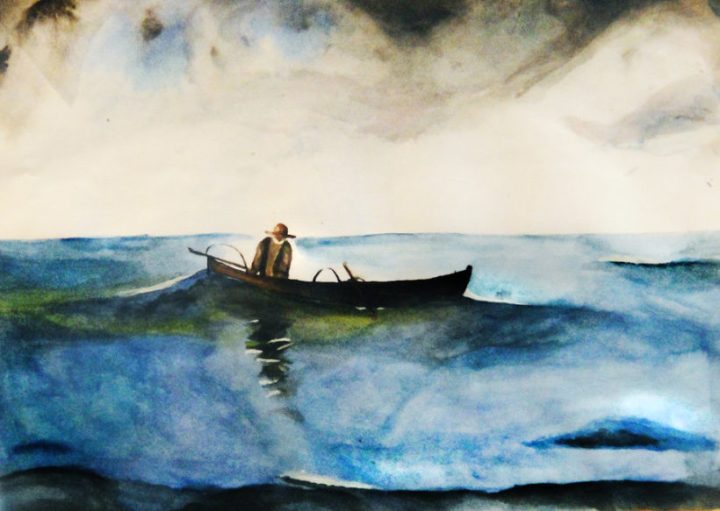
the_old_man_and_the_sea-820x583

“Beannacht”

On the day when
The weight deadens
On your shoulders
And you stumble,
May the clay dance
To balance you.

And when your eyes
Freeze behind
The grey window
And the ghost of loss
Gets into you,
May a flock of colours,
Indigo, red, green
And azure blue,
Come to awaken in you
A meadow of delight.

When the canvas frays
In the currach of thought
And a stain of ocean
Blackens beneath you,
May there come across the waters
A path of yellow moonlight
To bring you safely home.

May the nourishment of the earth be yours,
May the clarity of light be yours,
May the fluency of the ocean be yours,
May the protection of the ancestors be yours.

And so may a slow
Wind work these words
Of love around you,
An invisible cloak
To mind your life.

John O’Donohue, an Irish poet, theologian, philosopher and author, passed away in 2008 at the age of 58.

“Beannacht” is the Irish word for “blessing,” but it can also mean goodbye, which is fitting. One would offer a “beannacht” to a loved one as they headed out the door. Our “Bon voyage,” and “Safe travels” pale in comparison to this farewell, but they carry the same sentiment.  Unlike our current understanding of a “blessing” as a gift bestowed by God on some and not on others, this is the more ancient practice of offering a “blessing” as a prayer and a sending forth. I’m sorry we’ve lost that tradition, but grateful O’Donohue reclaimed it.

Like any good poet, he uses images, taken from the reality of his daily life and that of his readers, one for each stanza. For whatever befalls you, O’Donohue paints a picture of something in the natural world arising as a corrective to it: clay earth dancing, bright colors flying, yellow moonlight leading. Who wouldn’t feel safer in the world with these hopes wrapped around you? And he rewrites the Irish blessing so many of us are familiar with: “May the road rise up to meet you/ May the wind always be at your back… “, so we can hear anew how the power of the natural world is always at hand to help us on our journey.

It is all beautiful to me, but of course, the end is my favorite part. The true magic of any blessing is the love with which it is given and the open-heartedness with which it is received. Without love, they are empty words; with love, every goodbye is a blessing and every hello, a reunion of hearts.

I have a thing for Irish poets, especially their lilting, lyrical voices, so all the Irish poets I include this month will include a link to the poets reading their poems. I highly encourage a listen! You can listen to John here. 

51Hm5ek4XYL._SX329_BO1,204,203,200_

“Time After Time”

Time after time

I came to your gate with raised hands,

Asking for more and yet more.

You gave and gave, now in slow measure, now

In sudden excess.

I took some, and some thing I let drop; some

Lay heavy on my hands;

Some I made in to playthings and broke them

When tired;

Till the wrecks and hoards of your gifts grew

Immense, hiding you, and the ceaseless

Expectation wore my heart out.

Take, oh take – has now become my cry.

Shatter all from this beggar’s bowl:

Put out the lamp of the importunate

Watcher.

Hold my hands, raise me from the

Still-gathering heap of your gifts

Into the bare infinity of your uncrowded

Presence.

Rabindranath Tagore (1861-1941) was a Bengali poet, playwright, musician and essayist, who wrote about everything from spirituality to politics to science.  He was the first non-European to win the Nobel Prize for Literature.

The first time I read this poem, it shattered me, like the mirror it held up so I could see myself. In Tagore’s words, I saw my inevitable posture toward God – hands stretched out in supplication. Though it has been many years and I’ve made a real effort, not much has changed. Though grateful for my blessings, I am often aware of a perceived lack, that little extra “something” that would make my life better. Sometimes it is material, but often it is just a change in circumstance for me, my family, or the world. When I read this poem, I could weep with shame at my greed and blindness. Though healthy, educated, happily married with three children and the means to support them, surrounded by friends and family who love me, living in one of the wealthiest nations in the world, I still want more. More youth, more opportunity, more security, more excitement, more clarity. You name it,  I’ve probably desired it.

To me, this is a poem about the privilege of having more than we need, more than we’ve earned, more than we can use and still believing that it’s not enough. Blame biology, culture, or consumerism, but our automatic response is to ask for more. This poem reminds me that my “scarcity” is a farce, my “gratitude” is lip service, and that what I truly need is ultimately right here with and within me.

This poem convicts me, but finally ends on a hopeful note. I believe the Presence will come and deliver the gift of itself.  After all, it has been waiting to be asked for just that all along.

green-692079_960_720

“On Meditating, Sort Of”

Meditation, so I’ve heard, is best accomplished

if you entertain a certain strict posture.

Frankly, I prefer just to lounge under a tree.

So why should I think I could ever be successful?


Somedays, I even fall asleep, or land in that

even better place – half-asleep – where the world,

spring, summer, autumn, winter –

flies through my mind in its

hardy ascent and its uncompromising descent.


So I just lie like that, while distance and time

reveal their true attitudes: they never

heard of me, and never will, or ever need to.


Of course, I wake up finally

thinking, how wonderful to be who I am,

made out of earth and water,

my own thoughts, my own fingerprints –

all that glorious, temporary stuff.


The poet Mary Oliver, or “Moliver” as she is affectionately referred to around our house, is someone you will see pop up a few times this month. She is one of my favorites and there is a theme in her writing I’d like to explore with all of you: the sacrament of Nature, of being present in the moment however it arises and recognizing it for the holy gift it is.

I think this poem is a great start. Meditation and its companion, mindfulness, are buzzwords these days. They are offered as a remedy for everything from stress to chronic pain, as relief from anxiety and exhaustion. They will help us lose weight, sleep well, and even become better “team players” at work and home! Ugh! It kind of drives me crazy, because developing a meditation practice for those things is like taking a prescription drug for its “off-label” side effects. We might experience a relief of our symptoms, but it’s not what it was made for and it’s definitely not going to cure the underlying cause.

But I think Mary’s version of meditation might be just what the doctor ordered, in its gentle and holistic approach.

Lie down somewhere beautiful and let your mind drift. Don’t cling to what you think you’re supposed to do, or feel, or experience. Let life pass you by for a moment, or two and see yourself in the midst of things, where “distance and time” have “never heard of me, and never will, or ever need to.” From that place, we might wake refreshed and perhaps even “cured” of what ailed us in the first place. We might even find ourselves grateful to be in our own bodies and a part of this beautiful world.

Let this poem inspire you! It’s Spring! Go find a tree, a little patch of sunlight, a place where the breeze can kiss your face. Close your eyes and in the words of Rumi, allow yourself “to be silently drawn by the strange pull of what you really love,” which I hope is yourself and this beautiful, suffering world we live in.


Post Script: I recently acquired a copy of “Moliver’s” newest book, Devotions, as a gift from Tim. I had been on the waiting list at the library for so long and when I finally got my hands on a copy, the weeks just flew by. On the last day it was in my possession, he  caught me taking pictures of page after page on my cell phone. (Desperate times call for desperate measures! It took me months to get my hands on it the first time and I didn’t know how long I’d have to wait again.) However, two days later, it was in my mailbox. Though Tim generally supports my book-buying restraint, in this case, it deserved an exception. I highly recommend you put your name on the waiting list at your local library, or maybe even treat yourself to a copy!


It’s Easter, April Fool’s, Sunday.

It’s one of the few “forced” days of rest. For the most part, you couldn’t go to work, hit the gym, or the local mall.

How did you receive this day?

With joy and relief, or with dread for the too-many-hours set aside for something “special” that maybe didn’t even happen?

However you spent your day, it’s also the beginning of National Poetry Month.

Last year, I joined the poetry experience half way through and shared a poem a day and reflection on Facebook, but this year, I thought I’d celebrate NPM with all of you.

Welcome to Day One.

I have always loved poetry, as a reader, student and teacher.

I am captivated by the diversity, musicality, and creativity of poets across the ages. I love the turns of phrase that surprise, enlighten me and sometimes confound me. It doesn’t bother me to think, “What in the world does that mean?” I actually enjoy the surgical precision it takes to dissect a difficult poem, line by line.

I realize that puts me in the minority when it comes to casual poetry readers, but that’s part of what National Poetry Month is about: spreading the “good news” about poetry far and wide, just like the Apostles did during Easter. (I’m taking the confluence of the two events as a happy accident.)

So for the next thirty days, you’ll receive a “Poem of the Day” from me in your inbox.  I know it’s a heavy reading load, so feel free to delete if you aren’t interested, or enjoying them, but please don’t unsubscribe! I’ll be back to my infrequent posting schedule soon enough. And if you find a poem that strikes your fancy, feel free to share it by email or on Facebook, using the links below.

More Love = More Poetry

And without further ado, here is our first poem.

last-supper-ivan-guaderrama
The Last Supper by Ivan Guaderrama

“The Last Supper”

They are assembled around him, troubled and confused.

He seems withdrawn,

as if, strangely, he were flowing past

those to whom he had belonged.

The old aloneness comes over him.

It had prepared him for his deep work.

Now once again he will go out to the olive groves.

Now those who love him will flee from him.


He had bid them come to this last meal.

Their hands on the bread

tremble now at the words he speaks,

tremble in sudden silence

as a forest does when a gun is fired.

They long to leave, and they will.

But they will find him everywhere.

Book of Images, Ranier Maria Rilke

With Easter landing on the first day of National Poetry Month, this poem by Ranier Maria Rilke seemed an obvious choice. It spans the last few days of Jesus’ life from the Last Supper to the Resurrection (though that event is referenced only obliquely in the last line.) On Holy Saturday, we read the poem aloud as family a few times and I asked them what metaphor, or turn of phrase they noticed, or if there was a line that confused them.

One liked the metaphor of the gun in a forest. He knew exactly what that felt like, the eerie stillness that lingers after a shot, like everything is holding its breath, before it exhales in safety again. Another was struck by how sad it was to think that all the disciples were already on their way out the door, how they “long to leave” and will at the first sign of trouble. I was taken by the description of Jesus “flowing past/ those to whom he had belonged.” It’s a strange image, but one we can probably all relate to.

There have been times in all of our lives where we experience a “dislocation” from our peers. It’s almost a universal experience and it could be anything really – a medical diagnosis, a depression, deep grief after a loss, a shameful mistake we’re not sure we will be forgiven for. Though we try to participate in our communal life, it’s as if a barrier has been set between us, unseeable, but impenetrable nonetheless. I’ve never liked the experience, but rereading this poem, it is revealed as a holy space too, where deep work can be done.

And finally, Easter. Though the disciples were fleeing Jesus, they will “find him everywhere,” just as I do to this day, sometimes where I’m looking, but most of the time, where I’m not. This poem doesn’t offer the big “Alleluia” we’re used to on Easter Sunday, but ecstasy like that never lasts for long anyway. It’s the showing up time and time again that ultimately counts.