Goat Rodeo: about the most polite term used by aviation people (and others in higher risk situations) to describe a scenario that requires about 100 things to go right at once if you intend to walk away from it. http://www.urbandictionary.com

Most mornings with Kiko feel like I’m at a Goat Rodeo. Today was no exception and unfortunately, no one walked away from it completely unscathed. She stormed out of the house to wait in the misty rain for her carpool; I went to check my computer. This is what I saw on Facebook:

Oh, if I had only known! But wait a minute. I did know. Though I hadn’t seen her midnight post (I go to bed around ten), I could tell from the moment she woke up that today was not a good day. It was her father who didn’t know and who brought this morning to such an unhappy conclusion.

Kiko has never been a morning person; adolescence has done nothing to improve the situation. The challenging curriculum at her all-girls prep school has only made it worse. She does homework until eleven or so and then takes an hour or two to unwind. Her alarm goes off (for the first of several times) at 6:30 AM.

Though I am a morning person, I’ve learned to adjust my expectations. I speak to her minimally. I am helpful when possible. I appreciate her good mornings, using those days to sneak in an extra hug, or kiss and chat about life. On bad days, I avoid her. I pack her lunch, pat her on the head and try to never, under any circumstances, overreact to her snide comments, deep sighs and tragicomical complaints.

Tim has no such compunction. I don’t know what got into him this morning, but as Keara lay on the couch, soaking up her last moments in a horizontal position before the incessant verticality of her day, he would not leave her alone. As the youngest child in his family, his internal switch is permanently set to “tease.” As the father in this home, he has a reasonable expectation for respect and response. While neither of these things are bad in and of themselves, (I appreciate them most of the time), they are not great in combination with an overly tired, teenage girl. I didn’t hear the details of their exchange, but he made one crack after another, which she either ignored, or “cracked” back, until she stormed out of the house.

Exasperated, I looked at him and he said, “I don’t know how you don’t engage when she is acting like that.” I started straightening couch cushions. “Don’t you think she’s being unreasonable?” I folded throw blankets. “Seriously, when someone is being such a donkey, how do you not try to get them to stop?” I began to rearrange the trinkets on the entryway table. He finally got it. “Oh, you do it just like you are doing it to me right now,” he said as he turned and stalked up the stairs.

Ugh. He caught me and I didn’t even realize I was doing it. I was frustrated at him for messing with Kiko, but I didn’t have to ignore him as if he were a cranky, petulant teen. I could have engaged in conversation with him about his concerns. I could have empathized with his pain and his desire to connect with her. I could have recognized that he only wanted to be a good dad, to make her laugh, to start her day on a better note.

But instead of acknowledging any of that, I was smug and if there is one thing I hate being, that’s it. Cathleen Falsani wrote one of my favorite blogs of 2012, called “Deliver Us From Smugness.” If you have time, you should read the whole thing, but one line in particular has stayed with me on an almost daily basis. She writes,

“The opposite of love is smug.”

She goes on to explain that “To be smug is to be excessively proud of your achievements and successes. Conceited. Arrogant. Complacently self-satisfied.”

This morning I was smug with the man I love. I was excessively proud of how I wrangle the Goat Rodeo that is Kiko and her morning routine, instead of humbly grateful that I have crashed and burned enough times to know when and how to walk away.

So Tim, I hope you’ll forgive my smugness. It is the opposite of Love and Love is the one thing I want to be, every day, in every way possible.


As per our family agreement, this blog was read and approved by both parties involved in this morning’s Goat Rodeo. 

Based on the assumption that I am failing to meet everyone’s expectations, I find myself saying “sorry” all the time. Though I still know I am ‘enough,’ at least on a cosmic level, in an every day, nuts-and-bolts kind of way, I often feel like I am falling short. As a result, I find myself apologizing all the time, and quite frankly, I am sick of saying “I’m sorry!”

I say sorry to God if I get distracted during my prayers. I say sorry to Tim if I haven’t shaved my legs in a few days (oh, let’s be honest, a week or two). I say sorry to my kids when I run out of their favorite breakfast foods. I say sorry as I head out the door to work and sorry if I get home late.  I say sorry I can’t buy you that; sorry I can’t donate more; sorry I can’t stay later; sorry I can’t talk; sorry I can’t show up at all. Sorry! Sorry! Sorry!

Does anyone else have this problem?

One of my all time favorite lines from Seinfeld is from their trip to India. George and Jerry get in an argument and although Jerry apologizes profusely, George is having none of it. He is so mad, he spits out, “You can stuff your sorries in a sack, mister!”

That is what I would like to do with all my sorries. I’d like to stuff them in a sack, take them down to the river and drown them.

I am not even sure what all my sorries mean. An apology should be offered to a party who has been wronged by one of your actions, or choices, so when did I start thinking that saying “No” was a synonym for wrongdoing? When did I start thinking that my not-so-terrible choices warrant an apology?

Today, I am making a pledge to not say, “I’m sorry.” Just for today, I am banishing that word from my vocabulary. If I make a real mistake, then I will apologize, but I will not use that word.

From here on out, I will not allow “Sorry!” to be my automatic response every time I cannot be every thing to every body.

Writing that last line, I have my “aha” moment. How in the world did I get it in my head that I could be everything to everybody all the time?

Will you please excuse me while I go take off this messiah complex and slip into something more comfortable?

Ah, my own skin, much better.

It’s clear how closely my sorries are tied to my Superego. Psychologists say that’s the part of us that aims for perfection. I say it’s the part of us that believes we need to be ‘super.’ Author Rob Bell writes that we each have a “Super,” living inside of us: a super-mother, a super-man, a super-worker, a super-volunteer. You get the picture. (He also writes that we should take it out back and shoot it. It’s the only way we will ever be free.)

When we are young, we are simply ourselves, but the “Supers” come on hard and fast. As a kid, I needed to be a “Super-student,” able to get straight A’s in a single bound. As a teen, I secretly wanted to be a “Super-model.” As a young wife and mother, I aimed for “Super-woman,” a perfect balance of Martha Stewart, Mother Goose and Playboy bunny.  The avalanche of sorries that come out of my mouth are a clue that I’ve finally maxed out. Instead of dropping one impossible image of perfection for the next, I’ve just kept piling them on. Currently, I’m trying to add one more (as yet undefined) “Super-something” to the mix and I’m just not up to the task.

Repeating “Sorry” is my coping mechanism, but I’m willing to try something new. The next time I want to say, “Sorry,” I am going to smile instead. I am going to repeat a mantra I picked up from the poetic Anthony de Mello, SJ.

“Behold God beholding you… and smiling.”

It reminds me that I do not need to be perfect. That good really is good enough. That whatever else I do, or don’t do, God is smiling at me (and at you too.) I can drop the mask. There is only Ali, and I don’t need to apologize for being human, for having limited time, talent, or treasure. I have a feeling that if I can remember to smile, instead of reaching for that all-too-easy “sorry,” it will feel absolutely super.

Just as I was sitting down to write this blog, I happened to check Facebook and find a post by one of my favorite bloggers in the world, Glennon Melton, and I almost stopped writing RIGHT THERE, as in RIGHT NOW, as in FOREVER, because Glennon has a way of writing that makes me think, “Why do I even bother? Glennon says everything I want to say, but she says it so much better!” Now, if you go to Glennon’s post from today, you might possibly wonder why I would want to say that and today, I don’t, but there are lots of other times when she does, like here and here.

But then I remembered something that Glennon said last month as she was reading a book by Cheryl Strayed,

Dear God, she’s amazing. And I felt myself start to panic a little. OH MY GOD. SHE’S SAYING ALL THE THINGS I WANT TO SAY, BUT BETTER.  I actually thought about CLOSING her book and NOT reading anymore because my heart was panicking and shriveling a bit.

Sometimes, that’s honestly how I feel when I read Glennon, or Anne Lamott, or Paula D’Arcy, but then they go on and on about grace and abundance and then I breathe deeply, and then G (the Big G upstairs) reminds me that I am enough and that I believe in Love and then I can finally try to write again.

So I’m back and ready to tell you a story about my weekend.

It was a hot weekend here in San Diego, like hot hot, like “Texas-hot,” as my kids like to say. They’ve only been there a handful of times, but boy, do they remember. We are also in the midst of soccer season, which means our family had four games in two days. Tim is the manager of The Lad’s team, so we got to set up goals once, take down goals twice, pay the refs, and turn in the scores. Along with all the other parents, we also got to cheer on the sidelines.

Those sidelines were a mass of brightly-colored umbrellas, beach chairs, water bottles and spray fans. There were canopies and sunshades and baseball hats – anything and everything that could provide some relief for the humanity that was slow-roasting in the heat. A friend of mine turned to me and said, “Surely, there is a blog in here somewhere.” And so I looked around to see what I could see.

I saw kids, and I saw parents. I saw players running, kicking and heading. I saw goalies diving, missing, and saving. I saw coaches coaching, cheering and scolding. I saw it all, but nothing that you wouldn’t expect on any given “Soccer Saturday in the Suburbs,” as Tim likes to call it.

So I kept watching Finn’s game, until I was distracted by a commotion happening behind my chair.

As you can imagine, making shade on a weekend like this is serious business. The fans want to be comfortable, but we also want to provide some protection for our players as well. I’m not talking about the players on the field, who were out competing in the sun; I’m talking about the guys on the sidelines, the subs who were resting up to get into, or back into the game.

These 13 and 14 year old young men WOULD NOT STAY IN THE SHADE and it was comical to watch the parents do everything they could to make them, without actually making them.

When the boys were smaller, keeping them in the shade was an easy thing to do. Someone would bring a pop-up tent and someone else would bring a blanket and the team mom would tell them to sit on it and they would. Job done. But as they got older, they wanted to be up on their feet, standing by their coach, or sitting on a chair, and our job got a little harder, but we could shoo them back under the canopy and there they would stay.

But now these boys are young men and we can’t shoo them anywhere. They stand where they want to stand, where their coach asks them, tells them, or allows them to stand. It is no longer our place to tell them where to stay anymore. Their autonomy certainly doesn’t keep us from wanting to protect, however and that is where it gets comical. Each time the subs would move, a parent would move an umbrella with them. It is no easy task to get an umbrella stake into hard-packed dirt, so a mom, or dad would spend a couple minutes twisting, stomping and pushing the sun-protection into the ground. The players would stay put for about 30 seconds and then move on. Parents would wait a minute or two, hoping the players would realize their mistake and come back to the shade. They rarely did, but if they came back, it was instinctively, or by accident, never by conscious choice. Eventually, another parent would jump up and move the umbrella to the new spot and get it settled and then the boys would move on again. This went on for a good 30 minutes, or so before we finally just gave up and followed them up and down the field, like little rajas, holding the shade over them, because really, WE JUST COULDN’T LET GO.

This was the life lesson I was waiting for.

As parents, we want to protect our children. When they’re small, we know what’s best for them, and we can provide it, whether it’s shade on the soccer field, or restrictions on the television. We put a jacket on them when it’s cold, and sunscreen when it’s hot. But as they get older, we think we know what’s best for them and we struggle to provide it, whether they want it or not. The older they get, the more often they are going to step out of the shade we provide. We can twist and push and stomp all we want, but that doesn’t mean they are going to stay put. Our wisdom and support only serve a purpose when our children choose to stand under it.

I cannot follow my almost-grown children up and down the sidelines of their lives, trying to “protect” them from every element that might sap their strength, or burn them a little bit. (Thank goodness I still have Molly to shoo back under the canopy.) Keara and Finn need to be able to move freely, mix it up, and hear what’s happening on the field. They don’t need to be hampered by their well-intentioned mother, telling them to back up, sit down and take it easy. Champions are made in the full light of sun and I need to be brave enough to let them take their place in it.

P.S. We saw a lot of soccer this weekend and a lot of parents, who took great pains to keep their children cool and hydrated on a hot day. Kudos to you. I am not speaking of any one team, or parent. The only parent I am calling out is myself!

There are not many programs on television that I like to watch and even fewer that I’ll watch with my children. With a wide range of interests and maturity levels, finding common ground is difficult, but there is one program we never miss: Project Runway.

(If you aren’t familiar with the show, you can check it out here, but it’s basically a cross between Survivor and American Idol for up-and-coming fashion designers.)

My mother has always been a little concerned about our Project Runway viewing. To her dismay, it’s inspired Keara, her eldest granddaughter, to dream of a career in fashion. To her dismay, her eldest grandson, Finn, has watched it religiously since he was 6 years old, (To be honest, at 13, Finn has backed away from claiming it’s one of his favorite shows.) To her great dismay, little Molly does killer imitations of any and all of the most flamboyant contestants.

My mother has had all this dismay and has never once seen the show. She just saw the impact it had on our family culture and wasn’t so keen on it. And then, Season 10 began and somehow my mother saw it and then the real dismay began. She couldn’t believe I let my children watch. It was chaotic and cruel and the people were crazy and no one was nice. What in the world was I thinking? (Tim has given up asking that question, but he thinks it all the time as well. He is not a fan of Project Runway.)

But Episode 3 of this season gave me the perfect way to explain “what I’m thinking” by allowing my kids to watch the show.

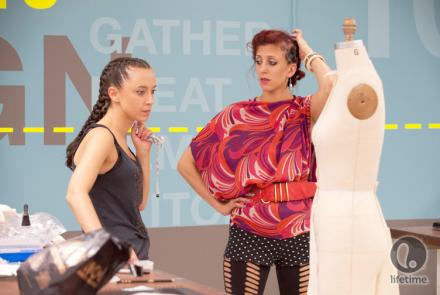
In that week’s challenge, designers were randomly paired up to create a red carpet, runway ‘look.’ Enter Elena and Buffy, two of the most unlikely partners you will ever find. Elena is angry and high-strung. Buffy is a friendly, jovial sort. Elena wears her dark hair in severe French braids and scowls at the camera, while Buffy flashes one smile after another. Buffy even has pink hair, accented with a multi-colored, cheetah patch shaved into the side. Elena designs would fit in The Girl With the Dragon Tattoo collection. Buffy could design for the Girls Just Wanna Have Fun boutique.

Their time together went about as well as you can imagine, with Elena bossing, criticizing, and sniping at her partner and Buffy keeping her head down, too afraid to say anything for fear of having her head bitten off. As I watched it with Molly, I thought how we might cover the basic Project Runway Life Lessons – again.

What kind of person do you want to be? A nice one.

How should you treat people? With respect.

Who do we root for? The good guy with the most talent, of course.

Those are the standard conversations Project Runway delivers to our home on a weekly basis.

But then it happened, that little moment where a whole new conversation unfolds.

In a cutaway interview, Elena defended her actions,

“Being from where I am, you need a toughness to survive. If you go to Ukraine, no one is going to say please and thank you and blah, blah, blah. To just survive and eat every day, people really have to hustle. You have to be very strong. The weak ones don’t survive.”

Suddenly her strident behavior made sense. She comes from a place of scarcity and even though she has lived in the States for almost 20 years, the fear of not having enough has never subsided. I imagine that fear gives rise to the aggression and arrogance that Elena displays, not just toward Buffy, but also toward everyone on the show, from contestants to judges to the grandfatherly host.

I recently read a passage from a book and I immediately thought of Elena. The author said, “Where does arrogance come from? The answer, I think, is fear. The more insecure I feel, the more arrogant I tend to become and the most arrogant people I know are also the most insecure. The arrogant ego… is fearful of losing its status if it loses the battle at hand.” In a world of scarcity, to lose a single battle is to risk losing everything.

In contrast to Elena, it’s clear that Buffy comes from a place of abundance, a place where it’s easy to say “Please” and “Thank you” and wait your turn, because there is always enough. (We thought she was from England, but it turns out she was raised in Dubai.) When you are assured of your place in life and in line, you can sacrifice your ego once in a while for the sake of peace and the well-being of the other. You know there is always another opportunity around the corner.

After Elena’s comments, I paused the show and Molly and I talked about scarcity and abundance, about communism and capitalism, and about how our childhood experiences shape us. Was Elena really talking just about food? What else might have been scarce? Maybe kindness and compassion, love, or respect? Even if they were present in her home life, they obviously weren’t abundant in her culture. To this day, their lack affects her perception of the world and therefore the audience’s perception of her.

I’m almost embarrassed to admit that Elena is currently listed as the “Fan Favorite” on the official website by a wide margin. What does that say about the typical viewer of the show? Nothing good I’m afraid, but clearly, we are not the typical viewer. Buffy is Molly’s favorite contestant and I asked her to think about what Buffy had in abundance as a child. Probably everything, we agreed. When you think of Buffy as a girl, you think of art supplies, dance lessons, and face painting, but Molly thought she probably had lots of love and patience, hugs and kisses too and maybe even a really funny dad. When you have an abundance of joy, it’s easy to share with others. I guess the same goes for pain too.

Molly and I wrapped up our “talking timeout” by naming some of the “abundance” people we know and how much we enjoy their company, but we also thought about the “Elenas” in our life, who might need a little more empathy the next time we encounter them on the playground, or in life. Scarcity is no fun and it’s scars run deep.

I never imagined I would be having this conversation with my 10 year old on a Saturday morning, but that’s the magic of Project Runway. Under the guise of fun and fashion, it allows me to talk with my kids about everything from politics to economics, morality to spirituality. You aren’t going to get that in 60-minutes or less anywhere else.

Humbled. Chastened. Abashed.

I’m not quite sure what to call it, but I think that is what I felt as I sat at my computer this morning.

It started out simply enough, a quiet cup of coffee together before Tim headed off to work and the kids woke up. We’d been on a family vacation for a few days. The house was a mess and the pantry was bare.

There was work to be done.

I knew I would be busy this day, with home and office work, with emails to answer and send, calls to make and return, pages to read and write. But I thought of how Tim was leaving for work before 7, shaved, showered and dressed – with shoes and socks on even – and how he wouldn’t be back for at least 10 hours. I thought about how most my work could be done in my pajamas and slippers, without ever leaving the comfort of my own home, or car, or neighborhood. In gratitude, I wanted to go the extra mile. As I looked up at him to say goodbye, I said, “Is there anything special I can do for you today, babe?”

I thought he might mention a favorite meal for dinner tonight, something he needed from the market, or a chore he wanted me to do.

Instead he took my hands in his, looked me in the eye and said, “Could you be happy when I get home tonight?”

Gulp.

I laughed and said, “Of course, I’ll do my best!”

And he laughed and kissed me goodbye and left. Within an hour, I had the kids up and all the breakfasts and lunches made and packed. I collected the swimsuits and towels and water bottles and hats and backpacks and fins and got them to their right owners. I applied sunscreen and hugged and kissed and sent my little lifeguards off to their 10th consecutive day at the beach.

And then I stopped and thought, “What did he mean by that?” and then I sat down to write.

Last year, my friend Nanette took me to a two-day seminar called, The Extraordinary Value of a Man. Go ahead and laugh. I know I did when I heard what it was called, but I adore Nanette and would go anywhere and listen to anything just to spend two days with her. I heard many things that weekend that made me uncomfortable as a middle-of-the-road feminist. I hate to hear traditional gender roles and stereotypes discussed as facts. I understand the danger of essentializing genders, of saying, “This is how men are…”, or “This is what women want…” As an academic, I understand how powerful and therefore how damaging those cultural messages can be. But as a woman and a wife, I heard many other things that were true of my husband and myself and the way we relate to each other. So although I think the seminar might have been more appropriately called The Value of an Extraordinary Man (because there is a big difference), one particular line helped me to understand better where this morning’s strange request came from. I had scribbled in the margins of a handout from the weekend,

“When you’re happy, he’s winning.

Let me clarify; I don’t think it’s strange that Tim wants me to be happy. I do think it’s a little strange that he asked to me to be happy. Generally, I’m a happy person. If you ask people to describe me, my smiley demeanor is one of the first things they will mention. Happiness, at least on the surface, is my default setting.

What I think Tim was really telling me when he left for work today was that he needed a win. When he comes home tonight, what he really wants to know is that what he did all day matters, that I have benefitted from his hard work and effort, from the sacrifices he makes to provide for our family, not just financially, but across the board in every way. He doesn’t want more accolades, or appreciation, or even fawning servitude. He just wants to see me smile. If the kids are smiling as well, that’s even better.

So what about those emotions I mentioned when I sat down to write about this? How could such a simple request bring about such a strong reaction? It certainly wasn’t his intention to make me feel that way and if I know my husband, he’ll apologize as soon as he reads this, even though he simply answered my question.

Tim didn’t call me out. He didn’t criticize me, or admonish me to do more. He simply asked me to be the one thing I claim to be  – happy. When I look at my life and the many things I am fortunate enough to have, I don’t know how I could be anything else. We have everything we need, and many things we want. We have health, home, family and friends. We have each other. Are there stresses and worries and things that go wrong? Absolutely. Is there pressure to succeed and perform at ever higher levels? Of course. Are there fights and parenting dilemmas and tension every day? You bet.

Can I still be happy at a certain time (around 5pm), on a certain day (Monday, July 30, 2012), in a certain place (our home)? I am certainly going to try. Depending on what happens at 4:59, making his favorite dinner might have been a whole lot easier. It doesn’t change the fact that my happiness is one of the things he is most proud of.  It’s chastening to think that the gift I share so freely with others has not been so freely given in my own home.  However, a little humble pie might be just the motivation I need to make it happen tonight and any other night I might forget to be grateful for all that I have.

No matter what faith tradition you come from, or even if you come from none at all, we’re all familiar with some version of The Golden Rule:

Do unto others as you would have them do unto you.

We learned it in our kindergarten classrooms, sitting shoulder to shoulder with the nose-pickers and glue stick-eaters, pretending we weren’t one of them. We heard it echoed at the start of every school year, when teachers established the rules that would govern the classroom. From playground politics to sticky-fingers in the supply cabinet, they could always refer back to that ethic of reciprocity, forever posted in a prominent place for all to see.

Following The Golden Rule was tough enough to do back then, but in many ways, I think it’s even tougher to do now. Oh, we might think we’ve got it down, waiting patiently in the Starbucks line, holding the door for strangers, and wishing acquaintances and friends “Happy Birthday” on their Facebook pages, but every day, from gossip (celebrities count!) to driving (don’t we like to see a blinker once in a while?) to how we greet our loved ones when they come home, we are challenged to act only in ways we would want to be acted upon.

Because of my faith tradition, I have had the added bonus, (or onus) of following Jesus’ precept to “Love thy neighbor as thyself.” As a young person, I thought the two rules were synonymous, but as I’ve gotten older, I’ve come to see how much more challenging it is to follow the latter, instead of simply abiding by the former.

Take carpooling, for instance. Are you familiar with the “Golden Rule of Carpool?”

Carpooling is a fact of life for most families, a necessary evil one moment, and a lifeline the next. With careful planning and selectivity, a carpool can magically reduce your driving workload in half, sometimes even more. It can give you time, peace of mind and a little more money in your pocket (or a lot with gas at $4/gallon.) However with the wrong people involved, carpooling becomes an exercise in frustration and masochism. Any experienced parent knows this, which is why we manage our carpools so carefully.

So on the surface, it would seem that the “Golden Rule of Carpool” is pretty straightforward. Carpool with people you trust. Show up on time and on the right days. Deliver children to the destination in a timely manner. Bring them home again safe and sound and having learned no new curse words from the moment they entered your vehicle until they left it. That is “doing unto others what you would have them do unto you.”

But is there a difference between that and “Christian Carpooling?” Recently I was challenged to think about what it means to truly follow in my Rabbi’s footsteps and “love my neighbor as myself” when it comes to the daily grind of transportation.

I’m not speaking of the times when we “rise to the occasion,” as my mother calls it. I am sure we’ve all stepped up and helped out a friend, or neighbor in need, due to sickness, injury, or hardship. In those cases, we don’t even mind doing all the driving ourselves, if it truly helps someone. We feel kind of good about making the sacrifice and deep down we expect that someone would do the same for us, if circumstances were different.

But what about those times when there is no need, no ‘occasion’ to rise to? What is The Golden Rule when it comes to someone else’s convenience, especially if it slightly inconveniences you? This was my dilemma.

My three kids have gone to a jr. lifeguard program every summer for the past four years. The beach is about 15 miles from our home and I have carpooled with the same two families every year. We have the “Golden Rule of Carpool” down pat. We show up. We drive safely. We even treat all the kids to Slurpees once, or twice a week. There is music; there is laughter; there is dancing; there is joy. This is my wheelhouse; sandy, salty, sunburned, wet-headed kids are a favorite of mine.

My carpool was planned weeks ago. We even included a new family for two of the four weeks when they needed our help. The passenger manifesto was maxed out at seven, (which is why so many of us can never get a Prius though we long for one.) I had an IPod full of summer pop music to wake the kids up on the morning commute, and I was looking forward to hearing all about their adventures when it was my turn for the afternoon drive home.

And then on Saturday night, just two days before the program began, I got a text from a mom I know in the neighborhood. I wouldn’t call us friends, but we are definitely friendly.

Her: I saw your kids are in Junior Guards with one of mine. Can we carpool?

Alas, No, was my easy answer. We are all full up, with 5, then 7. Sorry!  But, I added with Christian charity, if you get in a pinch, give me a call and I will try to help out! 🙂

She responded back quickly with Do you know such and such? which I did, of course. That family provided our #6 and #7 for part of the program.

Me: Yes, they are with us. Sorry!

To which she replied, Oh, you have 7 and I only have 1! Boo… hoo… 😦

At which point, my guilt kicked in. Something about those numbers tugged at my heart and I gave up on the “Golden Rule of Carpool” and switched to the concept of “Christian Carpooling” instead.

(A downside to a daily practice of meditation and prayer is that you become more and more aware of how everything you do is an act of faith.)

I started to think about how many carpool parables Jesus might use if he were alive today in Southern California. I thought about how I had “many” and she had only one. I thought about how I was part of the “inside” group with my carpool all organized and fun. I thought about how it must feel to be on the “outside,” just she and her child. I thought about how truly golden it would be if I reached out and included them, however I could.

I thought about all those things and then I did nothing.

But the very next day I got a phone call from her, asking again very nicely to please include her child in our carpool, at least at least for two weeks before the other kids joined in.

On the spot, I caved and Tim just shook his head. I have a long and checkered history of taking on other people’s carpool problems, but I couldn’t help it. Though I didn’t want to change my plans, it just didn’t seem right not to make her problem my own.

Is that last statement a sign of Christianity, or co-dependency? Is there a difference? Is that why we have so many co-dependent Christians?

And so in the midst of my Sunday chores, while my kids were out back, swimming and eating popsicles, I began the shuffling of responsibilities, the emails, and phone calls to the original parties: the “Would you mind…?” and the “How about…?” and the “Does this work for you?” When I got to the end of the driving assignments, I had apparently made a mistake, because then the text messages began. Our new carpool member couldn’t drive certain days and times and though the requests weren’t unreasonable by any means, I had to be the dispatcher, and start over again.

Sigh.

Why does “Christian carpooling” always come back to bite you in the butt?

I would like to say that my charitable impulse to include our new carpooler made these chores a breeze. I would like to say I felt good about rearranging our schedules. I would like to say I did it all with a smile on my face and love in my heart, but I would be lying. I didn’t. I was actually pretty darn bitter about having to spend time on a beautiful afternoon on something I didn’t want to do in the first place.

While I think I did the right thing by helping out this mother and child, I sure wish that when I have an impulse to do the right thing that impulse would stick around a little longer and carry me through the execution phase as well. But I guess an impulse is just that – a pulse. In my case, a split-second surge of goodwill, of trying to love my neighbor as myself, caused me to lose an hour or two to general crankiness, which I directed at the people around me. It was “the Cheese Touch” all over again.

When Tim called me out on it, I didn’t know what to say except this: I wish I were more holy, more Zen, more able to have my inside emotions align with my outside actions. I’m trying to get there, but when I struggle so much to get it right when it comes to something as simple as carpooling, I’ve clearly got a long way to go.

Post Script: We are three days into the jr. lifeguard program and our additional passenger is lovely. Neither child, nor parent has added one bit of stress, or unpleasantness to our days. In fact, the conversation is better with this one around.

Note to self: Make the effort. Withhold judgment. Love your neighbor.

Disclaimer: If you read this and knew I was writing about you, thank you for carpooling with us for these next few weeks. It’s a pleasure.

Many, many years ago, I was a part-time faculty member in the Department of Rhetoric and Writing at SDSU. It was my dream job – or rather, it was the job I dreamed of having, when having a job was just a dream.

At twenty-one, I was finishing up my B.A., applying to grad school, and engaged to be married to the man I loved. Tim and I went back and forth about whether I would get my doctorate and take a tenure track position wherever it was offered, or whether we would put down roots in San Diego and open a surf shop. Obviously, the surf shop won. One of the deciding factors was that I wanted to be a full-time mom to the kids we would have someday. While doing my research, I didn’t get the feeling that a university professor could take years off to lie on the floor and read board books and push around wooden trains.

So I dreamed of a part-time position, teaching and mothering in tandem, and my dream came true. From the time I got my master’s degree until I became pregnant with our third child, I had steady and regular employment at several different campuses around Southern California. And when I finally left, it wasn’t because things weren’t working out the way I hoped they would.

I left, because I wasn’t who I thought I was.

I had always loved to read and write. At twenty-one, I couldn’t imagine that wouldn’t always be the most important skill I had to share with my students and if I couldn’t teach them how to love reading and writing, then at least I could teach them how to do it well. So I taught them how to read critically, how to say what they meant, and sometimes even how to find something meaningful to say.

But after a few years of teaching, of watching students come in and out of my classroom, becoming better readers and writers, I realized that it wasn’t actually what I wanted to teach them any more. I realized that there were more important things I wanted them to know. I was teaching them how to write, but I wanted to teach them how to be.

Does that sound arrogant to you? Pompous? Conceited? If it does, you’re right and unfortunately, those words describe most of the college professors I had ever met, or at least the ones I disliked the most and I DIDN’T WANT TO BECOME ONE OF THEM. I didn’t want to be another authority figure, who ostensibly taught their subject matter, but in reality, filled lectures with their own personal philosophies. It didn’t matter if it was communism, atheism, socialism, patriotism, Catholicism, or simply hedonism. Although I couldn’t have named my ‘ism’ at the time, I knew I was struggling to teach without it.

And so, uneasy in my professional life, I carried on for another year or two, until I stumbled across an essay in an Oprah magazine from January, 2001. I still have the original page, tucked away in a file. It was written by Parker Palmer, someone I had never heard of at that point and it was called, “Are You Listening to Your Life?” Palmer’s words resonated with something deep inside me.

He said, “I was in my early 30s when I first began to question my calling, teaching at a university and doing it reasonably well, but I felt stifled by the confines of academic life. A small voice inside was calling me toward something unknown and risky, yet more congruent with my own truth.” He admired Gandhi, Rosa Parks and Martin Luther King Jr. He had read their work and allowed it to change him. He went on to admit that “Clinging fearfully to my academic job even though it was a bad fit, I tried to teach the way I imagined my heroes would. The results were rarely admirable, often laughable and sometimes grotesque, as when I caught myself preaching to students instead of teaching them. I had simply found a ‘noble’ way to live a false life, imitating my heroes instead of listening to my heart.”

And as I read those words, curled up on my couch with a cup of tea on a January afternoon, he spoke to my heart and he broke my heart. I remember the tears streaming down my face and my heart beating faster. Becoming a college professor was all I had ever wanted to do professionally. I had never conceived of a time when I would not want to read literature, write about literature and teach literature. I didn’t even know what else I could do. I just knew what I had to do, even though it seemed impossible. I knew it was possible, because I saw him do it first.

Frederick Buechner, an author and theologian, defined vocation as “the place where your deep gladness meets the world’s deep need.” I knew that there was a deep need for good writing instruction – any school principal, college dean, or business leader will tell you that, and I knew that I could meet that need; I was good at it. I had the reviews and renewed teaching contracts to prove it. But after my many years of teaching, I also knew that I would not find my deep gladness there.

I couldn’t teach, or preach in my classroom any more – it just didn’t matter enough to me if they knew how to write a thesis, organize an essay, or correctly punctuate a sentence. I still loved literature. I still loved being around young people. I still wanted to influence their lives. I just knew that my vocation was not teaching. I felt that staying in the profession was a disservice to my students and myself. It was no longer an authentic way of communicating who I was and what mattered to me. Maybe it was naïve to quit and get out of the work force, but I wasn’t able to see another way to listen to my heart and I had the privilege of making that choice.

For the next ten years, I found my “deep gladness” being a mother. As a bonus, nothing about that career choice kept me from sharing my “isms.” I didn’t have to hide my personal philosophy from “my students.” I was and still am allowed to teach, preach and even screech what I believe. As a matter of fact, it’s my responsibility to teach them how to be and as a bonus, I get to teach them how to write as well. It is one of the perks of my job, but as a full-time position, it’s rapidly coming to an end. They are all proficient writers, but even more importantly, they are beyond-proficient, decent human beings and so once again I have become uneasy in my “professional” life. While it has brought me “deep gladness,” I believe I can do more to “meet the world’s deep need.”

Though I wasn’t sure what I was “supposed” to do, a few years ago I started to write for an educational non-profit.  I began to speak to different groups when invited and last year, I started this blog. I hear from time to time that it has helped someone to think about how to be in this world and those comments always make me smile, because deep down I know I am still teaching, though maybe not in the traditional sense.

Ironically enough, I recently came across Parker Palmer again, this time in his book A Hidden Wholeness: The Journey Toward an Undivided Life. Though I got it at the library, it is covered in my sticky notes, of different sizes and colors, some for me, some for Tim, and some for my friend T, who reads every great book with me. She already has her own copy on order from Amazon.

In the very first chapter, he lays out a problem many of people face, myself among them.

Afraid that our inner light will be extinguished, or our inner darkness exposed, we hide our true identities from each other. In the process, we become separated from our own souls. We end up living divided lives, so far removed from the truth we hold within that we cannot know the ‘integrity that comes from being what you are.

At twenty, I pursued a career in good faith, thinking I knew who I was. At thirty, I took a leap and fully embraced it, but in the smallest terms possible, within the four walls of my home and the four people who lived there. At forty, I am knocking those walls down again, while trying to remain faithful to who I am and the truth I hold within. It is the truth I have learned over the last twenty years of teaching and writing, parenthood and marriage, business and friendship.

I am here to love. I am here to be with people, to support, and to serve them. In my best moments, when I am patient and humble and kind, I am here to help people see for themselves who they are and what they are capable of.

And it doesn’t matter whether I do it in a classroom, or a conference room, on paper, or in person. It is my vocation, “where my deepest gladness meets the world’s deep need.”

What is your vocation? What are you called to do in the biggest terms possible? How are you living it out?

That isn’t a loaded question. I think we all live out our vocation in at least some small way in our lives. It’s what gives us the ability to find joy, to smile and love and ultimately, to carry on, each and every day. 

Recently, the Lad and I watched the film Extremely Loud and Incredibly Close. We hadn’t planned on it being just the two of us, but one by one other family members dropped out, citing work, sleep, or just something more generally FUN. In hindsight, I don’t blame them, but Finn and I were compelled – me because I loved the book. Him because, well, I don’t really know.

It was a strange movie to watch with my son, because it is so much about the power of a good father-son relationship. Thomas Schell, played by Tom Hanks, sends his quirky son on elaborate adventures, designed to teach Oskar how to be brave and to experience more of the world than he would have chosen for himself. With patience and creativity, Thomas Schell embraces his son for who he is: intelligent and curious, but also compulsive and fearful.

That dynamic alone made it an interesting movie for me to watch with my son. I kept sneaking peeks at him to see what he thought. My husband Tim only has fuzzy memories of his own father, who died when he was 10. I know that a large part of Tim’s “fathering” is a result of the absence, not the presence of, a loving and involved father. While Thomas and Oskar interacted on screen, I would look at Finn and wonder, “How will he remember his dad? Is Tim making him brave? Is he making him kind? What kinds of things is Finn learning, beyond a killer ping pong serve and a sweet jump shot?” Deep down, I know the answers to those questions. Tim and Finn interact very much like Thomas and Oskar. They are cut from the same cloth, from broad shoulders to tender hearts and a wicked sense of humor.

But while I got lost in my reverie, the movie was passing me by. When I tuned back in, it was 9/11 and Thomas Schell is in the World Trade Center and then he is gone and it is Oskar and his mother who are left to pick up the pieces. In the beginning of the story, the mother is the observer in the family who admires and appreciates the connection between father and son, without needing to be a part of it. She knew her husband had Oskar, in all his weirdness, covered.

And then he doesn’t.

And although she does her best, it is nowhere near good enough for Oskar, who in his grief and anger and guilt screams, “I wish it were you that day,” to which she sadly replies, “I know. I do too, buddy.”

She knows her husband would have done it better. She knows she is failing Oskar in some crucial way and yet in that moment, in her own grief, it is beyond her ability to do better.

Again, I had to look at my son, who made sure he never looked at me during that scene.

What would he say, I wondered, if he had to choose? I know it’s a morbid question, but I am glad that it wasn’t immediately obvious to me who he prefers. I don’t actually know what any of our children would say.

I am the caretaker. Of that, there is no doubt. They love my cooking and the way clean clothes land miraculously on their bed every few days. They count on me to help them with their homework and projects and I am the only one who can rub their backs just right before they go to bed at night.

Tim is the player of all sports and card games, the Dairy Queen-on-a-school-night kind of parent. Grades don’t matter much to him; it’s all about whether they learned something, or not. He may feed them cereal every night when I am gone, but at least they get fed.

Between the two of us, we make a home and though it is unimaginable that we could do it alone, this movie gives me hope.

I don’t want to give away too many details here, but ultimately, the mother moves past her own grief and discovers a way to help Oskar heal. When he recognizes the sacrifices his mother has made for him, the love she has shown, he says through cathartic tears, “I thought only Dad could think like me.” (Which for a head person like Oskar – and myself – is the ultimate compliment.)

Linda Schell had thought so too, until she actually tried. Her willingness to embrace Oskar for who he is allowed him to reframe his story – the one he’d been telling himself his whole life, and especially since his father’s death – that his dad was the only one who loved him, the only who could love him. It turns out, that wasn’t true at all.

I immediately thought, Look, Finn, Love Wins.

It isn’t easy. It’s bound to be messy. It certainly requires more of us than we think we’re capable of, and frequently more than we want to give. But if we don’t give up, if we open our hearts, if we keep doing what Love asks of us, even when it seems impossible, then we can change our lives. We can change the lives of those we love. Heck, we just might be able to change the world. In the midst of tragedy, Linda Schell did it, and although she is a fictional character, there are thousands of people like her in real life that do it all the time.

And as the film ended and Linda held her son close, I gathered my own little man, who is growing quite big, in my arms as well. I kissed his forehead and rubbed the top of his ¼” crew cut and hoped I could remember forever how his freckled face looked as it turned towards my own. He is 13-years-old and before I know it, he may not be compelled for any reason to watch movies with his mom on a Saturday morning. Very soon, the Lad may have other plans, thank you very much.

But until that day, I will savor these moments. I will cherish each and every time I get to curl up on a couch with him, share a blanket and a bowl of popcorn. I will stand watch as he processes the vagaries of life on the silver screen, the pages of a novel, the columns of the morning sports page, and especially in his daily routine. And I will remind him every chance I get that Love Wins if we have the courage to choose it.

Rachel Held Evans wrote a great blog recently about the concept of being ‘enough’ and it got me thinking seriously about what that would actually mean – to feel like you were ‘enough,’ simply by the fact of your existence.

I’m not talking about being enough because I work hard, or prepare meals, or work out at the gym, or read good books, or go to church or do laundry, or get paid. I’m not talking about being enough, because I do anything right, or of value.

I am enough, simply because I am.

Talk about a radical idea…

Last week I made a hand-written sign to put above my desk where I sit and write. It said, “Things don’t have to be perfect. Good enough really is good enough!!!” If you’re familiar with my blog, you know that wanting things to be ‘perfect’ is one of my vices.

It’s something I’m working on, with imperfect results, of course.

Case in point, the first sign I made wasn’t just right and I was about to make a new one to improve the spacing and color coordination, when I caught myself. Apparently when I created the sign, I hadn’t actually meant it. I considered it a minor victory that I stopped myself and said, “This sign is good enough.”

I apologize to my kids frequently for putting them on the wrong side of the column – the side where I put things I can make perfect, things that I can control. Don’t ask me why ANYTHING is in that column at all. It’s a fantasy, but it’s especially insulting to other human beings when you make them your own personal perfection projects. My kids don’t deserve that! No one does. Tim, by the way, was off that list about 15 years ago, which I think is the reason we’re still happily married today.

Ah, but back to my sign. By creating the sign, I was trying to remind myself not to obsess over my writing, my work, my kids, my finances, my house, my life. I was trying to encourage myself to see that things really are okay, and that okay is okay.

But after I read Rachel’s blog, I saw that my signs didn’t go far enough. By telling myself to let things simply be ‘good enough,’ I was still saying flat out that they could be better, that they probably should be better, but that forgiving myself for not making them better was the best way to go.

But Rachel’s point is this – we are enough. Simply by the fact of our existence, our birth, our presence in the world, we are enough.

If I get the dishes done before Tim comes home, I am enough. If I don’t, I’m still enough. If I make a healthy, home-cooked meal, I am enough; if they eat McDonald’s, yep, I’m still enough. If I smile at my neighbor, work in a soup kitchen, and turn in a kick ass assignment for my boss, I am worthy and even when I don’t, I am enough.

And honestly, I don’t think feeling like I am enough would let me off the hook. It doesn’t mean that I can lay around the house all day, watching reruns, eating Cheetos and feeling good about myself. Well, sometimes I can. But for the most part, I imagine that having the sense that I am enough would give me the desire to treat other people as if they were enough – my kids, my spouse, the annoying checker at the supermarket. If I am enough, so are they, and so how in the world could I treat them as if they left something to be desired? However they are, they are enough to merit my love, my respect, my time and for the checker at Vons, at least a smile.

I went walking on Saturday morning, with this radical concept of enough-ness, rattling around in my head. After reading her blog, I got why she says we are enough – at least in theory. And I started to reflect on how I can know something is true and yet have that knowledge barely scratch the surface of my heart. And then I laughed, because of course, for me, knowing something is very different from feeling something.

I know I am enough, but do I feel like enough?

Not by a long shot!

So that was my task as I walked that morning. I prayed that my heart, this hard little shell that I have lodged deep in my chest, would crack open just a little bit, and allow what I know in my head to drop down into my heart, to give me just a glimpse, just a taste of what it feels like to be enough. I would have loved a rush of emotion, a complete transformation, a ‘born again’ moment, but alas, no such miracles were forthcoming.

But at one point under the balcony of trees in the canyon, I stopped and I just breathed in and out, trying to be present to myself, to my heart and mind. I lifted up my insecurities, my perfectionist impulses, my ‘to-do-to-be-perfect’ list and I dismissed them. I just said, “Here. I don’t want them. Take them and don’t give them back.”

Of course they didn’t really go anywhere. I talk a good game, but apparently my well-trained compulsions are on a short leash. They always come back to me, even when I don’t call.

So what I hoped for didn’t happen, but this did. After a minute or two of standing there, wishing like crazy that I could feel something that felt like being enough, I opened my eyes, and this is what I saw.

heart nature

And I knew that my prayers, my desires, my longings were heard. Somehow, the request had gone out. I did not get the answer I wanted, right when I wanted it, which would have been perfect, but I got a sign of Love, of Presence, and of Grace.

And it wasn’t just good.

It was simply enough.