7125995_origThis is Holy Space/ God is here – you are welcome/ This is your space to be with God/ And God’s space to be with you/ Make yourself at home/ Be yourself/ Be real/ There is no rush/ Let God love you

Just over a year ago, I began my walking meditations in the morning. I went outside and “walked” my prayers, because I needed to remove my head (read: my ego) as the primary operating system for my spiritual life. My mind, intellect and will had taken me about as far as they could go on that journey. I had knowledge; I had discipline; I had something to show for all my hard work: hundreds of pages of prayers and journals and an annotated reading list a mile long. But the fact of the matter was that little to none of this “spiritual” work was actually reaching my spirit any more. So when I had an opportunity to ask a wise woman how to change that, she told me to take a hike, literally. And so I did, every day, for months.

And my head was happy, because she still got to be in charge of directions and my heart was sad, because she had to actually feel what I was feeling. Instead of watching from a distance, my heart experienced disappointment, frustration and sadness. Sometimes, she felt lonely and confused. Previously, I could direct those emotions to my head where my ego would take over, fix the glitch and reason it all away. Our hearts have no such tools. To contain the paradoxes of our lives, they must soften, expand and adapt. In our hearts, we discover that our lives are not something to be solved, but rather something to be lived. By placing my head beneath my heart, I knew pain, but I also experienced authentic joy, connection and wisdom.

Switching the GPS for my spiritual journey from my head to my heart had some unexpected fall out. Simply put, I felt lost. All the maps I had used were obsolete; my best shortcuts took me to dead ends and dark corners. I could no longer get where my ego had been telling me I needed to go for the first forty years of my life. I didn’t realize it at the time, but my final destination had changed.

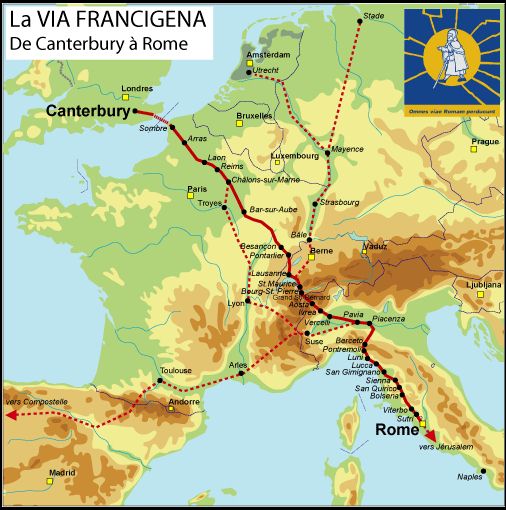
I had always thought of my life as a journey. The ultimate destination was heaven, but there were a lot of stops on this side of the grave. I witnessed the lives of my parents and their friends. I watched TV shows and movies; I read lots of books and they all seemed to say this: Life is about having a goal. Make a plan and make progress. Go to school, get your degree, get a job. Fall in love, get married and have kids. Raise your kids, work hard and retire. You’ll die, but you’ll rise again on the other side, better than ever. In this schema, life is about forward motion. You could expect some ups and downs on the journey, maybe even some detours, but you always knew where you were headed, because you had a plan. “Life as a journey” looked something like this.
mappa_via_francigena

If Rome is the birthplace of Western Civilization, picture Canterbury as heaven. For a scholar of British literature like myself, it’s not such a stretch. Can you see how it works? Though the way may be far, the journey is all mapped out for you. Anytime you get sidetracked, you can just get back on the road and head to your next destination. There are lots of people with you, safety in numbers and all, so you can never truly be lost.

But over the last few years, between the Great Recession, career changes, teenage children, and a dark night of the soul, the way disappeared. However, I didn’t know how to travel any differently. Even though I had switched operating systems, I just kept trying to make “progress.” It’s what our culture expects us to do. Make something happen. Keep something from happening. Set a course. Stay on course. Find a new course. Move on!  I had done it pretty successfully too, but as I listened to my heart, I finally had to admit that the “life as a journey” metaphor just wasn’t working for me any longer. It’s hard to move forward when you don’t know where you’re headed. So instead of a map, I found this image to rely on.

labyrinth1

In the center of my labyrinth is God and somewhere in the midst of the maze, I am. For the life of me, I couldn’t tell you where. I don’t have a map, or a plan; I have no idea where my next stop will be, or how long I’ll stay there. However, I am also no longer plagued by the question, “Am I making progress?” In a labyrinth, who can tell? When it seems like you are at the furthermost point, you can take one more turn and walk right into the heart of it all.  When you’re confident you are almost “there,” you can pretty much count on being wrong and finding yourself back in the outer ring once again. It is the way a labyrinth works.

Though the image would have terrified my ego, “life as a labyrinth” makes perfect sense to my heart. I may not be able to see where I am headed, but I know I’m never lost. There are simply no wrong turns. There is only one winding path and it leads directly to the heart of God. I cannot go astray as long as I am heading in the right direction. If I ever wonder what direction that is, I simply sit in silence and stillness until I find myself pulled in the direction of Love. And if I ever get scared, turn my back and start walking the other way, all is not lost. The labyrinth is my life; I can never walk out of it. I’ve just made the walk home a little longer.

*The poem is an excerpt from www.labyrinth.org.uk. The heart image is from talented artist, Whitney Krueger.

Last year, I wrote about one of my favorite annual traditions: washing my family’s feet on Holy Thursday. It resonated with many of you and some even said they were adopting it as their own this year. For those of you who missed it, I am linking to it here, but I have to be honest, it almost didn’t happen this year.

baby-feet

We are leaving for Mammoth today, so any foot-washing was going to have to happen a day early. It takes quite a bit of effort to create the experience and as of yesterday morning, I hadn’t done a lick of it yet. No songs, no letters, no time set aside. I started to rationalize: the kids are probably getting too old; they are so excited to go to Mammoth they will probably forget anyway; they would understand if I skipped it. But deep down, I knew. Nothing I needed to do was more important than creating this sacrament of love.

I was right.

Keara soaked up the moments, then hugged me tight.

Molly got tears in her eyes as we belted out her favorite song together.

Finn could hardly suppress his grin, saying “This is one of my favorite things you do.”

The Franciscan priest, Richard Rohr, said that of all the things the Catholic Church made into sacraments, he can’t believe they left this one out and I’ve got to agree. I hope that at least once in your life, you experience having your feet washed as a loving gesture, instead of a paid service, but I also hope you have the privilege of holding someone else’s feet in your hands and blessing them as Jesus did. It is a gift to both giver and receiver to be so vulnerable and to experience such intimacy and grace. This is sacred space. 

If they are honest about it, most writers want to say really important things, to have each story, paragraph and line convey something deep and meaningful. To be honest, I am one of those writers and my desire for significance frequently tempts me to say nothing at all. This week was no exception; I wanted to say something holy and  grace-filled as Easter approached, but I found my heart silent, until I saw this…

Since the video is five minutes long, I will keep my commentary short.

After morning carpool, I watched this video in my driveway and tears began to stream down my face. I don’t know why they came, but I have learned that when tears come unbidden, we are in sacred space. Our hearts are hearing a divine whisper and our body is responding in kind, but all too often, we shut it down and wipe them away. We actually run from the holy.

Poet Mark Nepo wrote, “Our ear is only a petal that grows from the heart.” What my ear heard in those five minutes, my heart loved. What my eyes saw, my soul celebrated. And as the crescendo played out before me and the children danced, I imagined the joy of this coming Sunday morning and the Alleluia choruses that will be sung the world over. I heard Rob Bell speak at USC last night on his new book, What We Talk About When We Talk About God, and strangely enough, he spoke of Nepo’s truth as well. Real seeing, he said, “happens when our eyes and our heart are looking at the same thing.” 

Whether we celebrate Easter or not, we are like the symphony in the square. We each have our own instrument to play, our own voice, talent and energy. My hope is that you will use yours this Sunday morning as you gather with your people – whoever and wherever they are – in Starbucks, in church, or in the middle of an Easter egg hunt. Let your ear be the petal of your heart. See the flash mob of joyful, exuberant love that surrounds you. Be brave and begin like the cello player, setting the process in motion. Be aware of the miracle of it all. And if the tears come, let them fall where they may. You are in sacred space.

As most of you know, I love to find intersections between the head and the heart, the moment and the infinite, the spiritual and the secular. The sacred is everywhere if we allow the possibility and so today, I offer you “The Spirituality of Spin.”

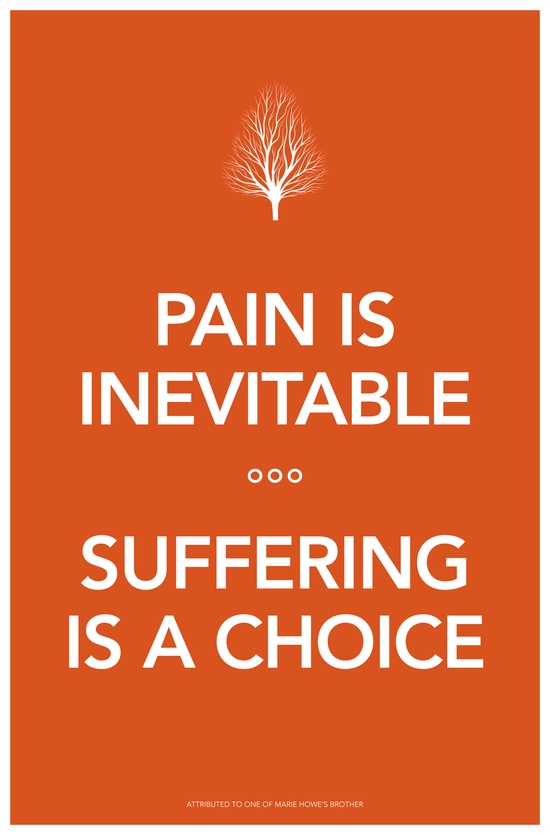
“Pain is inevitable; suffering is a choice.”

These are words of wisdom a friend shared with me recently when I was in a lot of pain. At the time, I wanted to haul off and hit him, but he was just out of reach and I was locked into my pedals anyway. The pain was real and physical, but he also was the one putting me through it. His name is Rich and he is my spin instructor, but I secretly think he was a Zen master in a former life. You’ve got to love a guy who can seamlessly bring Buddhist philosophy, 50s doo-wop music and prodigious amounts of sweat into the same moment.

spin

For many years, I avoided the spin room at my local YMCA. People who “spun” were intense. Whenever I walked by, the lights were dim; the music was pumping; the instructor was yelling, and the cyclists were staring at a glowing LED-display, mounted between their handlebars. They appeared transfixed, as if on ecstasy in a techno-fueled nightclub. Not my scene, thank you very much. I also happened to cherish sitting normally after a work out. Spin will never win, I thought smugly.

But about a year ago, one of my good friends defected to the dark side of the gym. She didn’t become an addict exactly, but two days a week, I’d see her in there, huffing and puffing and pedaling away. She invited me to come with her; I demurred. She told me what a good work out it was; I scoffed. She promised me my butt would adapt; I doubted it. But I couldn’t completely dismiss her perspective; I trust her. She’s a fit, successful, serene, 50-year-old woman who would never tolerate bad music, or macho bullshit. If she chose to spend an hour in a spin class, there must be something to it after all.

So I gave it a try and after a couple misses with bad music (the dreaded techno music) and worse instructors (pompous donkeys who sat up on their bikes and played air guitar while talking about how high a gear they were pushing), I finally made it to Steph’s cherished, Friday morning class and found my “spin” home.

Like any new exercise routine, or spiritual practice, spinning felt a little awkward at first. It was Catholic calisthenics all over again. We sat; we stood; we did a strange hover over the seat for 20 seconds at a time. I was always looking at my neighbor to gauge my posture and proficiency. I couldn’t tell if I was trying too hard, or not hard enough. I couldn’t seem to find the rhythm, when everyone else moved like an old pro. But the instructor Rich began that first class, and every class since with a gentle reminder: For the next sixty minutes, we simply need to be present to ourselves, to acknowledge what we feel and do what we can do. For the next hour, there are no problems to solve, or people to fix, so we can focus on why we are there: to transform our bodies and our selves. His stated goal as our teacher is to push us beyond our comfort zones, which is where all genuine improvement lies.

Though my ego and body didn’t love my first spin class with Rich, my soul immediately responded to his coaching style: creative and engaging, humble, but tough. It took only a few classes for me to begin to see how I could take his words into my spiritual life. Can you imagine a priest, pastor, or rabbi beginning every service that way? Asking us to breathe deeply, to center ourselves and let go of outside concerns? To be fully present to the Presence within us and open to the (sometimes painful) transformation that can take place if we allow it? Though they don’t usually ask, since I began spinning, I try to do it anyway.

Rich reminds us that if we wanted easy, we would be on a treadmill next door and I often think of that as I walk, sometimes reluctantly, into church. If I wanted easy, I’d be back in bed, munching on a donut and sipping my latte. I’m at church for a reason. Walking through life at a comfortable pace isn’t going to change me.

When our lungs and legs are burning, Rich calls out, “This is the feeling of improvement!” In all my years, during the many times I have been on my knees in prayer, in frustration, in desperation for things to be different, I had never thought of it that way. Our hearts and souls are no different than our bodies. Positive change never comes easily. Each step is just beyond our reach and the only way to get there is to do the very thing we don’t think we can do. In those moments in the classroom, Rich reminds us, “Somewhere inside of you is the person who can do this hard thing.” I want to believe he’s right, so I keep pedaling and push on, whether I’m on a bike, or in the midst of my life.

Finishing up a tough hill, Rich asks us to imagine our 80-year-old selves, thanking us for what we are doing right now at the age of 30, 40, or 50 and as I hold Tim’s hand at night, apologize for an unkind word, or let go of a petty grudge, I imagine the same thing. I am doing it for us now, but I’m also doing it for our 80-year-old selves. We plan to be together for another forty years at least, but that’s not going to happen if I don’t take care of business today.

One day when the hills were extra long and the incline steep, it seemed like the hour would never end. No matter how good the music, or how fine the company, I just didn’t have it in me to finish hard. I wanted to back off and quit, but sensing the mood of the room, Rich tried another tactic. He made sure we knew we were in this together. “Every one is feeling what you are feeling,” he likes to say and you can tell by the effort in his voice that he is no exception. He reminded me that solidarity is the key to enduring any difficult experience. Knowing we are not alone in our pain allows us to transform it. Great leaders, spiritual or otherwise, embrace the trials of their people and the burdens of their community. A great Leader is with you on your journey, in your effort and pain. She isn’t standing in the Promised Land, waiting for you to hurry up and get there. He doesn’t pretend that the journey didn’t cost him something as well.

Great leaders aren’t impatient. They don’t shame and blame, judge, compare and compete. They meet people where they are. They care and then they cure. I don’t know if Rich does all that in two, sixty-minute spin classes each week, but I do know I leave there better prepared to face my day, more sound in body and mind.

Pain

The most Zen of Rich’s words are where I began. Though they were spoken in the sanctuary of the spin class, they have resonated with me every day since. When I encounter frustrations, big, or small, I am reminded that the choice is mine. The pain may be inevitable, but the suffering is not. I still choose to suffer more than I’d like, but because I signed up for improvement, I’m willing to work on it. I breathe deeply, relax my hands, and drop my shoulders. I feel what I am feeling and then I move on. I know I will be glad I did it today and perhaps even more grateful down the road. And ultimately and perhaps most importantly, I know I’m not alone. I have a great Leader.

FatherKnowsBest_S2

This morning I attacked Tim with a “Plan of Attack” for tomorrow. We have a 7:00 am departure time for one carpool, a 7:30 drop off for another, the Lad bringing up the rear with a 9:00 start time. We have an 11:45 dismissal, a 4:30 pick up across town, and a soccer meeting at 6:30. I leave for work at 4:00, so Tim is on his own for those last two items on the agenda, plus dinner and homework.

This is a fairly typical Wednesday.

Tomorrow is also Ash Wednesday, the beginning of the Lenten season, so I threw some mass times at him as well. The local church bulletin listed services at 8:00 am, 5:30 and 7:00 pm.

“Which one can you make?” I queried. “Kiko is going at school; Finn and I can go to 8:00 am. Can you make it to the 5:30 with Molly, after your 4:30 pick up and before the 6:30 meeting?”

He looked at me like I was insane and I bristled. He wasn’t raised in a Catholic home, so I just knew what he was going to say. We don’t need to go tomorrow. We have a crazy schedule; let it go. You sound like your mother.

I was wrong.

He said, “Can we pull Molly from school in the morning? I’ll go into work late and we can go as a family at 8:00.” I must have looked surprised, because he clarified, “If we all go separately, whenever it fits, then it feels like something we ‘have to do.’ I want it to feel like we mean it, like it’s sacred space and time.”

Gulp. I was being religious, but not spiritual.

In my last blog, I spoke about people who honor rules and traditions more than their meaning. In this blog, I wanted to show you how easily it can happen. In the busyness of my life, in my planning and organizing mode, I lost sight of the holiness of the ritual, the significance of it all. While I was thinking “Get it done,” Tim was thinking, “It’s only worth doing if we do it right.” Have I mentioned lately how grateful I am to be married to this man?

As someone who is spiritual and religious, I seek the balance between the two. I don’t want to follow a set of instructions mindlessly, but I don’t want to throw them out either.  It seems to me that Tim’s wisdom is something I need to carry into this 40 day season of Lent as well.

Some years, I get lucky. On just the right Wednesday in February, my mind and heart are open to experience the movement of the Holy Spirit in my life. Some years, I don’t. Whether from stress, or illness, or just plain busyness, I am less prepared to recognize an invitation to Love. This is where religion can be our best friend, or our worst enemy. Following traditions and worshipping as a community can open us up when our hearts are closed down, but if we go through the motions without engagement and intention for too long, then we lose their meaning entirely.

Tonight, our family will celebrate a G-rated Mardi Gras. I don’t have to teach, so I’ll make a nice meal and we will sit around the table, listen to music and tell stories. I bet we’ll laugh and probably bicker as well. We’ll talk about Lent and what it means to be in the desert, to be scared and tempted and lonely, but we’ll also talk about what waits for us on the other side, if we trust in the power and presence of Love.

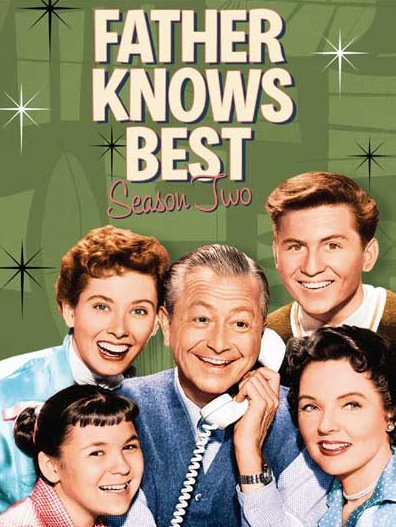
Though the kids might discuss what to ‘give up,’ I’m going to share how the tradition got started in the first place. I don’t want them worrying about “getting it done,” because “It’s only worth doing if we do it right.”   Apparently, in this case, their father knows best.

On the brink of a new day.

This blog is a departure from my usual storytelling and I hope you’ll bear with me. One of the websites I check in with frequently is Sojourners online magazine. They have a published a series of articles on the rise of “The Nones,” those Americans who don’t identify with any religion, or who would say that they are “spiritual, but not religious.” It has caught my interest and although I try not to get sucked down Internet rabbit holes, I have to admit this one’s got my number. I think it’s because I identify with both groups in some real ways.

Like many people I know, I stand in the gap.

As a Catholic Christian, I’ve watched countless friends and neighbors walk out of the church. Some linger at the door on their way out with a wistful look, wishing things could be different. Others hit the ground running and never look back. I understand both exit strategies and have been tempted to join them, but I haven’t, not yet. I am spiritual, but also still religious, albeit reluctantly so at times.

As much as I appreciate the conversations that are going on, we “religious” aren’t going to change anyone’s minds by talking about it, by beating our breasts, or wringing our hands. The “nones” aren’t going to walk back into church, because someone tells them they should, or because it would be good for them.  Shoulds are rarely effective with adults and if churches were actually good for them, in some tangible way, the “nones” would still be there in the first place.

I think the only way for churches to reverse the exodus of the “nones” is by becoming different churches.

DaringGreatly_final525In the New York Times best-selling book Daring Greatly, Brene Brown identifies a phenomenon she calls “the disengagement divide,” or values gap. It is the space between our “aspirational values,” those we claim to live by and our “practiced values,” the way we actually live. It’s the gap between what we practice and what we preach. The gap is inevitable, on both a personal and ecclesial level. But while the first one is manageable, the second is unwieldy to say the least.

On a personal level, we can take responsibility for the gap. We know that perfection isn’t possible, that we fall short each and every day. But if we are healthy and self-aware, we seek forgiveness and make amends. We get up and try again. Though it is a Sisyphean task, a majority of us strive to make the breach as small as possible.

Historically, institutional churches have not made that same effort.

I think it is the “disengagement divide” that the “nones” are fleeing more than anything. A few “nones” might have left the church because of bad music, or a lack of parking spots. A few more might have left because it wasn’t convenient, either to their psyche or their schedule. But I imagine that most “nones,” especially those who identify as spiritual, but not religious are leaving because “the disengagement divide” has become a chasm.

We call ourselves Christians. Right there in our name, we claim whom we follow, Jesus the Christ. That gives us a certain set of “aspirational values” to live up to. It doesn’t mean we need to be perfect, but it does mean we mean have a lot to strive for. Above all, we have to love God and we have to love our neighbor as we have been loved by Christ himself.

Institutionally, we have not done that very well and we have not apologized very often, or taken the necessary steps to correct it either.

Instead, churches have created another sub-group: the “RBNS”s, who are “religious, but not spiritual.” Despite its best efforts, or perhaps because of them, religion has a way of becoming legalistic, of creating in and out groups, and when you are on the inside, it’s awfully tempting to let go of the struggle that true spirituality requires. Belonging to a religion can make it too easy to follow a list of rules and regulations and claim the perks that come with membership.

Spirituality on the other hand is a relationship, an encounter with the Divine that calls us to transcend this material world and the hold it has on us.  It asks us to go deeper. It is through spirituality that we struggle with despair and hope, love and fear, doubt and certainty. Journeying with the Holy Spirit in this way allows us to transform ourselves, our relationships and hopefully the world around us, in a way that mere religion can’t.

Ideally, churches are there to hold us while we engage in this life-long process, but when filled with members (or leaders) who are “RBNS,” our struggle is looked upon as a failure on our part. We are told we just need to “get saved,” or “confess our sins,” or simply trust that they’ve got it all worked out for us from a place of authority. If we would just fall in line, everything would be okay and if we can’t, because we are gay, or divorced, or want to talk about women’s ordination, or whatever is taboo in our religion, that’s when we head for the door.

I haven’t done so, not yet and it saddens me that so many of my peers and the younger generation have done so. I understand it. I am not surprised by it, but I think we will all be sorrier for it. Our churches get more rigid without the leavening yeast of youthful creativity, passion and resources. The “nones,” and the SBNRs relinquish the hard-won wisdom of their religious ancestors, forcing themselves to reinvent the spiritual immunizations that will keep their children mentally, emotionally and spiritually healthy in this difficult world.

I think it comes down to community, another word that gets tossed around a lot in these conversations. Churches are crying out, “You need us! You don’t think you do, but you really do!” The “nones” are shouting back, “I’ve got my own community, thank you very much and it’s way less hypocritical than yours!” There is truth in both of those statements.

We were made for connection and belonging. We need community to hold us together, to remind us of whom we are and what we are about, to lift us up when we falter and praise us when we succeed. Church communities can do that better than any other when the gap between their “practiced values” and “aspirational values” is small. When Agape is the operative word in theory and in practice, we see Church and Community at their finest. But when the gap is large, it can be the loneliest feeling in the world to be in free-fall, knowing that the people who were supposed to love you in God’s name are nowhere to be found and are perhaps even the ones who gave you a shove off the ledge.

I know there are churches out there that do it differently. I have read hundreds of comments from men and women who want the “nones” to know that their church isn’t like that, that they love with their whole hearts and work earnestly to welcome and include everyone: rich and poor, black and white, gay and straight, sure and not-so-sure. I’ve listened to sermons from their pastors, been witness to their diversity and cheered for the life-giving work they’ve done. I like to think my church falls into that category as well. But it doesn’t change the fact that if we have the word “Baptist” or “Catholic” or even the word “Christian” in our name, we are going to have an uphill row to hoe. Despite our protestations, we are associated with leaders who have not walked the talk and institutions that have allowed the “disengagement divide” to flourish for too long.

Though I’ve been on the ledge and even felt a nudge or two in the back, I’m not letting my “church” get rid of me that easily. I’ve benefitted too much from my religious background, education and traditions to let it go. My community is the church and the church is the people of God. I have far more faith, hope and trust in them as individuals and as a group than I do in an institution, whose leadership is charged with protecting tradition and the status quo.

Through his work as a community organizer, President Obama observed in Dreams from My Father that “communities are not a given in this country… Communities need to be created, fought for, tended like gardens. They expand or contract with the dreams of men” (and women I have to add).

I have big dreams for my community, the people of God, but I am pretty sure God’s dreams for us are even bigger. We have a garden before us, a plot of land to tend. I don’t want to fight against SBNRs, people who aspire to something beyond themselves. I want to fight with them to uphold the values that transcend our differences in religion, culture and language, values like Love, grace, beauty, compassion, mercy, justice and equality. I know that wherever those things are found, God is.

I am happy to tell you that Sojourners decided to use this blog as part of their Meet the Nones series. You can check it out here, and read other perspectives as well.

I’ve been doing a lot of “F-ing” around lately.

Get your head out of the gutter.

I’m talking about feeling.

I’ve been Feeling with a capital F and you all know how I feel about that.

I’ve been Feeling frustrated, as if I am in free-fall. I am failing and flailing.

When I admitted my feelings to my genius-friend Steph, she promptly pooh-poohed them.

While I may feel fallow, in her opinion, I am actually flourishing.

For weeks now, she said, I’ve been glowing; she said I must be growing. She said something BIG is happening.

I’m not buying it.

Nothing is happening; that’s the problem.

Apparently God agrees with Steph, because the Universe keeps sending me invitations to see this time of my life in a positive way, but it is sooo hard to do. I see the invitations to be patient, to trust and to wait. I say yes to them on one level, but my ego wants no part of this patience party. My ego wants results.

And so I keep feeling the way I do, and the Universe keeps inviting me to feel differently.

My dear Aunt Beth posts a lot of things on Facebook. Some are profound, some sweet, some silly. I put this one in the silly category, but it turns out that was a bit hasty. Seeing it for the first time, I didn’t think twice. Walking recently, I saw this image for what it was – another invitation.

Success new vision

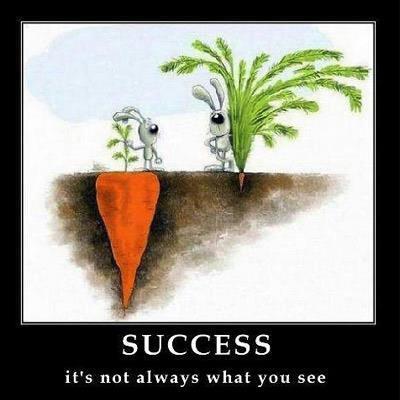
I want to be the rabbit on the right. I want to have something big and green and leafy in my hand. I am supposed to be building a brand, making a name for myself, getting “gigs” as a writer and speaker. I do what I can to make that happen and then I breathe and I pray. I write and teach, mother and wife, love and laugh and mourn. All these actions are good and necessary, but in the eyes of the world (and I guess my own too much of the time), they don’t amount to much.  They aren’t producing the kind of  “greens” I’d like to see.

In contrast, God is inviting me to see myself as the rabbit on the left, the one standing by the shabby, little sprouts. The invitation is to be patient. The invitation is to trust that something good is growing. It may be buried deep; it may be under a lot of manure. But that something, whatever it is, is worth waiting for. The rabbit on the left will be much happier in the long run, if she doesn’t give up and abandon her garden. Sometimes, for this rabbit, that feels like a big if.

Sometimes, this rabbit thinks she should get a job at McDonalds.

In case you haven’t guessed, I am a terrible gardener. I have little patience for seeds and the nurturing they require. I only plant flowers in full bloom and when they die, it’s at least a year, or two before I can muster up the energy to replace them. Perhaps that is exactly what this season of my life is here to teach me: to be a good gardener of my soul.

The seeds of our dreams were planted deep in our hearts in childhood. They began with gifts we were given and were shaped by the experiences we lived. They were nurtured by love, or warped by indifference, ridicule, or fear. But eventually, given time and even a ray of sunlight, those dreams begin to grow. For some of us, the harvest may come early; for others, it may come very, very late, if at all. I imagine the fruit of our labor may not even be what we thought we were growing all those years. In my case, I hope it will be even sweeter for the surprise.

carrie-mathison-homeland-15014-1280x800

 Let me begin my first post of 2013 by saying that I hate New Year’s Resolutions.  I never make them and I get uncomfortable when people begin to talk about them. It’s like talking to someone with a booger hanging out of his nose; it’s awkward and embarrassing for both of you. Personally, I can never find time over the holiday season to reflect on what truly needs to change in my life and how I am going to do it effectively and for the long-term. Who can think straight with eggnog, peanut M & Ms and sugar cookies at your fingertips? Companies don’t hold major strategy sessions in December. They hold parties and give bonuses! I try to be as kind to myself as I am to my employees, or would be if I had any.

 In that spirit, I am tabling any discussion of “resolutions” for a later date. Until then, let’s talk television.

One of my favorite shows of 2012 was “Homeland” on Showtime. If you haven’t seen it, let me summarize it briefly for you: Carrie Mathison, played by the fearsome Claire Danes, is a CIA agent, whose mission in life is to catch terrorists who want to attack her beloved USA. Carrie is tough, talented, insightful and excellent at her job. Carrie is also bi-polar, spotty about taking her medicine, and has recently undergone electro-shock therapy. I know it sounds crazy so far, but the writers make it work. The audience believes in Carrie, her insights and methods, because she is never wrong. When every Chief Knucklehead at the CIA doubts her decisions, or refuses to follow up on one of her leads, we all shake our heads in collective disbelief. Apart from willful obstinacy, why would you doubt someone who is always right?

Eric Deggens, a TV critic from Florida, named this phenomenon PDS: Persistent Disbelief Syndrome. He called it a cheap trick that good writers shouldn’t rely on. Its use isn’t limited to “Homeland” either. PDS is a mainstay of CBS’s “Elementary,” and USA’s “Psych,” among others. According to Deggens, there is no reason for characters who are so consistently right to be so consistently doubted. He concludes, “In the era of excellent series like ‘Mad Men’ and ‘Homeland,’ why do producers turn, time and again, to the simple crutch of Persistent Disbelief Syndrome?”

I think I know why and I don’t think it’s a cheap trick.

PDS isn’t just a storyteller’s gimmick. PDS lies at the core of human nature. We doubt what we can’t see for ourselves, what we don’t understand, what we didn’t discover on our own. There may be exceptions to the rule, but they are primarily limited to scientific principles.

No matter how many times I am right about directions, my husband still doubts my ability to get us there. No matter how many times Tim predicts trouble when our kids start to wrestle, I let it happen anyway, only to have clean up the wreckage shortly thereafter. No matter how many times we urge our kids to put on shoes before they go outside to play, they ignore us, only to frequently hobble back inside a few minutes later with a stubbed toe, or a bee sting in their heel.

Nowhere is Persistent Disbelief Syndrome more prevalent than in our relationship with God. The Hebrew Scriptures are rife with stories of the Israelites forgetting who Yahweh is and what Yahweh has done for them. From freeing them from slavery to sending them manna from heaven and water from a rock, the Israelites continued to doubt that God will care for them. The New Testament shows that the followers of Jesus do no better. Though Peter witnessed miracles, healings and conversions, and even the transfiguration, he still jumped ship the moment Jesus’ story took a dangerous turn. The Apostle “Doubting” Thomas could be the patron saint of PDS (though we might call it Perpetual Doubt Syndrome in his case).

Over and over again, the scriptures ask us to “Be not afraid,” but that is easier said than done. Fear dissipates only where trust prevails and sometimes, it is really, really hard to trust God. How many loved ones have we lost before their time? How many once-cherished beliefs have been stripped away? How many hopes and dreams have been unmet, leaving us disappointed and lost? Those are ripe conditions for PDS to flourish. When someone consistently disappoints our expectations, credibility becomes an issue, even if he, or she is never wrong about the one thing

To avoid chronic PDS, I have to remind myself frequently that I can trust God about the one thing. I have not yet faced a situation I could not deal with, an obstacle I could not surmount, a hardship I could not grow and learn from when I have trusted in and aligned myself with the power of Love. But it is still hard.

“Love never fails,” a wise man once wrote; what fails is our ability to trust in that Love. And when we doubt, like Carrie’s coworkers on “Homeland,” all hell breaks loose. We go after the wrong target; we leave dangerous people in trusted positions; we make poor decisions based on our own limited perspective. Relying on our own imagination to decide what’s possible, what’s good and just in every situation, we are bound to screw up. But if we can get past our PDS and trust the Love that always seems to get it right, we’ve got a shot at saving our hearts, our lives, and maybe even our very homeland.

During this season of joyful noise and celebrating, shopping and baking, my Christmas gift to you is silence.

There is so much to be done this time of year, so many things vying for your time and resources. When I thought about what I would like for Christmas, I knew it would be less – less of everything – and so I thought the kindest thing I could do is not add my too-many words to your already busy schedule. We are taking a couple weeks off, but let me leave you with this image.

Christmas collageOur house looks like Buddy, the elf, came and decorated. Kiko and Finn think it’s a little much, but Molly G is in heaven. She sleeps in her Santa hat and her snowflake footie pajamas. She turns on every twinkly light in the house whenever she walks in the door. Whether it’s too much or just right, I don’t care. Her Christmas energy could power a small city and I know it won’t last forever. I am savoring her enthusiasm and joy.

To balance out the Christmas crazy, I sit still by our tree in the silence of the early mornings. I center myself in Love and remember the best Advent advice I’ve ever heard:

Be a womb.

It’s the only way Love can be born. IF we can be open to something new, IF we can bear the growing pains that come from being stretched beyond our comfort zones, IF we can promise not to rush people and circumstances into what we want them to be, instead letting them gradually become who and what they are meant to be, IF we can do all this, we will bring Love into the world.

That is my goal for the next month: to be a womb, a warm, safe, life-giving place where Love is born.

Merry Christmas!

Christmas collage

“Be a womb” is courtesy of Loretta Ross-Gotta from her essay “To Be a Virgin.”

If you do want more words, I have a few excellent suggestions.

The first is an sermon called “Pregnant Old Ladies and Other Signs that God’s Story is Better Than the One We Tell Ourselves,” by the lovely and amazing Nadia Bolz-Weaver.

Occupy Advent is on Facebook and they are delivering a daily dose of inspiration, which is witty, irreverent and spiritual. I am so glad I “liked” their page.

LORRI TIPPETT 6/1/1968 to 11/22/2012
LORRI TIPPETT
6/1/1968 to 11/22/2012

Our friend Lorri passed away on Thanksgiving morning. I didn’t write about it; I didn’t know what to say. I couldn’t make sense of it;  it didn’t make any sense. One day, a healthy, 44-year-old woman is walking around, talking, laughing, loving. The next day, she isn’t. An aneurysm, a coma, a passing, and she’s gone and all the time you thought you’d have together, and all the plans you’d made are gone too. There was no story for me to tell. There was just sadness and the bare truth that life is too short and none of us are guaranteed even one moment more than the one we have right now. But at her memorial service on Friday, a story unfolded before me that I wanted to share, a beautiful tribute to a beautiful woman, whom some of us were privileged to know.

The celebration of her life opened with the worship band from her home church playing a song called, “Strong Enough” by Matthew West. The lyrics go like this,

“You must think I’m strong/ To give me what I’m going through./ Well, forgive me if I’m wrong/ But this looks like more than I can do/ on my own./ I know I’m not strong enough/ To be everything that I’m supposed to be./ I give up. I’m not strong enough./ Hands of mercy won’t you cover me?/ Lord, right now I’m asking you to be/ Strong enough/ Strong enough for both of us.”

Having attended more Roman Catholic funerals than evangelical memorial services, I was shocked as the service began with this powerful anthem with its heavy drumbeat, but I was  immediately taken by the message and the power of music as it pulsed through the room. The song choice clearly acknowledged that her “celebration of life” was inextricably linked to our pain and loss.

As I gazed up at the stage, I caught sight of the drummer. Unlike the rest of the band, dressed casually in dark denim and tee shirts, I saw a flash of white and the slash of a dark tie. It took my breath away. I watched him keep the beat, strong and steady. With his eyes closed, he poured his heart and soul into playing that song. He wasn’t singing, but I knew this was his song. It was his prayer and cry. Up on stage, in the recesses of light, Lorri’s husband Todd played this anthem, finding the strength to make it through the next hour and hopefully the next week, month and year to come.

Todd and Lorri
Todd and Lorri

When the song was over, Todd stood up, put his coat back on and walked off stage to sit once again at the side of his son and his mother-in-law. There were more songs and poems, slide shows and readings and then Todd got up to speak. I don’t know how he did it, but we were all blessed to see Lorri through his eyes. She had been in real estate, selling dirt lots and dreams to countless families in the Chino Hills area. Todd captured the essence of what she did for him with that very same metaphor. He said, “She found me when I was a dirt lot and left me a million dollar man.” She was his coach, manager and cheerleader, but most importantly, she was his biggest fan. That was Lorri’s gift; she made everyone feel as if she were their biggest fan.

My children were no exception. Though the kids were emotionally and physically exhausted as we drove home that night, they would not have missed her service for anything. They wanted to go to show their love and respect for “Miss Lorri” and her family. Tim and I weren’t positive we should bring them, but we were so glad we did. Even in her absence, Lorri taught my children a lesson about the impact that even one life of honesty, integrity, compassion, generosity and faith can have on an individual, a family and a community around the world.

Lorri’s too-short life also taught me a lesson. While it isn’t practical to “live every day as if it were your last,” it is critical to live as if each one matters. As I go through my days, I find myself checking in:

Am I loving with my whole heart? Am I wasting time on things that don’t matter? Is my worry overwhelming my joy? If this day were my last, am I living it well enough?

That last question, more than any other, has become a transformative one for me. I don’t want to close my eyes on a day I am not proud of. It doesn’t need to be perfect, but it needs to be good enough.

So thank you Lorri Tippet for the way you lived your life, the way you loved others and for all the lessons you taught us, in this life and beyond.

l.wXGtdiVVYDJXFmCw

P.S. “Strong Enough” was purchased on Itunes on our drive home. If you don’t know it, take a moment and check it out.